

























































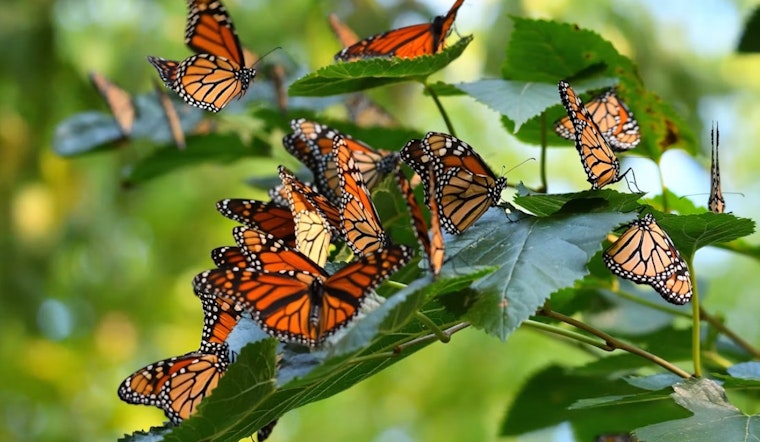
Monarch butterflies are massing along Michigan's Great Lakes shorelines this month, staging for a journey that can stretch up to 3,000 miles to wintering grounds in central Mexico, southern Florida, or the Pacific Coast. The fall migration is underway and will continue through November, with adult monarchs already spotted along the shores of Lake Michigan, Lake Superior, Lake Erie, and Lake Ontario.
The butterflies use the Great Lakes shorelines as navigational tools, following the coastline rather than risking a straight shot over open water, according to the Detroit Free Press. One of the best places to catch that behavior in action is the Stonington Peninsula near Escanaba in Michigan's Upper Peninsula, a stopping-off point where thousands of monarchs gather during peak migration before crossing Lake Michigan and Green Bay. Visit Escanaba says a September visit usually guarantees at least some migration activity there, with the insects riding prevailing winds after a cool front to reach Wisconsin's Door Peninsula. Birders can also watch the migration unfold at Whitefish Point Bird Observatory, Tawas Point State Park, and Lake Erie Metropark.
Why Monarchs Cluster Along the Shore
Monarchs roost together in groups for warmth and safety as overnight temperatures drop, a pattern observations suggest is tied to both protection from predators and heat retention. The Journey North citizen-science program tracks these nighttime roosts, which can range from just ten butterflies to thousands clustered together in tree branches. Migrating monarchs travel solo during daylight hours, then form these communal gatherings at dusk along coastal stopovers, per Journey North.
Michigan State University Extension notes that large groups of monarchs congregating along shoreline habitats can be just as spectacular a sight as the seasonal bird migrations that draw birders to the same coastlines. Great Lakes shorelines provide both the roosting areas and the milkweed plants monarchs depend on throughout their journey. Once conditions are right, the U.S. Forest Service notes that monarchs use air streams to accelerate their flight, reaching speeds of 10 to 30 miles per hour and covering as much as 80 miles in a single day.
The USDA Forest Service has run one of the longest continuous citizen-science monitoring efforts in North America at Peninsula Point in the Hiawatha National Forest, hosting volunteer censuses, wing tagging, and larval counts there since 1996. Located at the tip of Delta County's Stonington Peninsula, the site serves as a critical funnel point where monarchs rest before attempting the crossing to Wisconsin. Anyone who spots a monarch in Michigan can log the sighting through Journey North online, where the latest reports as of Monday, September 8, already show sightings scattered across the state.
Tagging, Telemetry, and a Record-Setting Butterfly
Long before smartphones entered the picture, researchers were tracking monarchs the old-fashioned way. Founded at the University of Kansas in 1992, the Monarch Watch program has distributed coded wing tags to volunteers who have since tagged more than 3 million monarchs across North America, yielding over 19,000 tag recoveries in Mexico. In April, Monarch Watch reported the recovery of a tag at Mexico's El Rosario sanctuary that set a program record: it had been applied to a female monarch by a Kansas high school student back in 1997, making it 29 years old by the time it turned up.
That decades-old paper trail is now being joined by real-time digital tracking. As Hoodline reported this week in its piece on tiny trackers following monarchs to Mexico, conservationists are now pairing traditional wing tagging with ultra-lightweight, solar-powered radio transmitters through an effort called Project Monarch, letting anyone follow an individual butterfly's route on a smartphone. Researchers with that project recorded a continuous 726-mile flight track from Cape May, New Jersey, to St. Augustine, Florida, using the micro-transmitters. Research highlighted by the Xerces Society for Invertebrate Conservation in May found that monarchs overwintering in Florida aren't an isolated population at all — they're part of the broader eastern migratory flyway, flying back north each spring in April and May to breed.
A Federal Listing Decision Still Looms
The fall spectacle is unfolding against a backdrop of federal regulatory uncertainty. The monarch butterfly was formally listed as proposed threatened under the U.S. Endangered Species Act on December 12, 2024, after the U.S. Fish and Wildlife Service had previously classified it in 2020 as a candidate species that was warranted for listing but precluded by higher-priority species. The agency reopened public discussion of the proposal on March 18, 2025, gathering feedback on protective rules and critical habitat designations before a final decision.
The monarch population has been in steady decline, driven mainly by habitat loss from urban development, climate change, deforestation, and large-scale agriculture, even though the IUCN Red List classified the species as least concern in 2021. Recent wintering numbers in Mexico offer a mixed picture: World Wildlife Fund Mexico and its partners reported in March that eastern migratory monarchs occupied 2.93 hectares of forest in the 2025-2026 winter season, a 64% jump from 1.79 hectares the year before. But the Wisconsin Monarch Collaborative cautions that scientists estimate long-term population resiliency requires an average of at least 6 hectares of occupied forest in Mexico — meaning even this year's gain leaves the population at less than half of the sustainable threshold, well short of the historic highs above 18 hectares recorded in 1996-1997. On the West Coast, the picture is grimmer still: the Xerces Society's 29th annual Western Monarch Count recorded roughly 12,260 overwintering butterflies along coastal California this past winter, the third-lowest total since record-keeping began in 1997.
What's Drawing Monarchs to Michigan Yards
Michigan's own wild monarchs are fueled largely by the state's native milkweeds, including common milkweed, swamp milkweed, butterfly milkweed, and poke milkweed, on which female monarchs lay their eggs. Adult monarchs feed on nectar from a wide range of flowers, including wild cherry, lilac, labrador tea, blazing star, red clover, dogbane, goldenrods, ironweeds, joe-pye-weed, marigolds, asters, rattlesnake-master, sunflowers, thistles, and vetches, in addition to milkweed itself. That milkweed diet also gives monarchs a toxin they retain into adulthood, a defense that has helped make them one of the most recognizable butterflies in North America.
Monarchs are the only butterfly species known to make spring and fall migrations the way birds do, and the generation born late in the season is built for the long haul: it can live up to nine months, long enough to fly south, overwinter in central Mexico's oyamel fir forests at elevations of roughly 7,800 to 11,800 feet, and then migrate back to the United States the following spring. Most monarchs live only two to six weeks, but this final generation of the year carries the entire migratory cycle forward, a biological relay that has now stretched across three decades of tagging records and, increasingly, real-time satellite-style tracking from the ground up.




