

























































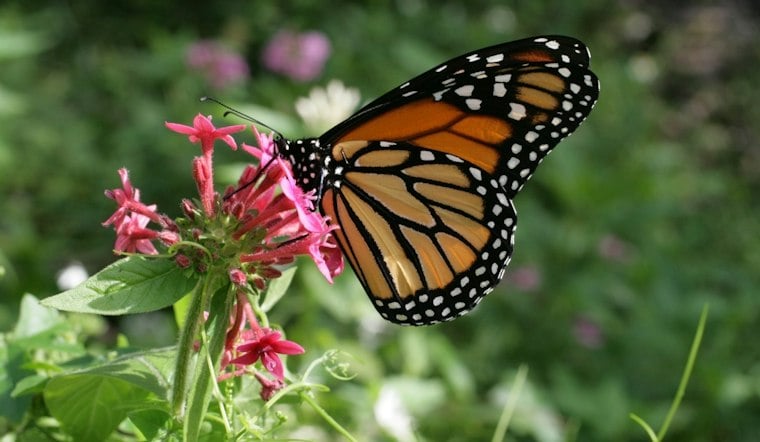
The skies over South Carolina's Upstate are filling with orange and black wings this week as monarch butterflies pass through on one of the animal kingdom's most extraordinary journeys. Peak migration season has arrived, and the Blue Ridge Mountain corridor running through the Upstate and into western North Carolina is serving as a critical fueling stop for insects flying up to 3,000 miles toward their winter roosts in Mexico.
For most of South Carolina and the northern half of Georgia, peak migration begins sometime around September 24, according to wyff4.com. The outlet reports that the area along the Blue Ridge Mountains, including the Upstate of South Carolina and Western North Carolina, is one of the monarch's prime migration corridors and fueling stops. About 99% of monarch butterflies live east of the Rocky Mountains and migrate south to Mexico for winter, and many of the insects moving through the region now will have flown farther south by October 11, per the same report.
Monarchs are the only butterflies known to make such a long, two-way migration every year, a journey that has drawn comparisons to the epic travels of birds or whales, according to FOX Carolina News. That multi-generational relay depends entirely on one plant: milkweed, which sustains the energy monarchs need for the trip and serves as the only host plant their larvae can use, as abcnews4.com notes. Per Monarch Watch and the South Carolina Wildlife Federation, monarch butterflies cannot survive a long, cold winter, which is why the trip south is not optional.
Greer's Gardens Become a Butterfly Pit Stop
South Carolina Public Radio describes the state as an important stopover for the species, reporting that South Carolina serves as an important stopover for these iconic butterflies. Nowhere is that role more visible than in Greer, where the city provides pollinator gardens that function as an Upstate layover for monarchs on the move, according to FOX Carolina News. City officials say Greer was designated the first Monarch City USA community in South Carolina, a distinction earned in 2022, according to the Municipal Association of South Carolina, making it the first city in the state to receive the honor.
The designation focuses on rebuilding the butterfly's natural habitat and supporting its migration, per FOX Carolina News. In practice, that has meant planting milkweed — the only plant the monarch caterpillar will eat — throughout Greer's gardens, with the city now dedicating whole swaths of land specifically to the butterflies, the Municipal Association reports. Greer also received a grant from the South Carolina Wildlife Federation to plant 100 milkweed plants near its golf course and driving range, and city staff collect and incubate monarch eggs at a city office where residents can learn about the insect's lifecycle.
Nearby, the City of Clemson earned its own Monarch City USA accreditation in 2022 and has since worked to plan and establish pollinator beds across the city aimed specifically at supporting monarch migration, according to the City of Clemson. Statewide, the South Carolina Wildlife Federation has pushed its own milkweed campaign this year, mailing 5,000 packets of native milkweed seeds to residents across South Carolina, according to the South Carolina Wildlife Federation. The organization says it also hosted 20 volunteer days to hand-mix and package those seeds ahead of the mailing.
A Population Still Far From Stable
The stakes behind those local efforts are laid out in continental-scale numbers. The eastern monarch population occupied 2.93 hectares during the 2025-2026 overwintering season, according to the Monarch Joint Venture, about a 64% increase compared to the previous year's estimate of 1.79 hectares. Researchers recorded nine monarch colonies in Mexico that season, three in Michoacán and six in Estado de México, the organization reports.
Even with that rebound, the group says the eastern population remains below the roughly six hectares of occupied overwintering habitat needed to support long-term stability, and its research review notes the population has now grown for three consecutive years while still remaining below half of its target. The western monarch overwintering population, meanwhile, rose to 12,260 individuals, far short of its 500,000 target, according to the same review. Monarch Joint Venture attributes the pressure on the species to habitat loss, extreme weather, changing climate conditions, pesticide exposure, predators, parasites and disease.
Longer-term decline estimates vary by source and methodology. wyff4.com reports that some researchers estimate the monarch population has declined by 80% to 90% since the 1990s, while the South Carolina Wildlife Federation states the population along normal migration routes from Canada to Mexico has dwindled by almost 97% over the past 20 years. Separately, abcnews4.com reported that a 2025 study found the once over one million strong monarch population had dwindled to an all-time low of 10,000. Monarch Joint Venture's research review also notes that butterfly populations across the United States broadly have declined by 22% over the past two decades.
For now, the message from conservationists on the ground is that every garden helps. Whether it is Greer's dedicated pollinator plots, Clemson's targeted beds, or the thousands of milkweed packets mailed out statewide, the small-scale plantings are the closest thing residents have to a direct hand in a migration that spans thousands of miles and multiple generations of a single, fragile species.





