

























































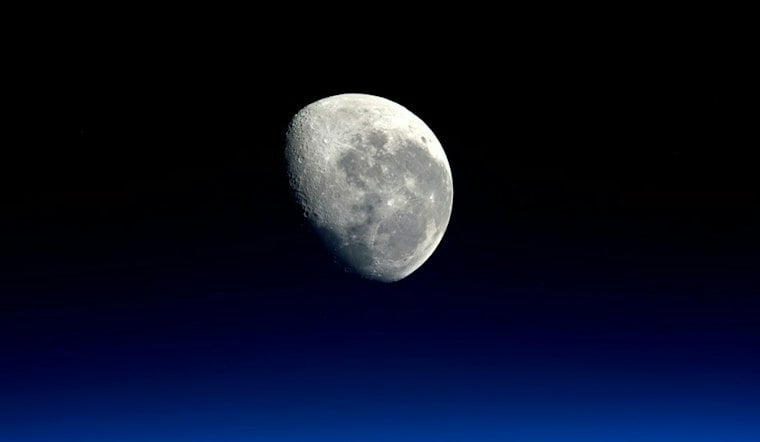
A crater bigger than the Roman Colosseum has turned up on the Moon, and NASA scientists say the impact that carved it is so rare it may only happen once every 132 years. The scar, roughly 728 feet across and up to 141 feet deep, sits on the lunar near side and now ranks as the solar system's biggest known impact crater formed in recent times.
A Discovery That Took Nearly a Year to Confirm
According to The Associated Press, NASA's Lunar Reconnaissance Orbiter first spotted the crater in May 2024, though the impact itself escaped real-time detection by telescopes on Earth and in space. Wide-angle images that hinted at the change weren't identified until August 2025, and the orbiter didn't gather more detailed pictures until that fall. Intuitive Machines image-processing specialist Robert Wagner, who works with NASA's LRO/LROC data, is credited with the actual discovery, noticing an unusually bright patch surrounded by a dark halo on October 24, 2025, during a routine data-quality check of automated orbiter maps, according to NASA Science. Automated software had already flagged the changed terrain before Wagner inspected the site by hand. The Lunar Reconnaissance Orbiter, in orbit since 2009, didn't fully confirm the find until early 2026.
By comparing sequential orbital imagery from before and after the strike, researchers narrowed the impact window to between April 11 and May 22, 2024, per ScienceDaily. Earlier imagery provided a pre-impact comparison. NASA scientists later used the orbiter's Narrow-Angle Camera, including an image taken on December 5, 2025, to capture additional surface detail.
Named for a Pioneer of Impact Science
The crater was named for Thomas McGetchin, a former director of Houston's Lunar and Planetary Institute. The International Astronomical Union made the designation official, and per the Lunar and Planetary Institute, McGetchin took the director role in 1977 and co-authored a 1973 ejecta distribution model still used as a foundational framework in impact mechanics today. The site sits directly on the geological boundary between the Moon's rugged highlands and a flat basaltic mare on its eastern edge, a location that the Lunar Reconnaissance Orbiter Camera Team at Arizona State University says lets researchers study impact effects across two very different crustal terrains.
Impact mechanics models suggest the object that struck the Moon was an asteroid or comet fragment roughly the size of a three- to six-story building, according to EarthSky. Mark Robinson, chief scientist for the orbiter's cameras and now at Intuitive Machines, was lead author of one of the two studies on the crater, both of which appeared in the journal Science Advances in 2026. McGetchin crater is three times larger than the previous record-holder the orbiter had found a decade earlier — though the Moon still bears a far older impact scar stretching more than 1,500 miles across.
A Cold Spot Stretching Four Miles Wide
The new impact churned the lunar surface across more than 66 miles and hurled dust and rocky soil away at a steeper angle than scientists expected, per the AP's reporting. A separate study identified a 4-mile-wide cold spot ringing the crater, and Diviner instrument thermal measurements found the patch runs about 9 degrees Celsius, or 16 degrees Fahrenheit, colder at night than surrounding terrain, according to Sci.News. Loosened topsoil holds less heat than undisturbed regolith, which produces the chill.
David Paige, a co-author of the cold-spot study at the University of California, Los Angeles, said impacts can garden the lunar regolith, churning and mixing the top layers of soil. That gardening effect isn't new to lunar science: Apollo astronauts left footprints in the lunar regolith, according to Sky & Telescope.
Ejecta Reached Far Beyond the Crater Rim
Robinson's study found that high-velocity impact debris and secondary particles altered the lunar surface out to distances exceeding 1,000 crater radii from the impact center, according to Aerospace Global News. Researchers say the Moon's soil is overturned by ejected material roughly every 80,000 years, a faster pace than previously thought, and Robinson has said Apollo moonwalkers' dusty footprints will definitely be gone within that span, per the AP.
Over its more than 17 years circling the Moon, the orbiter has identified at least 1,000 new impact craters and logged roughly 100,000 minor surface disturbances tied to cosmic impacts, EarthSky reports. NASA's next step is calculating the risk of ejected crater material striking the agency's planned lunar base, part of preparations for a permanent astronaut outpost on the Moon. That risk assessment is expected to help engineers harden future structures against damage from flying debris kicked up by impacts like the one that formed McGetchin crater.
Hoodline previously covered a smaller crater the orbiter traced to a stray rocket stage, a reminder that both artificial debris and natural impactors are actively reshaping the lunar surface as NASA plans its return to the Moon.





