

























































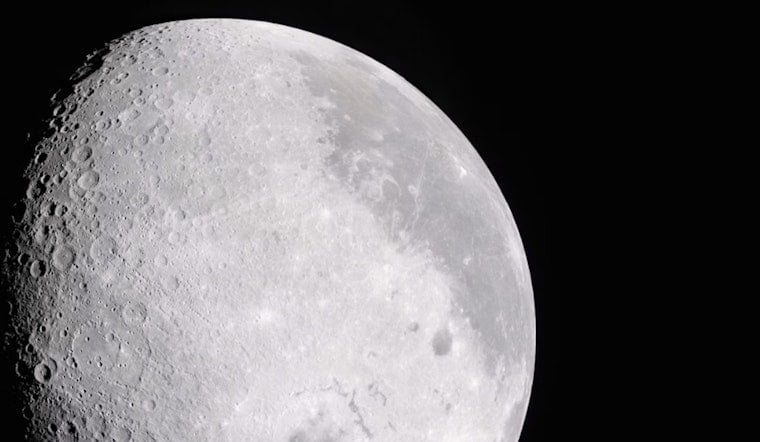
NASA has released the first detailed photos of a 60-foot-wide crater gouged into the Moon's surface near Einstein Crater, the scar left behind when a spent SpaceX Falcon 9 upper stage slammed into the lunar surface at roughly 5,400 miles per hour on August 5. The rocket piece, more than 40 feet long, had been drifting through space since it helped launch Cedar Park-based Firefly Aerospace's Blue Ghost lunar lander a year and a half earlier, and its collision with the Moon delivered the kinetic force of three tons of TNT.
The stage began its journey on January 15, 2025, when it carried two pieces of equipment bound for the Moon, according to Fox 10 Phoenix. One of them, Firefly Aerospace's Blue Ghost lander, became the first private spacecraft to successfully land on the Moon, a milestone Hoodline covered in Firefly's historic lunar touchdown after the mission launched atop the same Falcon 9 rocket detailed in Hoodline's coverage of the Blue Ghost launch. The other payload aboard that mission, ispace's Hakuto-R Mission 2 lander known as Resilience, crashed while attempting its own landing on June 5, 2025, according to Space Daily.
Why the Rocket Stage Ended Up on a Collision Course
SpaceX explained in an August 2026 statement, per the same Space Daily report, that the upper stage entered its unplanned lunar collision course due to gravitational forces and solar radiation pressure acting on it during an 18-month drift through cislunar space. Most Falcon 9 second stages are disposed of through controlled reentries over Earth's oceans, but deep-space missions like this one leave stages without enough fuel to be steered back down. SpaceX noted that its fully reusable Starship vehicle is designed to eliminate expendable second stages altogether going forward.
Locating the resulting crater required precise coordination. South Korea's Danuri lunar orbiter, operated by the Korea Aerospace Research Institute, captured the first before-and-after imagery of the site on August 5 and 6, transmitting coordinates to NASA that let the Lunar Reconnaissance Orbiter track down the new crater, according to Space.com. Danuri had observed the target area 30 minutes before impact and conducted eight imaging passes afterward.
A Six-Day Wait and a Ten-Mile Margin for Error
Photographing the crater was its own technical feat. NASA engineers had to tilt the Lunar Reconnaissance Orbiter as it circled the Moon 60 miles up at one mile per second, and they waited six days for lunar rotation to bring the impact site into view, Mashable reports. If the orbiter's camera had fired even 10 seconds early or late, the crater would have drifted 10 miles off-center and out of frame.
The images came from the orbiter's Narrow-Angle Camera, run in partnership with Arizona State University, which can resolve lunar surface features as small as 3 feet across, according to the Arizona State University Lunar Reconnaissance Orbiter Camera Science Team. NASA reported that the high-resolution imagery revealed dark and bright streaks radiating from the crater like butterfly wings, with the darker rays showing ancient surface regolith altered by solar radiation and cosmic rays over time, and the brighter rays made up of deeper material thrown outward by the impact. The finished crater measured 60 feet wide and less than 10 feet deep.
Before Impact, a 100 Percent Certainty
Even before the collision, NASA's Center for Near Earth Object Studies at the Jet Propulsion Laboratory had calculated a 100 percent chance of impact, narrowing the predicted landing zone to two ellipses each measuring 2.1 miles long by 0.4 miles wide, according to NASA. The center normally tracks natural near-Earth asteroids, and this event served as a training exercise for its trajectory modeling tools applied to artificial debris.
Ground-based instruments also caught a piece of the action. Although the collision itself was not observed in real time, the Very Large Telescope in Chile, operated by the European Southern Observatory, detected chemical signatures of sodium and lithium gas in the ejected debris plume for up to 10 minutes after impact, Smithsonian Magazine reported.
A Rare Kind of Crash, but a Common Kind of Force
Accidental human-made rocket impacts on the Moon remain unusual. This crash was only the second known instance of one, following a March 2022 collision of an upper stage from China's Chang'e 5-T1 mission that carved a double crater on the lunar far side, according to Discover Magazine. Intentional spacecraft impacts date back to the Soviet Luna 2 mission in 1959, but uncontrolled deep-space orbital decay resulting in a lunar strike is rare.
The force involved, however, is nothing unusual for the Moon. NASA calculations released in August 2026 indicate that natural meteoroids strike the lunar surface with the same kinetic energy as this rocket stage, equivalent to three tons of TNT, roughly once every six days. Because the Moon has no atmosphere to burn up incoming debris, meteoroids reach its surface on a near-constant basis, unlike on Earth.
Firefly Aerospace, whose Blue Ghost mission set this chain of events in motion, has continued expanding its footprint back home, having grown its Cedar Park headquarters to 144,000 square feet earlier this year. Meanwhile, the Falcon 9 booster that originally launched the Blue Ghost mission, B1085, was reported flying its 18th mission in Hoodline's coverage of a recent Starlink launch, a reminder that while the reusable booster keeps flying, the upper stage it once carried ended its journey embedded in the lunar surface.





