

























































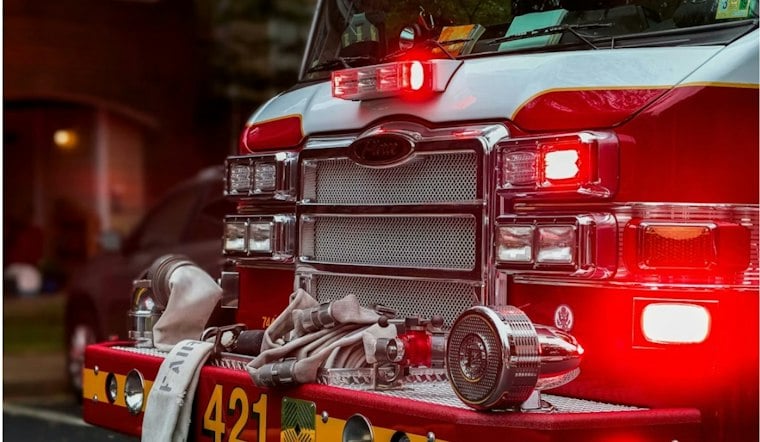
A large mulch fire broke out in Livonia yesterday, sending huge plumes of smoke into the sky and forcing crews to shut down a stretch of 7 Mile Road while they worked to extinguish the blaze.
The fire was first reported yesterday, according to ClickOnDetroit, which captured video of firefighters working to knock down the flames as thick smoke rose over the area. Metro Detroit was experiencing dry, seasonal weather that day, with sunny skies and high temperatures reaching the upper 70s, conditions that made the rising smoke plumes clearly visible across Wayne County, the station reported separately in its weather coverage.
7 Mile Road is a major east-west commercial highway in Livonia that carries more than 29,000 vehicles daily through high-density retail and industrial zones between Inkster and Middlebelt roads, according to a local property listing from Mid-Mitten Realty. Shutting down even a portion of that corridor during peak fire operations would have rippled through traffic across northern Wayne County.
Why Mulch Piles Can Ignite Without a Spark
Large mulch piles are a recurring fire hazard because of a phenomenon known as spontaneous combustion, in which heat generated by microbial decomposition becomes trapped inside deep organic stacks. According to research published by Quanturi, internal pile temperatures can climb to between 155 and 185 degrees Fahrenheit until the material ignites without any external flame or spark.
The U.S. National Park Service estimates that spontaneous combustion causes roughly 14,070 fires nationwide each year, frequently involving stored mulch, compost, moist hay, and oily rags. Some states have responded with strict rules for commercial mulch storage; in Massachusetts, for example, fire safety standards require a minimum 30-foot separation between mulch piles and 25 feet from property boundaries specifically to prevent spontaneous combustion and rapid flame spread, per Mass.gov.
A Familiar Challenge for Metro Detroit Fire Crews
Mulch and wood fires also raise air quality concerns, since the fine particulate matter they emit can degrade local conditions to moderate or unhealthy-for-sensitive-groups levels, prompting state environmental agencies to monitor smoke plumes drifting across residential corridors, according to the State of Michigan. Smoldering mulch fires are also notoriously difficult to fully extinguish. In August 2024, a massive mulch fire at Detroit Mulch Co. on Prairie Street burned for several days, sending thick smoke across northwest Detroit and Windsor, Ontario, and requiring heavy machinery and aerial ladders to douse subterranean hot spots, as reported by FireRescue1.
Livonia itself has seen large-scale outdoor fires before. In prior Hoodline coverage, an early-morning fire triggered by a downed power line at the PADNOS Recycling Center destroyed an estimated 70 to 100 vehicles before crews from five Livonia fire stations extinguished the blaze in November 2024.
Local Resources on the Scene
The Livonia Fire Department operates five fire stations equipped with advanced life-support units and hosts Western Wayne County's Hazardous Materials Response Team, according to the City of Livonia. All Livonia firefighters are cross-trained as paramedics, giving the department broad capability for major incidents. The department traces its roots to 1941, when it began as a volunteer township service housed in a local gas station, and it hired its first full-time firefighter in 1947 before expanding to multiple stations as the city grew.
Large organic-material fires have posed similar challenges elsewhere in recent months. A stubborn compost fire in Sherburne County smoldered overnight and required heavy machinery and mutual aid from 11 departments to extinguish, Hoodline reported in April. A separate large commercial mulch pile fire near a shopping district in Leominster likewise required extensive water hauling and regional fire support, according to earlier Hoodline coverage. As of yesterday, the exact commercial site where the Livonia mulch ignited and the cause of the fire had not been detailed in available reporting.



