

























































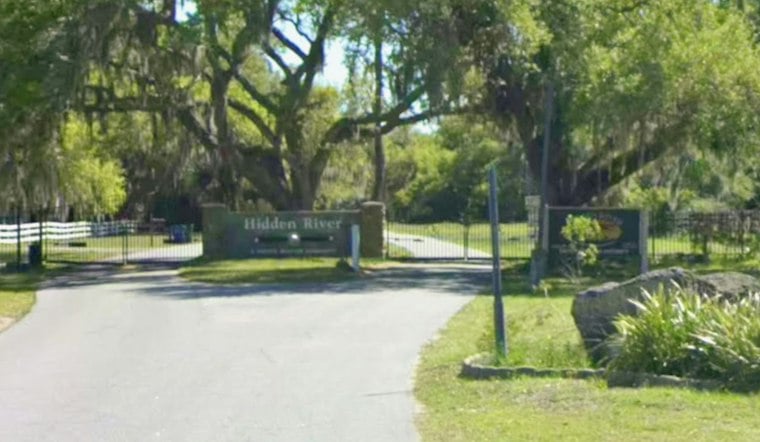
A bill to grant the Myakka River's 34-mile Sarasota County stretch federal Wild and Scenic River protection is now one step closer to a full U.S. House vote, following a hearing before the House Natural Resources Subcommittee on Federal Lands on September 2. Rep. Greg Steube, the bill's sponsor, and local environmental leaders testified in support of the measure, which has been decades in the making for advocates along the river.
H.R. 642, the Myakka Wild and Scenic River Act of 2025, seeks to place the Sarasota County portion of the river into the National Park Service's Partnership Wild and Scenic River program, according to Tampa Free Press. That framework, as detailed by LegiScan, creates a joint arrangement to protect free-flowing waters that run mostly through private and non-federal land, explicitly prohibiting federal land acquisition through condemnation or eminent domain and allowing property transfers only by donation or willing-owner consent. The bill also integrates the existing local Myakka River Management Coordinating Council rather than creating a new National Park System unit.
Steube, who grew up working cattle along the river according to the Tampa Free Press report, said his legislation would recognize the 34-mile segment in Sarasota County and help preserve it for future generations. The hearing where he and other supporters testified examined nine public lands and conservation measures ahead of full committee markup, according to the U.S. House Committee on Natural Resources.
A Bicameral Push With Broad Local Backing
The effort isn't confined to the House. U.S. Senator Rick Scott introduced an identical companion bill, S. 2270, in the Senate on July 14, 2025, to establish the same federal status for the river stretch, according to Civixly. Senator Ashley Moody also leads the Senate companion effort alongside Scott, per the Tampa Free Press report.
Support for the measure spans an unusually wide range of local and state figures and institutions, per the same report. Backers include Sarasota County Commission Chair Ron Cutsinger, U.S. Representatives Darren Soto, Vern Buchanan, Gus Bilirakis, Kat Cammack, John Rutherford and Daniel Webster, along with former state legislator Laurel Lee and Chief Financial Officer Jimmy Patronis. Institutional support comes from the Florida Fish and Wildlife Conservation Commission, the Myakka River Management Coordination Council, the City of Venice, the Greater Sarasota Chamber of Commerce, the Lakewood Ranch Business Alliance, and the Trust for Public Land.
Four Decades of State Protection Preceded the Federal Push
The Florida Legislature designated the same 34-mile segment as the state's first and only State Wild and Scenic River back in 1985, under the Myakka River Wild and Scenic Designation and Protection Act, according to Friends of Myakka River. That designation came after a 1984 National Park Service study found the river eligible for federal protection but concluded there was no non-federal management model available at the time to make it work.
The local push actually predates that state designation by a decade. December 16, 2025 marked the 50th anniversary of Sarasota County's original 1975 commission resolution requesting federal Wild and Scenic River designation, which prompted a 1978 federal law ordering the initial National Park Service study, according to the Myakka River Partnership. That law, Public Law 95-625, amended the national Wild and Scenic Rivers Act specifically to direct the federal study.
Dam Removals Bolster the Case for Federal Status
Advocates argue the river is in a stronger position to meet federal criteria today than it was 40 years ago, thanks to recent ecological restoration work. The river's natural hydrological flow was fully reestablished following the removal of the Upper Myakka Lake weir in 2022 and Down's Dam in May 2025, per the Myakka River Partnership. Removing those historic barriers restored natural seasonal water fluctuations and fish passage that the river had lacked for generations.
Those restorations have become part of the case advocates make before Congress, bolstering arguments that the Myakka River now meets the criteria for federal protection that it lacked when first studied decades ago. The river itself spans 66 to 72 miles total across Manatee, Sarasota and Charlotte counties, with roughly 314.7 square miles of its 602-square-mile watershed sitting within Sarasota County before the river discharges into Charlotte Harbor, according to the University of South Florida Water Institute.
Existing Local Rules Would Remain in Place
Federal designation wouldn't replace the protections Sarasota County already enforces. The county has maintained a 220-foot Myakka River Protection Zone under a county ordinance adopted in December 1998 and consolidated in 2008, restricting development impacts near riverbanks, according to the Sarasota County Water Atlas. The setback measures run landward from wetland vegetation specifically to protect water quality and reduce erosion.
That local regulatory buffer sits alongside a substantial public conservation investment. Since 1984, Sarasota County and the Southwest Florida Water Management District have conserved more than 41,000 acres within the Myakka River watershed through direct purchases and conservation easements, per the Myakka River Partnership. Much of that funding was driven by the county's voter-approved Environmentally Sensitive Lands Protection Program.
Legislative History and What Comes Next
Steube first introduced the Myakka protection measure in December 2024 before reintroducing it as H.R. 642 on January 23, 2025, according to LegiScan. The bill has attracted eight Florida co-sponsors spanning both major parties, including Rep. Darren Soto.
With the subcommittee hearing behind it, the Myakka River protection proposal has advanced toward possible consideration by the full U.S. House of Representatives, per the Tampa Free Press. The measure now awaits potential floor action as its supporters continue pressing for what would be the culmination of a five-decade local campaign.




