

























































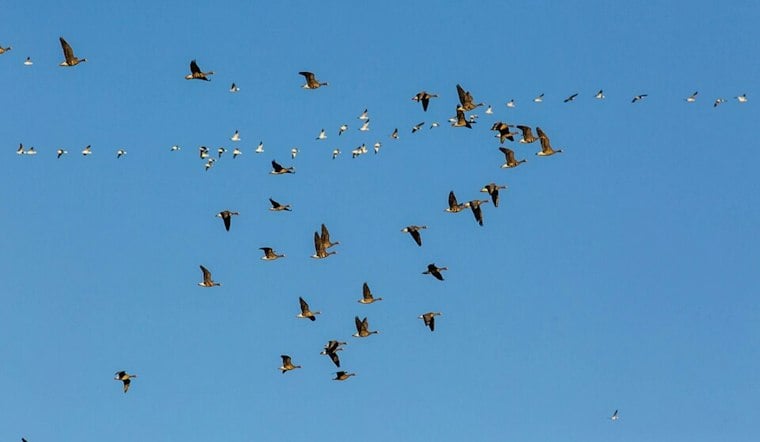
Almost a million birds passed over Clallam County in a single night this week, part of a surge of fall migration that saw nearly 7 million birds cross Washington state on Thursday night alone. With the peak of the season still ahead, bird advocates on the Olympic Peninsula are asking residents to do one simple thing after dark: turn off the lights.
The Cornell Lab tally counted 938,400 birds crossing Clallam County the night before, according to KUOW. The county sits on the Olympic Peninsula along the Pacific Flyway, a migratory corridor stretching from Alaska all the way to Patagonia, and millions of birds pass over it every fall and spring. Fall migration through Washington reaches its peak in late September and early October, per the Cornell Lab, and more birds were expected to fly across the state over the weekend.
Why Nighttime Skies Are So Dangerous
Most birds prefer to migrate after dark, when the air is calmer and predators are less of a threat. More than 80% of North American migratory species travel at night, according to BirdCast, the radar-based forecasting tool that tracks the numbers and flight paths of birds aloft. But nighttime also brings a hazard many travelers never evolved to handle: artificial light.
Many birds are drawn to artificial light, and city glow can disorient them, throwing off their sense of direction and preventing them from reaching their destinations. In the worst cases, that disorientation sends them crashing into buildings. The same combination of artificial light and glass along migration routes is, in BirdCast's words, a deadly one for birds passing through. Per a 2014 study, at least 1 million birds collide with buildings in the United States every day, and many of those collisions happen at night. The U.S. Fish and Wildlife Service has said artificial-light hazards can mean the difference between life or death for migrating birds.
A Sequim Volunteer's Nightly Routine
Patti Giffin, an Olympic Peninsula Audubon Society volunteer from Sequim, has built small habits into her evenings to reduce the risk. She turns out lights near windows at night, shuts her drapes, and skips the porch light during migration season unless she's expecting company. Bird experts say extinguishing or dimming lights, especially after 11 p.m., can help migrating birds stay on track, and Giffin argues the effort shouldn't stop at individual households — she advocates that cities and homeowners' associations mandate bird-friendly lighting.
The Olympic Peninsula Audubon Society has spearheaded a lights-out campaign in Washington, and DarkSky International has partnered with the group on the effort. September, October and early November are considered especially important months for the campaign, coinciding with the heart of fall migration.
How Washington Compares to Oregon
Washington currently has no designated Dark Sky Places, unlike its neighbor to the south. DarkSky International has designated eight locations in Oregon as Dark Sky Places, including Sisters and Antelope, communities that have taken steps to cut back on light pollution. Dark Sky Places are recognized for reducing artificial lighting that can interfere with both stargazing and, as advocates in Clallam County are underscoring this migration season, the safe passage of birds overhead.





