

























































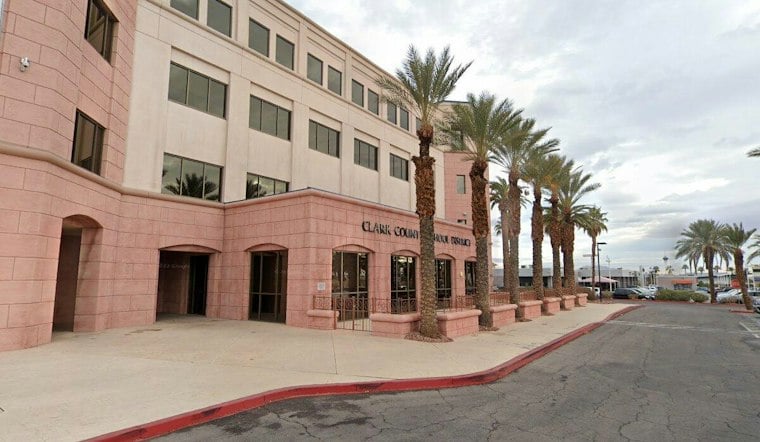
Nevada's latest statewide achievement results show that most public school students remain below grade-level expectations, while the state's first district-level accountability results give Clark County School District an overall rating of two out of three. The new rating provides a broad assessment of district performance, but the underlying subject- and grade-level results show a more uneven picture, with gains in some areas alongside substantial gaps.
State Superintendent of Public Instruction Victor Wakefield said a majority of Nevada students were not meeting grade-level expectations, according to KLAS 8 News Now. The findings landed even as state officials touted improvement in some areas and pointed to a statewide plan meant to set new goals for lifting outcomes. Wakefield took over the state's top education post in November 2025 after Jhone Ebert left the role to become superintendent of the Clark County School District, according to The Nevada Independent.
A New District-Level Rating System Under SB 460
The new Nevada District Performance Framework gives districts a separate accountability rating for the first time, rather than limiting the state's report card to individual schools. The framework combines district support measures with school outcomes on a one-to-three scale: three represents performance above expectations, two represents the middle rating, and one represents performance below expectations, per the same 8 News Now report. CCSD received a two. Carson City School District, Eureka County School District, and the State Public Charter School Authority received threes, while Elko County, Lander County, and Nye County received ones.
Senate Bill 460, passed during the 2025 legislative session, combined education overhaul proposals from Senate Majority Leader Nicole Cannizzaro and Governor Joe Lombardo to establish the state's first statewide District Performance Framework, according to 2 News Nevada. The same law also directed the Nevada Department of Education to cut administrative reporting burdens on educators; the department targeted 89 of 400 state-mandated reports for elimination, modification, or consolidation in July, determining that 22 percent were redundant or obsolete, per the department's own reporting-efficiency project.
How to Read CCSD's First District Rating
The rating is an initial summary under a new framework, not a replacement for the achievement data behind it. Nevada's 2025 Senate Bill 460 requires district accountability reports to include the most recent three-year achievement trend for each tested subject and grade level, according to the Nevada Legislature's enacted law. That requirement means CCSD's two should be considered alongside its subject- and grade-level results and their direction over time. The state's longer-term benchmark is also framed around improvement. Nevada's 2025-2030 statewide education plan calls for at least a five-percentage-point annual increase in K-3 reading proficiency based on spring MAP results, according to the Nevada State Board of Education and Department of Education. As a prior Nevada benchmark, CCSD's share of students on track to reach math proficiency within three years or by eighth grade rose 2.0 percentage points during the 2024-2025 school year, according to the state's 2026 annual progress report.
Star Ratings Slip Statewide as CCSD Sees Mixed Movement
Under the individual Nevada School Performance Framework, schools receive one- to five-star ratings, per the Nevada Department of Education's report card guide. Statewide, the number of five-star schools fell from 146 in 2024-2025 to 122 in 2025-2026, while one-star schools climbed from 140 to 162, per the 8 News Now report. Anthony Saville Middle School dropped from three stars to two stars over that span, the outlet noted.
Within CCSD, the picture was more encouraging: 73 percent of schools improved or maintained their star ratings, with 353 schools posting comparable ratings, 49 improving by at least one star, and 209 holding steady, according to the same report. Marshall C. Darnell Elementary School climbed from one star in 2023-2024 all the way to five stars in 2025-2026. CCSD serves roughly 300,000 students across nearly 400 campuses, making it the nation's fifth-largest school system and the source of roughly two-thirds of Nevada's total public school enrollment, according to The Nevada Independent — a scale that means CCSD's local results largely drive the state's overall numbers. Hoodline previously reported on a new $40M campus that opened with a three-star rating under the same framework.
Math and Science Proficiency Remain Stubbornly Low
The proficiency numbers themselves show how far Nevada schools remain from state targets. CCSD middle school math proficiency rose 2.5 percentage points this year, and statewide seventh-grade math proficiency increased 1.7 percentage points, per 8 News Now's breakdown of the report card. But Nevada's eighth-grade math proficiency still sits more than 12 percentage points below the state's 2030-2031 goal of 40 percent.
The raw numbers underscore the gap: Clark County elementary math proficiency stands at 39.5 percent, middle school math proficiency at 28.9 percent, and high school math proficiency at just 22.6 percent — meaning only about one in five CCSD high schoolers is proficient in math. Science scores tell a similar story statewide, with elementary science proficiency at 17.4 percent, middle school science at 33.4 percent, and high school science at 26.5 percent. Clark County high school science proficiency, reported elsewhere in the same data as 27.3 percent, increased 4.2 percent year over year.
Reading Scores Move in Different Directions by Grade
English language arts results were similarly uneven. CCSD high school ELA proficiency increased 2.4 percentage points, and district officials said half of CCSD high school students are now proficient in ELA, per the 8 News Now report. But CCSD middle school ELA proficiency dropped 1.9 percentage points, and statewide seventh-grade ELA proficiency declined 5.3 percent.
Clark County's grade-band ELA numbers came in at 45.9 percent for elementary, 41 percent for middle school, and 51.3 percent for high school. Senate Bill 460 also codified “science of reading” instructional models for elementary educators statewide, expanding a practice CCSD had piloted using federal ESSER funds to place PreK-3 literacy specialists in elementary schools who coach teachers on-site, according to Education Scorecard.
Absenteeism Falls as District, State Chart Five-Year Plans
One clear bright spot for CCSD was attendance. The district reduced chronic absenteeism at all schooling levels, with elementary absenteeism down 6 percentage points, middle school down 5.4 percentage points, and high school down 4.4 percentage points, per 8 News Now. CCSD Superintendent Jhone Ebert said teachers should adjust instructional practices so students are actively solving problems and asking questions rather than passively receiving information, the outlet reported.
Ebert's district has a five-year strategic plan, approved in May and running through 2031, targeting academic excellence, career-connected learning, and campus safety as part of what CCSD calls its “Destination District” vision. On the state level, the Nevada Department of Education opened a public comment period on September 9, running through October 21, for its draft 2026-2030 Statewide Plan for the Improvement of Pupils, which sets five strategic priorities aimed at improving student outcomes by the 2030-2031 school year. The department requested public input on the plan as part of that process, according to the same 8 News Now report.
The renewed focus on secondary outcomes includes attention to so-called disconnected youth — young adults aged 16 to 24 who are neither enrolled in school nor employed — and career-connected pathways. A separate July analysis also examined public school systems and school safety.





