

























































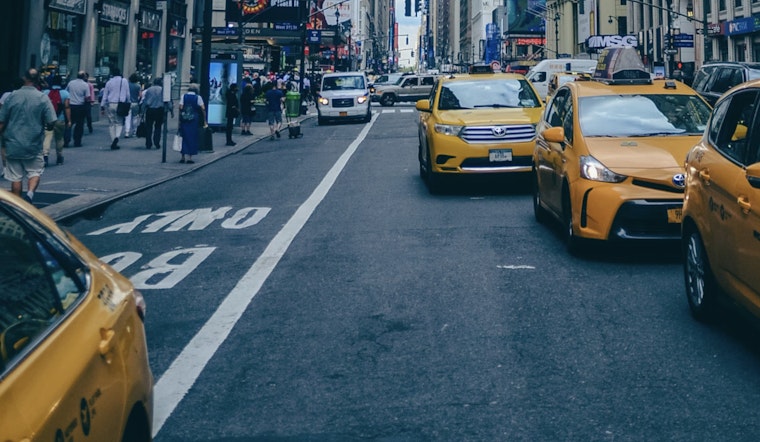
For years, New York City cab drivers have known one rule cold: those commercial parking signs lining the curb are off-limits to yellow taxis, no matter how badly a driver needs a bathroom break. The city's Department of Transportation is now considering changing that, with a proposal that would let taxis and for-hire vehicles pay to park at commercial meters for up to three hours at a time.
The idea would open roughly 13,000 commercial meter spaces across the city to drivers who currently have almost nowhere legal to stop, according to Spectrum News NY1. Right now, those commercial parking signs specifically exclude yellow cabs, per the outlet's reporting, leaving drivers to rely on a patchwork of dedicated taxi relief stands that are in famously short supply. Citywide, NYC DOT manages just 108 total taxi and for-hire vehicle relief stands, according to the NYC Department of Transportation — 68 in Manhattan, 26 in Queens, 11 in the Bronx, just 3 in Brooklyn, and none at all in Staten Island.
Driver Khandaker Maniruzzaman put the problem bluntly, telling NY1 that commercial parking cannot currently be used by taxis because drivers receive tickets for doing so, and that parking is very hard to find. Fellow driver Gurbachan Singh echoed that frustration, saying taxi drivers face difficulty because the city has very limited restrooms and parking spaces. Oumar Barry, another driver, said that when free taxi relief spaces aren't available, drivers may park illegally and risk tickets — and that receiving those tickets is a major problem.
A Legislative Push Behind the Proposal
The DOT's proposal traces back to Local Law 24 of 2026, originally introduced as Int. 1000-2024 by Council Member Justin Brannan. The bill passed the City Council on December 18, 2025, and took effect on January 17, 2026, establishing a pilot program for for-hire vehicles that the city was required to launch within 180 days, according to Black Car News. That city council pilot program opened commercial meters to for-hire vehicles first, and DOT has since moved to expand the concept to yellow taxis as well.
NYC DOT formally published notice of the change on July 22, 2026, scheduling a public hearing for September 1 on the proposed rule, which would amend Title 34, Chapter 4 of the Rules of the City of New York. Per the notice, the provision is set to remain in effect through July 2028. If the proposal advances, DOT will decide when taxis could actually begin parking in commercial spaces, per NY1's reporting.
Relief Stands Already Stretched Thin
The scale of the shortage helps explain why drivers have been pushing for more options. Of the 108 existing relief stands citywide, 67 are shared between yellow taxis and for-hire vehicles, while 40 are strictly reserved for yellow cabs and just 1 is designated for FHVs, according to NYC DOT figures. NY1 reported that taxi relief stands, which allow drivers to leave their vehicles for up to an hour, include nearly 300 spaces available to taxis overall, with the central business district alone home to 55 of those relief stands. Drivers have been known to practice pulling into tight relief stands, including one at 21st Street and Seventh Avenue in Manhattan, to get comfortable navigating the limited real estate.
The pressure on that limited infrastructure is playing out against a backdrop of more than 178,000 TLC-licensed drivers competing for curb space across yellow taxis, green cabs, liveries, black cars, and app-based services, according to Black Car News. Meanwhile, yellow cab medallion trips averaged 117,781 per day in February, down 6.8% year-over-year and still roughly 43% below pre-pandemic 2020 levels, with 2,771 medallions sitting in storage, per data reported by AutoMarketplace.
The Ticket Math Drivers Are Watching Closely
That declining trip volume is exactly why the financial fine print of the new rule matters so much to drivers. Illegal parking or standing in restricted commercial or no-standing zones currently carries base fines of $115 to $150 per citation, according to city fine schedules cited by AutoMarketplace's reporting. Barry told NY1 that how much the proposal actually helps drivers will depend heavily on the hourly cost the city sets for parking at those commercial meters.
The Taxi and Limousine Commission has said the goal of the plan is to ease parking difficulties for drivers without cutting into their daily earnings, according to NY1. That balancing act is complicated by the broader economic squeeze already facing medallion owners, who are also working to comply with a federal court mandate requiring half of the city's 13,587 authorized medallions to be wheelchair-accessible by late 2028 — a target that stood at 58% as of early 2026, per AutoMarketplace.
Looking Beyond Human Drivers
One wrinkle raised by industry observers is that the proposed rule attaches parking permissions to vehicle classification rather than to the presence of a human driver. Autonomous vehicle operator Waymo published research in August arguing that staging self-driving fleets at city curbs can cut empty miles by more than 60%, a finding that has prompted analysts to ask whether the same commercial meter access could eventually double as staging infrastructure for driverless fleets, according to reporting referenced by AutoMarketplace. That possibility sits alongside the city's broader curb strategy dating back to a 2023 Curb Management Action Plan from the NYC Mayor's Office, which prioritized dedicated pickup and drop-off zones and flexible, demand-responsive meter pricing.
For now, the immediate question for drivers like Maniruzzaman, Singh and Barry is far simpler than autonomous vehicle logistics: whether they'll finally have a legal, affordable place to park when nature calls. The September 1 public hearing marked a formal step in that process, but DOT has not yet said when — or whether — the rule will take effect.





