

























































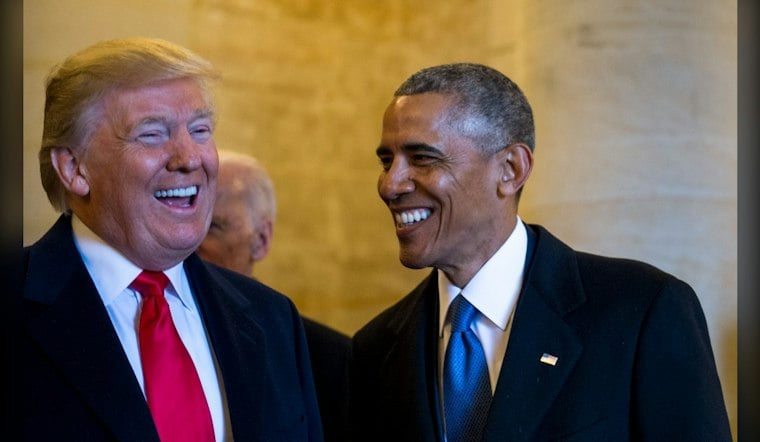
Barack Obama says the federal government is less corrupt than at virtually any point in U.S. history, and he told listeners of his new podcast that “people are always surprised” when he says it. The claim, aimed at explaining how far bribery and patronage have receded from American politics, landed with an unexpected twist this week: Donald Trump's own rapid response account thanked him for it.
Obama made the remark on A Great Book with Barack Obama, a six-episode podcast that premiered on Audible on September 24, as Cleveland.com reports. He said people are always surprised when he tells them the federal government is “less corrupt than probably it has ever been in terms of pure bribes, patronage or favors,” according to the same report. The show is produced under an exclusive first-look partnership between Audible and Higher Ground, the media company founded by Barack and Michelle Obama, marking their sixth collaborative audio project, according to Audible.
The White House's rapid response account seized on the line, writing simply, “So true — thank you, President Trump!” per the same Cleveland.com account, turning a former president's historical observation into a talking point for the sitting one.
A Novel About a Political Machine Sparked the Remark
Obama's comment came during a conversation with Pulitzer Prize-winning historian Jill Lepore about Robert Penn Warren's 1946 novel All the King's Men, according to Cleveland.com's report. The book, which won the Pulitzer Prize itself, was inspired by the rise of 1930s Louisiana Governor Huey Long and follows a fictionalized Southern leader whose populist agenda becomes entangled in cronyism and political dealmaking, per Audible's account of the episode. Obama and Lepore also discussed former President Lyndon B. Johnson's rise and fall amid political corruption in the South, the outlet notes.
Obama argued that reforms before and after Watergate eliminated or greatly reduced the possibility of maintaining old-style political machines, trading votes, and doing favors, according to Cleveland.com. He added that those same reforms made some things harder to accomplish, since old-fashioned political dealmaking had once helped bridge ideological differences. The Ethics in Government Act of 1978, passed in Watergate's aftermath, created mandatory public financial disclosures for high-ranking officials and established the U.S. Office of Government Ethics, according to the U.S. Office of Government Ethics. That statute followed the earlier dismantling of the federal patronage “spoils system” under the Pendleton Civil Service Reform Act of 1883, enacted after the 1881 assassination of President James A. Garfield by a disgruntled office seeker, per government reform records posted to Regulations.gov.
Public Perception Tells a Different Story
Obama's structural argument lands amid record-high public perceptions of widespread government corruption. A Gallup poll released September 2 found that a record 89% of U.S. adults believe government corruption is widespread, a 10-point jump from 2025 and the highest level in Gallup's two-decade trend, according to Gallup News. Concern rose most sharply among Democrats, jumping from 57% in 2024 during Joe Biden's presidency to 91% in 2026 following Trump's return to office, while 90% of independents and 83% of Republicans also see corruption as widespread, per the same poll as reported by The Washington Post.
Public trust in Washington has fallen just as steeply. Only 17% of Americans said in late 2025 that they trust the federal government to do what is right always or most of the time, according to aggregated Pew Research Center polling, down from a peak of 77% in 1964. An Economist/YouGov poll this month found that 53% of registered voters described Trump as corrupt, versus 23% who said the word does not accurately represent him, with “corrupt” emerging as the top word respondents chose to characterize him among a list of positive and negative terms, per Cleveland.com's reporting. A separate poll cited in the same report found 44% of Americans believed corruption had increased a lot since Trump returned to the White House in January 2025, while 18% said it stayed the same, 15% were not sure, 10% said it increased a little, 8% said it decreased a little, and 4% said it decreased a lot.
Democrats Point to Wealth and Access, Not Bribes
Congressional Democrats have spent the run-up to the midterms attacking Trump over government corruption and questioning his family's profits while he has been in office, according to Cleveland.com. Their argument leans less on the classic bribery Obama described and more on wealth concentration inside the administration: an August investigation by Public Citizen found Trump appointed 57 officials worth at least $100 million in his second term, more than four times the combined ultra-wealthy appointees of the Bush, Obama, and Biden administrations, as reported by the Associated Press. Eight of Trump's 23 Cabinet members are worth at least $100 million, including Treasury Secretary Scott Bessent and Commerce Secretary Howard Lutnick, per the same report.
That gap between Obama's structural framing and the public's broader definition of corruption is itself part of the story. Obama's comparison rests on the absence of old-fashioned machine favors and patronage hiring, while polls from Gallup and Pew capture a public view of corruption that spans campaign finance, ultra-wealthy appointees, and potential business conflicts of interest rather than explicit criminal bribes.




