

























































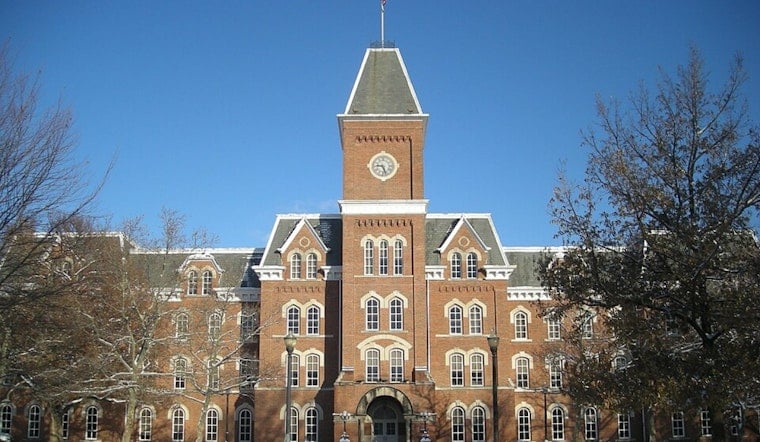
Ohio State University has agreed to pay $2.1 million to resolve a federal investigation into a former earth sciences professor who concealed his ties to the Chinese government while collecting NASA and National Science Foundation grant money for more than a decade. The professor, C.K. Shum, admitted to participating in Beijing's Thousand Talents Plan in 2019, according to the settlement, but the university did not formally disclose his affiliations to NASA and the NSF until 2023.
Shum researched global sea-level rise linked to geophysical sources and brought expertise in satellite operations, tide modeling, hydrology and ice mass balance to his work at OSU's Department of Civil, Environmental and Geodetic Engineering, where he ran the Laboratory for Space Geodesy and Remote Sensing Research in Columbus. As reported by Cleveland.com, he received NASA and NSF grants from November 2012 to August 2023, and the federal government contends that his grant applications and funding drawdown requests failed to disclose his and other lab employees' Chinese affiliations and funding.
The four-year gap between OSU's internal discovery of Shum's undisclosed overseas funding in September 2019 and its formal disclosure to federal grant sponsors in 2023 became a central driver of the federal scrutiny that followed, according to the Washington Times. Shum had disclosed his positions with Chinese universities and state-run research organizations in an annual report to his OSU department since at least 2014, per Cleveland.com, even as the federal government says his grant paperwork omitted those same ties.
Thousand Talents Plan at the Center of the Case
The Thousand Talents Plan was established by the People's Republic of China to recruit individuals with knowledge or access to intellectual property, and the federal investigation ultimately found other lab employees with ties to China as well. Yu Zhang, a lab worker listed on the grant applications, was also investigated by the federal government and is no longer employed at OSU. The government's contention centers on the claim that Shum violated OSU policies governing outside activities and affiliations by failing to disclose his participation in the program.
Once the university learned of the affiliations, it suspended Shum's privileges as a principal investigator, halted spending on the relevant grants, and initiated formal disciplinary proceedings against him in 2023. OSU officially terminated Shum in January 2024, according to the Washington Times. The university also repaid $254,661 to NASA and NSF that same month.
OSU Denies Liability, Cites Cost of Litigation
Ohio State did not admit wrongdoing in the settlement, and the agreement itself states that it is neither an admission of liability by OSU nor a concession by the United States that its claims are not well founded. The university agreed to the $2.1 million resolution — transferring the remaining $1.8 million electronically to the federal government — to avoid what it described as protracted litigation, the Washington Times reports.
Chris Booker said Ohio State cooperated with the federal government throughout the process, per Cleveland.com's reporting. The university maintains it has research compliance and secure research offices, requires conflict-of-interest and research security disclosures, provides foreign influence training programs, and promotes research integrity and security. As part of the resolution, the federal government released OSU, Shum, and Zhang from criminal liability.
Federal Officials Frame Case as National Security Issue
Robert Steinau, an official with the NASA Office of Inspector General, said following the settlement that federal law enforcement will not tolerate research institutions concealing foreign ties that compromise national security, according to the Washington Times. Brett A. Shumate said American universities must fully disclose all foreign funding in grant applications and added that the Justice Department will hold accountable universities that fail to comply with disclosure requirements, per Cleveland.com.
The case sits within a broader legal framework governing NASA-funded research. Under the 2011 Wolf Amendment, federal law strictly restricts NASA from using government funds to participate, collaborate, or coordinate bilaterally with the Chinese government or Chinese-owned entities without explicit authorization from Congress and the FBI, according to CASRAI. The Justice Department enforces university research disclosure requirements primarily through the federal False Claims Act, which holds that submitting inaccurate foreign grant applications or progress reports constitutes a civilly actionable false claim for federal funds, per the same CASRAI guidance.
Part of a Pattern for Ohio State and Other Institutions
This is not the first time Ohio State has faced this kind of federal scrutiny. In November 2022, the university paid $875,689 to settle separate federal civil allegations that it failed to disclose a professor's foreign government support and foreign talent plan participation on NASA, NSF and Army grants between 2012 and 2020, according to the Department of Justice. And in May 2021, former OSU rheumatology professor Song Guo Zheng was sentenced to 37 months in federal prison and ordered to pay over $3.8 million in restitution after pleading guilty to lying on grant applications to conceal his own participation in the Thousand Talents Plan while obtaining $4.1 million in NIH funding.
Ohio State is far from alone in facing this type of enforcement. Between 2020 and 2024, the Justice Department reached major civil False Claims Act settlements over undisclosed Chinese research ties with several institutions, including $7.6 million with the Cleveland Clinic Foundation in 2024, $5.5 million with the Van Andel Research Institute in 2020, and $1.9 million with Stanford University in 2023, according to a WilmerHale analysis. Hoodline previously reported on a similar federal probe at Harvard examining China-funded scholarships and grant compliance.


.jpg)