

























































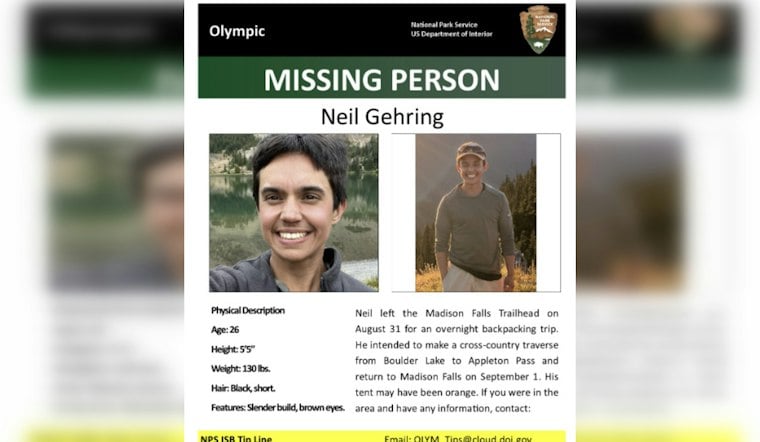
Ten days of aerial sweeps, ground teams, drones, and dog searches have turned up nothing in the hunt for 26-year-old Neil Gehring, a wildland firefighter who vanished during a solo backcountry trek in Olympic National Park. Now, park officials say they're changing course, shifting from grid searches along his expected route to chasing down new tips from the public.
Gehring set out from the Madison Falls trailhead on August 31 for what was supposed to be a one-night, off-trail traverse from Boulder Lake to Appleton Pass, according to KATU. He registered his permit with the National Park Service on August 31 and was due back September 1; when he didn't return, park dispatch logged him as overdue at 6:30 a.m. on September 2, according to Olympic National Park. Search teams mobilized soon after.
Gehring is described as 5 feet 5 inches tall, roughly 130 pounds, with a slender build and short, black hair, per KATU's report. His tent, which he may have had with him, is orange, according to the park's account. Anyone with information is asked to call 888-653-0009 or email [email protected].
A Firefighter's Training Meets an Unforgiving Traverse
Gehring works as a wildland firefighter, Clallam County Sheriff's Office Chief Criminal Deputy Amy Bundy said in an interview reported by the Peninsula Daily News. That background matters: wildland firefighters typically receive specialized physical conditioning and land navigation instruction, the outlet noted, which makes his prolonged disappearance during this particular route especially puzzling to those following the case.
The route he chose is not for casual hikers. The Boulder Lake-to-Appleton Pass traverse is an off-trail, unmaintained cross-country stretch through steep subalpine ridges and dense forest, according to National Park Service wilderness trip planning guides. Officials say the terrain in that section features unmaintained way-trails, thick forest canopy, steep alpine ridgelines, and sudden weather shifts — conditions that have complicated both drone flights and helicopter sweeps throughout the search, per Olympic National Park.
Search Effort Pulls in State and Volunteer Resources
The scale of the response has stretched across multiple agencies. The Clallam County Sheriff's Office Search and Rescue team joined the effort from September 5 through September 8 after Washington's State Emergency Operations Center issued a statewide call for search assistance, the Peninsula Daily News reported. Volunteer group Seattle Mountain Rescue also sent more than a dozen personnel equipped with drones, thermal imaging cameras, and artificial intelligence mapping tools into the rugged terrain, according to KIRO 7 News Seattle.
Despite that combination of federal rangers, county volunteers, and specialized rescue teams, ten straight days of searching along Gehring's expected route produced no leads, prompting the park's decision to pivot toward evaluating incoming public tips rather than continuing broad grid sweeps, Olympic National Park said in its update.
A Park Built for Remote, High-Stakes Rescues
Olympic National Park's rangers field roughly 150 emergency calls a year across nearly 922,000 acres of rainforest, alpine peaks, and remote coastline, according to Washington's National Park Fund. That vast, rugged footprint is part of why search operations here can stretch on so long, and why the region depends on shared resources: Mount Rainier, North Cascades, and Olympic national parks split a single dedicated short-haul rescue helicopter under contract each summer for technical aerial evacuations, per the National Park Service.
Digital safety tools have made a dent in the problem elsewhere in the park. A partnership between AllTrails and Olympic National Park that added real-time hazard alerts has contributed to a 66 percent drop in search-and-rescue incidents on targeted high-risk routes since 2021, according to an AllTrails Public Lands Program case study. Even so, off-trail traverses like the one Gehring attempted fall outside those marked routes, leaving hikers without the same layer of digital guidance.
The northern stretch of the park near the Appleton Pass trailhead network has seen serious search-and-rescue operations before. In June 2025, crews carried out a multi-day recovery operation after an 18-year-old visitor fell over nearby Sol Duc Falls, according to National Parks Traveler. For now, Gehring's case remains open, with park officials asking anyone with information about his whereabouts to come forward as searchers lean on public leads to guide their next move.





