

























































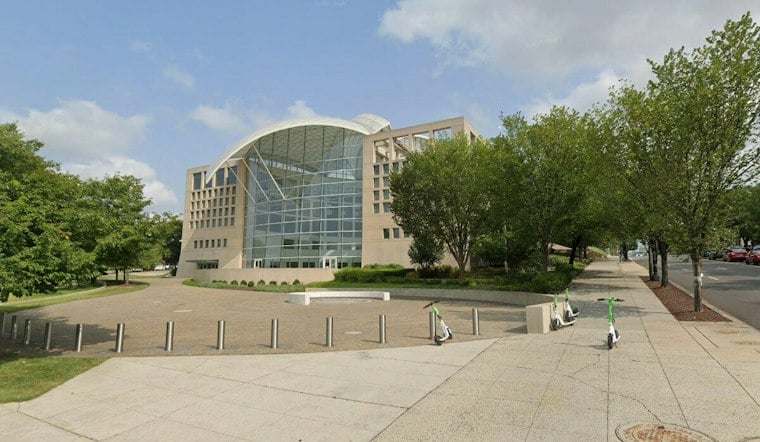
Ousted board members of the U.S. Institute of Peace filed an emergency motion Thursday asking a federal judge to block plans to carve President Donald Trump's name directly into the stone facade of the institute's Washington, D.C. headquarters. The move would make permanent what is currently temporary bolt-on lettering, and it lands in the middle of an unresolved court fight over who actually controls the building.
According to The Guardian, the plaintiffs argue that chiseling lettering into the permanent stone structure would cause irreparable harm compared to the temporary signage installed late last year. The State Department officially announced the renaming of the entity to the Donald J. Trump Institute of Peace on December 3, 2025, affixing the bolt-on lettering to the building facade even as litigation over legal control of the institute remained ongoing, according to WUFT. As part of that December announcement, the State Department praised Trump as “the greatest dealmaker in our nation's history,” per the same outlet.
Per The Independent, the emergency motion states the building was largely funded by private donations to a tax-exempt nonprofit corporation, and describes the structure as expressive architecture designed to symbolize the institute's independent mission. The filing argues that altering the building's design to impose a different message would cause irreparable harm, and journalist Kyle Cheney reported on the emergency motion on X, per the Independent's account.
A Building Designed as a Symbol of Independence
A five-story USIP headquarters opened in 2011 and sits near 23rd Street and Constitution Avenue NW, on the last buildable parcel at the northwest corner of the National Mall. Congress established the U.S. Institute of Peace as an independent, nonpartisan federal nonprofit under the United States Institute of Peace Act, signed into law by President Ronald Reagan in 1985, a statute that placed the institute outside executive department control.
The current fight traces back to February 19, 2025, when Trump signed an executive order designating USIP an “unnecessary governmental entity,” a move that led to mass firings and funding freezes at the institute, according to the Brookings Institution. Trump and Elon Musk had sought to reduce what they viewed as government waste, and the mass firings at USIP have been challenged in court ever since. The U.S. Court of Appeals for the D.C. Circuit issued a stay pending appeal in USIP v. Jackson on June 27, 2025, temporarily pausing a district court ruling that had found the administration's takeover and dismantling of USIP unlawful, per the Civil Rights Litigation Clearinghouse. The ousted board members are now seeking narrow emergency relief on the carving question.
Kennedy Center Ruling Looms Over the Case
The USIP dispute follows a similar legal battle at the Kennedy Center, where Hoodline previously reported on the fallout from a court order removing Trump's name from that facility. U.S. District Judge Christopher Cooper ruled on May 29, 2026, that the Trump administration unlawfully added Trump's name to the John F. Kennedy Center for the Performing Arts, holding that statutory landmark names created by Congress cannot be altered without legislative approval, according to 930 WFMD. Cooper said Congress gave the Kennedy Center its name and only Congress can change it, and he ordered physical signage bearing Trump's name removed; the signage was removed in June 2026.
The Trump-appointed Kennedy Center board had voted in December 2025 to put Trump's name on the center, a decision that prompted artists to refuse to perform there. The controversy also produced legal fallout of its own. Democratic U.S. Representative Joyce Beatty filed a federal lawsuit, according to Spectrum News. Beatty had served as an ex officio member of the Kennedy Center board of trustees.
Public Opinion Runs Against Self-Naming
Even as the legal fights continue, available figures suggest most Americans are uneasy with the practice. Only 9% said naming buildings after Trump would be acceptable while he remains president, while roughly 70% either opposed the practice or would accept it only after he leaves office, according to figures linked through the cited source.
The naming pattern extends beyond buildings. On December 22, 2025, Trump and the U.S. Navy announced plans to build a new class of nuclear-powered guided-missile warships designated the Trump-class battleship, with the lead ship named USS Defiant, according to Navy.mil. The planned program's cost is not established here. As it stands, the Donald J. Trump Institute of Peace building currently carries Trump's name attached to its facade while the words Institute of Peace remain permanently etched into the structure itself, a juxtaposition the emergency motion now asks a judge to keep from becoming entirely stone.




