

























































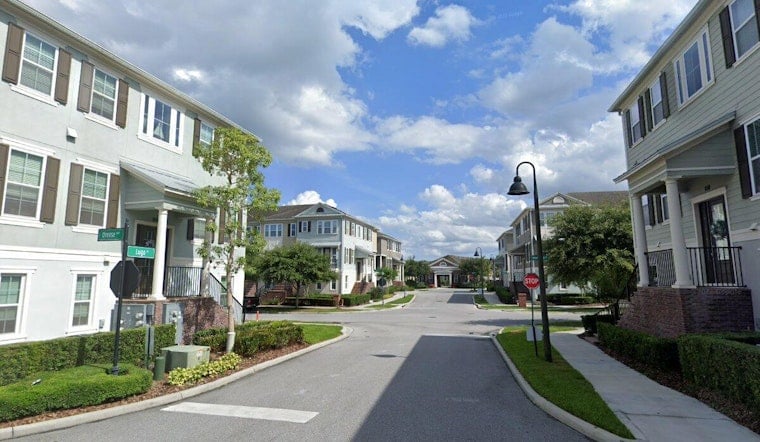
Ian Tasman watches customers dodge traffic on Central Avenue every day from the window of his pharmacy near Oviedo on the Park, and he says it's only getting more dangerous as the surrounding neighborhood keeps growing. A planned crosswalk meant to help pedestrians cross that stretch of road near the city's downtown hub is now stalled after Florida Gov. Ron DeSantis vetoed $500,000 in state funding earmarked for two crosswalks in Oviedo.
The veto, part of a wave of line-item cuts DeSantis made to the fiscal year 2026 state budget, eliminated the money the city had been counting on for crosswalks at Central Avenue and Boardwalk Avenue near Oviedo on the Park, as well as at Lockwood Boulevard and Fallbrook Drive near Seminole State College, according to Spectrum News 13. DeSantis signed the overall $117.6 billion budget in June after making nearly $810 million in vetoes statewide, cuts he defended as necessary fiscal restraint on non-essential local projects, according to CBS News. Oviedo now has no current funding to move forward with the Central Avenue crosswalk, though the city plans to proceed with the Lockwood Boulevard project as part of its Capital Improvement Plan, even though that project's full scope has not yet been finalized.
A Pharmacy Owner's Front-Row View of the Problem
Tasman opened his independent pharmacy, Pharmacy on the Park, four years ago, and he told the outlet the surrounding area is exploding with growth, completely surrounded by residential development including townhomes and apartments. His pharmacy, which has 25 employees and benefits from its proximity to Oviedo on the Park, is already out of space, and he hopes for another building to eventually rise across the pharmacy's parking lot. Traffic along Central Avenue is a constant concern for him, and he said the continued growth near his business makes pedestrian safety more important, not less.
Tasman said he hopes the city eventually finds a way to fund the crosswalk, warning that waiting too long means officials would only be reacting after something happens. Pedestrians currently find it difficult to travel between Oviedo on the Park and Boston Hill Park across Central Avenue, which is also known as State Road 434 and carries about 16,900 vehicles each day, per the same report.
Why the State, Not the City, Calls the Shots
Central Avenue's designation as State Road 434 means jurisdiction over traffic modifications, speed limits, and crosswalk approvals falls under the Florida Department of Transportation rather than the city alone, according to Oviedo Community News. That means any state-maintained roadway requires FDOT engineering evaluations before Oviedo can install local traffic controls, which is why city staff must now work with state lawmakers and lobbyists to try to revive the funding.
Oviedo leaders are evaluating how to move forward with pedestrian safety projects overall, including reconsidering previous appropriations requests such as the vetoed Central Avenue crosswalk. City staff plan to finalize a list of recommended projects that will be brought to the Oviedo City Council in October.
A Corridor Under Pressure as the Area Grows
The stakes extend beyond one intersection. A broader FDOT corridor evaluation released in August recorded 419 traffic crashes between 2021 and 2025 along a segment of State Road 434 carrying more than 30,000 vehicles daily, according to Spectrum News 13, which has also proposed raised medians and roundabouts along parts of the corridor to curb high-risk turning crashes. Statewide, Florida ranked as the fifth-deadliest state in the nation for pedestrians in Smart Growth America's “Dangerous by Design 2026” report, which recorded 3,726 pedestrian fatalities between 2020 and 2024, as reported by the Florida Phoenix.
There is some regional progress to point to. The Orlando-Kissimmee-Sanford metro area dropped from the nation's most dangerous metro for pedestrians in 2019 down to 25th in 2026 in Smart Growth America's rankings, with regional transportation planners crediting targeted safety programs and street redesigns. Still, driver behavior remains a persistent problem: Central Florida's Operation Best Foot Forward found in 2025 that drivers stop for pedestrians in marked crosswalks less than half the time, with just a 45% compliance rate recorded in surveyed corridors, according to WFTV. Florida law requires drivers to stop and remain stopped for pedestrians in marked crosswalks, with violations carrying a minimum $164 fine and three license points under Florida Statute § 316.130(7), per Bike/Walk Central Florida. According to FDOT's Pedestrian and Bicycle Safety program, its data driven enforcement effort aims to reduce traffic crashes resulting in serious and fatal injuries to pedestrians. According to FDOT's Highway Safety Matrices, counties and cities of varying size that rank in the Top 40 percent of fatalities and serious injuries are highlighted for safety attention.
A History of Friction Over Crosswalk Design
This is not the first time state rules have tangled with Oviedo's crosswalk efforts. Seminole County spent more than $31,000 in late 2025 painting black pavement over bright green crosswalks in Oviedo to comply with a state mandate requiring standardized pavement markings, according to WKMG ClickOrlando. Local officials reported the state-mandated cover-up paint began peeling off within months.
Oviedo on the Park was master-planned as a 108-acre downtown district with roughly 800 residential units and the $9 million, city-funded Center Lake Park, and it's now widely considered Oviedo's modern downtown. That density is only expected to grow: developers secured approvals in July to convert the Oviedo Mall's vacant Macy's site into roughly 700 new apartment units, a $100 million mall makeover that will add still more residents within walking distance of Central Avenue.





