

























































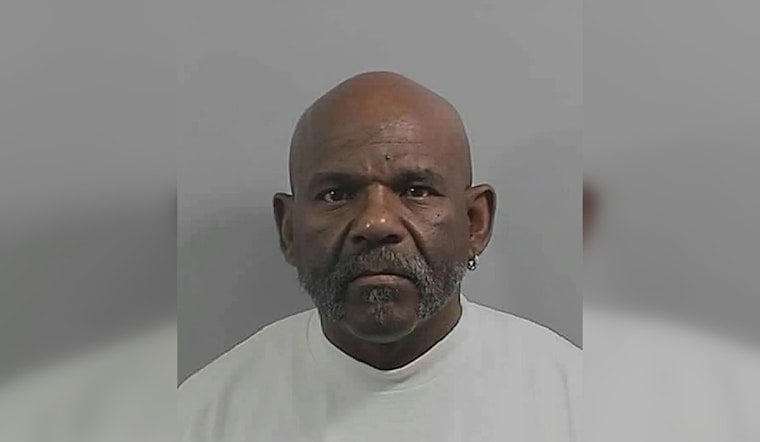
A Los Angeles judge has ruled there is enough evidence to try a 26-year-old man accused of fatally shooting a 70-year-old Panorama City resident outside an apartment building long controlled by the Blythe Street gang. Andrew Lopez, described as a reputed Blythe Street member, pleaded not guilty to murder, attempted murder and firearms offenses in connection with the August 2024 killing of Clyde Moore, who was shot once in the back of the head while sitting in a red Jaguar sedan outside 9010 Tobias Ave.
According to the Los Angeles Times, Judge David Walgren ordered Lopez to stand trial after prosecutors laid out testimony from Moore's wife, who said Lopez approached their car that August morning while armed with a gun and demanded, “What y'all n— doing out here?” Moore's wife had gone to Tobias Avenue to give money to her uncle, and she told the court she recognized Lopez as the same man who had approached the couple six months earlier and demanded payment for them to be in the area. Prosecutors said Moore tried to flee in his car and crashed through a wrought iron fence before Lopez shot him; his wife testified that Lopez also raised the gun toward her.
Authorities said they found cocaine, drug paraphernalia and three counterfeit $100 bills in Moore's car, and Lopez was arrested the day after the shooting. Officer Julio Paredes testified that Blythe Street members dominate the Tobias Avenue building, per the Times, and LAPD investigators obtained surveillance video that appears to show Lopez running on the stairs to sell drugs. Lopez was living in a third-floor unit of the apartment complex at the time of his arrest, and Moore and his wife had lived only a few blocks away.
A Drug Hub With a Bloody History
The address at 9010 Tobias Ave. has been the site of several killings, and Blythe Street considers the building its stronghold, guarding its turf there even as rivals have tried to move in. In February 2024, Luis Gaona was shot to death outside the same complex, and detectives suspected members of the Original Valley Gangster Crips killed him in an attempt to seize control of the drug-dealing hub. Blythe Street members reportedly retrieve drugs from apartment units there for waiting customers.
Judge Walgren, who is presiding over the Lopez case, also presided over an earlier trial connected to a 2018 killing at the same building, when Oscar “Smokey” Molina was gunned down. Prosecutors alleged that former Blythe Street leader Ezequiel “Wicked” Romo ordered Molina's killing from prison, and this year, Eder “Mousey” Mendoza and Lorenzo “Scooby” Gonzalez were convicted of murdering Molina and a woman who witnessed it.
A Weakened Gang, a Racially Charged Turf War
Blythe Street is a predominantly Latino gang embroiled in a turf war with the Original Valley Gangster Crips over drug territory, according to the Times report. That conflict has taken on a racial dimension in the Moore case, where the victim's wife testified that a slur accompanied the demand for money. Los Angeles Times reporter Matthew Ormseth, who covered the courtroom proceedings, noted that fresh red graffiti reading “Calle Blythe” was photographed near the site of Moore's killing.
The turf war over the Tobias Avenue drug hub followed a leadership collapse within Blythe Street. In 2023, Romo and seven associates were sentenced to life in prison without parole for murder, attempted murder and conspiracy, according to the Los Angeles Times, creating a power vacuum that rival gangs have since tried to exploit. By August 2026, Los Angeles County Deputy District Attorney Eric Siddall said Blythe Street “is no longer a serious gang,” telling the paper it now has “no shooters” and “no serious leadership” after years of federal and state prosecutions targeted its senior members.
Decades of Economic Decline and Enforcement
Panorama City's gang troubles trace back in part to 1992, when General Motors closed its assembly plant at the eastern end of Blythe Street, eliminating 2,600 union-wage jobs and deepening economic distress in a neighborhood that has since transitioned into a predominantly Latino immigrant community, per the Times. The area has also drawn targeted law enforcement attention for more than three decades; in April 1993, the Los Angeles City Attorney obtained a 22-point gang injunction against Blythe Street, the first such injunction issued in the San Fernando Valley and only the second in LAPD history, barring members from congregating on rooftops or carrying pagers.
Violence at the Tobias Avenue address predates the current case by more than a decade. In February 2014, 31-year-old Carlos Sanchez Cruz was fatally shot point-blank on the sidewalk outside the same building during a $50 dispute involving gang members, and he was later declared brain dead at Holy Cross Hospital, according to the Times' earlier coverage.
Legal Stakes and Citywide Context
Any prosecution seeking to frame Moore's killing as racially motivated would need to clear a specific legal bar. Under California Penal Code Section 422.75, prosecutors can request sentencing enhancements when a felony is committed because of a victim's actual or perceived race, but proving that motivation requires meeting a distinct statutory standard separate from a narcotics or turf-related motive, according to the Kraut Law Group. Separately, California's Street Terrorism Enforcement and Prevention Act, codified at Penal Code Section 186.22, allows enhancements up to life imprisonment for crimes committed to benefit a criminal street gang, though prosecutors must prove a pattern of gang activity beyond a reasonable doubt, per Eisner Gorin LLP.
The Tobias Avenue case unfolds against a broader citywide backdrop of falling violence. LAPD Chief Jim McDonnell reported in February 2026 that homicides in Los Angeles dropped 19 percent in 2025 compared with the year before, marking the city's lowest annual murder total since 1966, with a 68 percent clearance rate for homicides that year. Mission Community Police Station, which covers Panorama City along with Sylmar, Arleta, Mission Hills and North Hills, patrols 25.1 square miles and serves more than 225,000 residents across those five San Fernando Valley communities.




