

























































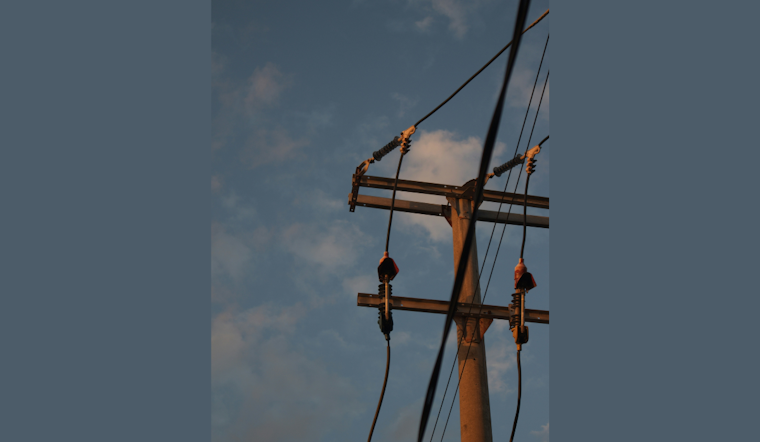
A transmission-line equipment problem in Petaluma knocked out power to about 3,500 customers Wednesday morning. PG&E then planned a brief, intentional power interruption for roughly 20,000 customers across Sonoma County that same night. The utility said it needed to temporarily shift those customers to a different power source so crews could safely repair the damaged equipment, with the switch expected to briefly cut power for some of them between about 8 and 10 p.m.
Morning Outage Sets Off a Countywide Fix
The original failure hit Petaluma-area customers Wednesday morning, according to the San Francisco Chronicle. PG&E restored electricity to about 2,000 of those customers by rerouting them onto an unaffected line, but roughly 20,000 customers were expected to be transferred to a different power source so crews could work on the transmission equipment without risking further disruption. The utility said it expected to finish the repairs later Wednesday evening.
By around 3 p.m., PG&E's own outage alerts showed several separate Sonoma County outages affecting thousands of customers, a sign that the temporary rerouting was already rippling through the system. The Chronicle's report noted that moving customers onto a substitute circuit had already caused another short-lived interruption that afternoon, on top of the original morning blackout.
Why the Evening Switch Could Cause Another Blip
Once repairs on the transmission equipment wrapped up, PG&E planned to move the 20,000 affected customers back to their normal power source, a process the utility said could itself cause another brief, momentary outage. PG&E spokesperson Megan McFarland told the Chronicle that switching everyone back to their original source carried that same risk, and that the resulting interruption was expected to last less than 20 minutes.
That kind of short interruption falls into a specific regulatory category. Under California Public Utilities Commission rules, power blips lasting less than five minutes are defined as “momentary outages” and tracked separately from longer, sustained outages, according to the California Public Utilities Commission. Reliability data track the frequency of these momentary interruptions separately from longer outages.
Police Warn Drivers as Signals Go Dark
With traffic signals losing power during the outages, Petaluma police reminded drivers to treat any intersection with a dark signal as a four-way stop. That instruction reflects state law: under California Vehicle Code Section 21800(d)(1), drivers approaching an intersection with an inoperative signal are legally required to stop before entering, per FindLaw. The stakes behind that reminder are real: traffic signal violations contributed to nearly 34% of severe crashes in Petaluma between 2020 and 2023, according to data compiled by Flahavan Law Offices.
The disruption touches a meaningful slice of the city. Petaluma has an estimated population of roughly 59,247 residents, per U.S. Census Bureau figures. The planned switching operation involved about 20,000 customer accounts across Sonoma County, but the available reporting does not establish how many were in Petaluma. PG&E transmission equipment was involved in the repair, while Sonoma Clean Power, a public agency serving more than 229,000 accounts regionally, supplies electricity to many customers in the region, according to S&P Global Ratings. The sources do not establish whether Sonoma Clean Power supplied generation to the customers affected Wednesday.
A Familiar Pattern for the North Bay Grid
PG&E used circuit switching Wednesday as part of its response to the Petaluma equipment problem, within a sprawling system of 106,681 circuit miles of distribution lines and 18,466 circuit miles of transmission lines across a 70,000-square-mile territory, the utility says. As of Wednesday, PG&E's broader grid-status page showed no systemwide supply constraints, suggesting the Petaluma-area work was an isolated repair rather than part of a larger regional problem. According to a California Public Utilities Commission Energy Division compliance report, a program intended to improve transmission-system reliability included replacing aging infrastructure and modernizing facilities, with a total of $464.6million. PG&E's 2023 general rate case filing reports that the utility replaced 133 units in 30 electric substations, at an estimated average cost of $211,000 per unit.
It is not the first time equipment trouble has left a large swath of Sonoma County in the dark this year. In August, a semi-truck snagged a utility tension wire in Sebastopol, snapping a power pole and cutting electricity to more than 3,000 West Sonoma County customers and two school campuses, as Hoodline reported at the time. And in May, high winds led branches to strike lines and transformers to fail, cutting power to nearly 6,700 North Bay PG&E customers, according to Hoodline.




