

























































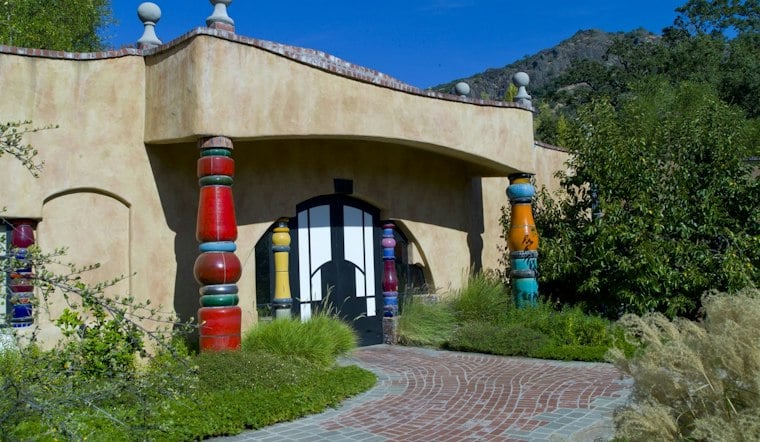
Along the Silverado Trail in Napa Valley's Stags Leap District sits a winery that looks nothing like its neighbors: a gold onion dome catches the light above a building with no two doors or windows alike, its roof planted with grass and small olive trees that visitors can actually walk across. It's Quixote Winery, a 42-acre estate whose main structure was designed by an Austrian artist who believed straight lines had no place in nature — or in buildings.
A Vienna Meeting That Became a Decade-Long Build
Quixote's address at 6126 Silverado Trail places it squarely in the golden hills of the Stags Leap District, according to Quixote Winery. The estate's founder, Carl Doumani, discovered the work of Austrian artist, architect and environmentalist Friedensreich Hundertwasser in 1989 and commissioned him to design a winery on the property, per the same account. As The Napa Valley Register reports, Doumani flew to Vienna that year to meet Hundertwasser in person and strike the deal.
What followed was not a quick project. The Napa Wine Project notes that the design alone took roughly three years, with construction stretching another seven, and that the building was ultimately finished in 2000, according to The Napa Wine Project. The Register describes letters and revisions crossing the Atlantic over the better part of a decade.
Columns Smashed With a Hammer, on Purpose
Hundertwasser's design demanded materials that didn't exist on the shelf. The winery's columns were built from stacked, mismatched ceramic beads, per the Register. When one column came out finished and flawless, Hundertwasser reportedly took a hammer to it himself, explaining, “If they don't see we use broken materials, they'll never know.”
That embrace of imperfection runs through the whole building. Quixote's floors are intentionally uneven, which Hundertwasser described as “a melody for the feet,” according to the Register's account, and he was known for arguing, as the paper reports, that the straight line is godless. The one-story structure pairs that philosophy with colorful ceramic tiles and the shimmering gold onion dome, a combination Danny Mangin describes as striking “a seriously playful pose.”
A Roof Built to Give Land Back
Hundertwasser's own design statement frames the roof as restitution: “Everything that was taken from nature during the construction of the building has been returned to it on the building's roof,” according to Hundertwasser. The organization describes the building as completely overgrown with nature, allowing people to wander and walk upon all parts of the roof. The Register describes a living roof with grass, bushes and trees. The design reflects Hundertwasser's broader belief, per the Register, that every horizontal surface open to the sky should be green space, and that trees had the right to grow out of building windows.
The result is a structure its own publicists call singular: the Stags Leap District's own listing describes Quixote as “an expressive masterpiece of vibrant mosaics, organic curves, and colorful towers,” according to Stags Leap District. The Register goes further, calling it the only building in the Western Hemisphere designed by Hundertwasser — a distinction echoed by Mangin, who calls it the artist's only U.S. project. Inside, the building features brick, a colorful patio wall, tiles laid over the land's natural rises, and custom signage, per the Register.
From a Weekend Property to a Name Fight in Napa
Doumani first came to Napa Valley in 1969, decades before Hundertwasser entered the picture. Doumani founded Stags' Leap Winery in 1972, per The Napa Wine Project. He sold it to Beringer in 1997.
Doumani later sold Quixote itself in 2014 to Jinta Vineyards and Winery, according to The Napa Wine Project. He died in 2025.
What Quixote Pours Today
The winery's production figures vary depending on the source: The Napa Wine Project puts output at around 2,000 cases annually, focused on Petite Sirah and Cabernet Sauvignon, while the Stags Leap District's own listing cites 3,000 cases a year of estate-grown Cabernet Sauvignon and Petite Sirah. Vineyard acreage is similarly described differently across sources — The Napa Wine Project frames the property as 42 acres overall, while Mangin describes a 27-acre vineyard containing four distinct soil types. Visitors today can book appointment-only tastings daily from 10 a.m. to 3 p.m., per the Stags Leap District listing, and the wine program features Petite Sirah.




