

























































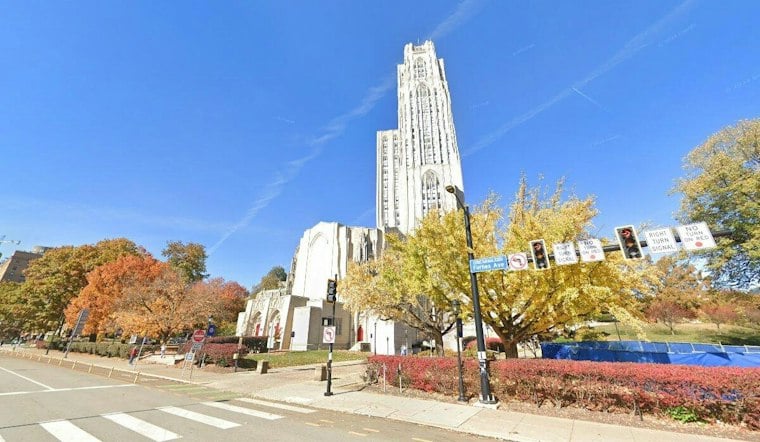
Pittsburgh's 42-story Cathedral of Learning is marking 100 years since its groundbreaking, and the University of Pittsburgh isn't letting the milestone pass quietly. Beginning Friday, the campus will host a three-night light-and-sound experience, with nightly light shows projected onto the building's Gothic facade at 9 p.m. through Sunday. Cathy-Palooza is a separate event scheduled for Sunday, September 27, from 1 to 4 p.m.
The Gothic Revival tower, designed by architect Charles Zeller Klauder, was the tallest academic building in the world when it opened, according to WTAE. It remains the tallest university building in the United States and one of Pittsburgh's most recognizable landmarks. Drew Armstrong, a professor of history of art and architecture at the University of Pittsburgh, told the station the building was intended as a work of art, adding that the Cathedral of Learning held the title of tallest academic building until Moscow State University's tower went up in the 1930s. “The ambition was to create a building of global significance,” Armstrong said, per the station's report.
A Chancellor's Ambitious, Debt-Averse Vision
The story begins in 1921, when John Bowman became Pitt's chancellor and envisioned a building that would inspire awe and underscore the importance of both the university and the city, according to Armstrong's account relayed by the station. Bowman's original plans called for a 52-story structure, but that vision was scaled back to 42 stories specifically to avoid saddling the university with debt, the same report notes.
Financing an undertaking of that size during hard economic times required creativity. Pitt launched a community campaign to raise $10 million — equivalent to roughly $200 million today — and, per Armstrong, the university sought contributions from 97,000 schoolchildren who each donated a dime toward the effort. That grassroots, dimes-and-limestone fundraising campaign has become part of campus lore.
Construction itself stretched across a decade. Following a September 1926 groundbreaking, the first classes were held inside the building in 1931, the exterior Indiana limestone masonry was finished in October 1934, and the structure was formally dedicated in June 1937, according to the Brookline Connection. Students spent years attending classes inside while work continued on the building around them. The tower briefly held the title of Pittsburgh's tallest building after its steel frame went up in 1929, a distinction it lost when Downtown's Gulf Tower was completed in 1932, according to Pittwire.
Living Classrooms From Around the World
Among the building's defining features are its Nationality Rooms, which reflect the heritage of Pittsburgh's immigrant communities and represent the traditions of different groups who shaped the region. The rooms opened in a first phase of 18 and have since grown to 31 today, according to the station's report. Rather than functioning as static museum displays, they serve as living classrooms still used for instruction.
Per Armstrong, the university has held that the rooms should showcase the best of the immigrant groups that helped form the future of American culture. That mission has occasionally intersected with real history in unexpected ways — the English Nationality Room, for instance, incorporates authentic 19th-century stone fragments salvaged from the British House of Commons after it was bombed in London in 1941, according to the Pittsburgh History & Landmarks Foundation.
A Landmark Beyond Architecture
The Cathedral of Learning is listed on the National Register of Historic Places. But its history extends well past architecture and preservation. On January 15, 1969 — what would have been Dr. Martin Luther King Jr.'s 40th birthday — members of the Black Action Society staged a nonviolent sit-in at the building's eighth-floor Computer Center demanding a Black Studies program, according to Pittsburgh Urban Media. A separate community campaign for the building's African Heritage Classroom began in 1972 and resulted in its dedication in 1989.
The tower has also needed regular upkeep to stay presentable. In 2007, on the 70th anniversary of its dedication, Pitt trustees launched a major exterior restoration that cleaned decades of industrial steel-mill grime from the Indiana limestone facade, according to the University of Pittsburgh. Families of wild peregrine falcons have nested near the top of the building for decades, according to the Pitt Alumni Association. For the centennial, peregrine falcons will get their own moment in the spotlight with a falcon-viewing activity among Cathy-Palooza events.
Cathy-Palooza and a Century of Celebration
The centennial festivities extend to Pitt's alumni community as well. The Pitt Alumni Association introduced a signature Blue Curaçao cocktail dubbed The C100 at an Ale to Pitt reception, alongside a hands-on station where attendees can build mini Cathedral models out of plastic bricks, timed to coincide with Pitt's 2026 Homecoming celebration.
Cathy-Palooza, a separate Sunday event, brings the celebration to campus with a cinematic light show as its centerpiece. As Armstrong put it in comments to the station, the Cathedral of Learning is continuously changed and transformed to reflect the university's needs — a description that, a century after its groundbreaking, still seems to capture the building's role as both a historic monument and an active hub of campus life.





