

























































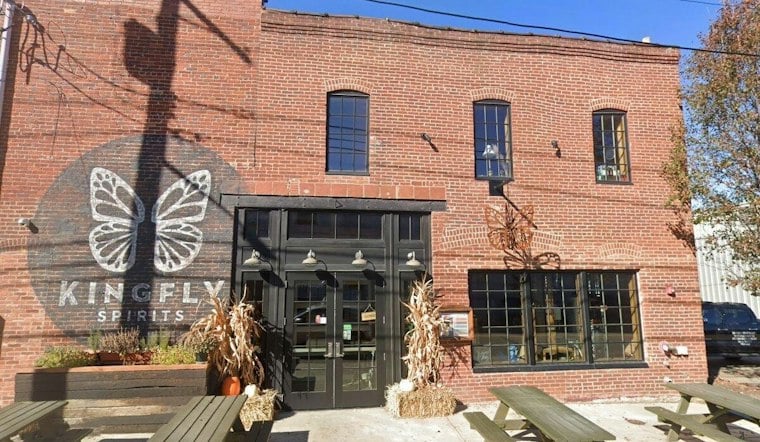
A whiskey name that vanished from Pittsburgh more than a century ago is coming back to life in the Strip District, with plans to open a tasting room in the same Smallman Street building that housed Kingfly Spirits before it abruptly went dark. H. Obernauer & Co., founded in Pittsburgh in 1885, is being revived by Matthew Obernauer, the great-great-grandson of original founder Herman Obernauer, who sold the liquor business in 1915 after state regulatory pressure and concern about a future national prohibition.
Kingfly Spirits operated at 2613 Smallman Street for seven years before its sudden shutdown in February, a closure Hoodline covered in a report on the venue going dark overnight. TribLive reported that H. Obernauer & Co. plans to use the vacant space for a tasting room between Wigle Whiskey and Maggie's Farm Cocktail Bar and Barrelhouse. The venture is expected to open by the end of the year, according to TribLive.
A Family Story Passed Down for Generations
Matthew Obernauer, who relocated to Squirrel Hill with his family in 2024 after working as a corporate lawyer in New York and in the Colorado Rockies' legal department, is reviving the company based on a family story he heard from his grandfather as a child, according to TribLive's reporting. Obernauer has said his ancestor created something more than a century ago that he later held himself.
Herman Obernauer began his Pittsburgh business in 1884 with a saloon at 395 Fifth Avenue before converting the operation into a wholesale liquor rectifying firm at Fifth and Stevenson in Uptown, according to the Pittsburgh Post-Gazette. As a rectifier, he blended whiskeys made by other distillers according to his own signature recipes rather than distilling from scratch himself, per TribLive's reporting. Herman Obernauer went on to create several trademarked lines, including “Belle of Pittsburg Whiskey,” “H.O. Brown Gin,” and “Dr. Michael Cox's Stomach Bitters,” according to Peachridge Glass. He also served four times as a Democratic presidential elector for Pennsylvania and was a prominent member of Pittsburgh's Rodef Shalom Congregation, according to the historical blog Pre-Pro Whiskey Men.
Rebuilding in a Historic Carriage House
The Smallman Street building itself carries its own layered history. The space originally operated as a 1906 carriage house and underwent a major architectural renovation that earned a Pennsylvania Historic Preservation Award in 2019, according to Kingfly Spirits' own account of the property. TribLive's reporting notes the new venture will handle its actual production elsewhere, with barreling, blending, and bottling taking place in a separate warehouse facility in Lawrenceville while the Smallman Street site serves strictly as a public tasting room. H. Obernauer & Co. plans to offer American whiskey, bourbon, and rye whiskey, with Matthew Obernauer's revived company based in Pittsburgh, per TribLive.
What the Public Record Establishes So Far
The verified material reviewed for this article does not identify a Pennsylvania Liquor Control Board license or application for H. Obernauer & Co., nor does it identify zoning, building-permit or occupancy records documenting the conversion of 2613 Smallman Street into a tasting room. The Pennsylvania Liquor Control Board says a distiller must hold an active Limited Distillery license to participate in its Spirits Program, which allows participating in-state distilleries to place up to 10 products in as many as 10 Fine Wine & Good Spirits stores. Separately, the Urban Redevelopment Authority of Pittsburgh says projects along Smallman Street are adding mixed-use commercial and retail space and are intended to improve safety, pedestrian experience and traffic circulation while retaining the corridor's character.
The available historical record also distinguishes Obernauer's reported 1915 sale from national Prohibition: according to the Pittsburgh Post-Gazette, the 18th Amendment was ratified on Jan. 16, 1919, and Prohibition ended with ratification of the 21st Amendment on Dec. 5, 1933. Those dates provide national context but do not, on their own, establish how comparable Pittsburgh rectifying or wholesale firms responded between the 1890s and 1920.
Erin Lee, who will serve as director of operations for H. Obernauer & Co., brings an unconventional path into spirits. Before becoming head distiller at Illinois-based FEW Spirits, Lee worked as a fashion designer and certified tea sommelier, entering the industry through the STEPUP Foundation's equity internship program, according to Craft Spirits Magazine.
A Regulatory Shift That Made It Possible
None of this would be legally possible without a change in Pennsylvania law more than a decade ago. Act 113, passed in December 2011, established the limited distillery license, permitting craft producers making under 100,000 gallons annually to sell directly to consumers and operate on-site tasting rooms, according to the Post-Gazette. TribLive's reporting credits the Meyer-Grelli family, founders of Wigle Whiskey, with lobbying for that state-law change allowing distilleries to sell products onsite. Wigle Whiskey, named for Phillip Wigle, was founded in 2012; Wigle's dispute with a tax collector in the 1790s helped spark the Whiskey Rebellion, and he advocated for his right to distill during that era, per TribLive.
The Meyer-Grelli family sold Wigle Whiskey in 2022, when it was acquired by Pittsburgh Spirits, a company owned by Pittsburgh Pirates owner Bob Nutting, according to Craft Spirits Magazine. Alex Grelli, a former Wigle Whiskey co-owner now a distinguished service professor of law and entrepreneurship at Carnegie Mellon University's Tepper School of Business, is among those tied to the distillery's founding era, per TribLive. Wigle's current COO, Alex Moser, is also mentioned in the broader account.
A Neighborhood Shaped by Waves of Industry
The Strip District's transformation into a craft beverage destination is only the latest chapter for a neighborhood that has cycled through industries for two centuries. It was home to iron mills, foundries, and glass factories in the 1820s and 1830s, per TribLive's reporting, before produce merchants moved in near the Pennsylvania Railroad yards and the area became a wholesale center in the early 1900s. Wholesale produce dealers remained alongside new retail shops that opened on Penn Avenue and Smallman Street, according to the same report.
Maggie's Farm is another neighbor to the incoming Obernauer tasting room and part of the Strip District's craft beverage scene.
Rye Whiskey's Return to Its Roots
The Obernauer revival also taps into a broader regional legacy. In the late 19th century, Western Pennsylvania was one of the nation's primary whiskey production centers, world-renowned for Monongahela Rye, a bold, spicy, grain-forward style, according to WhiskeyPulse. Herman Obernauer got his start on Fifth Avenue during that era.
Risa Kumazawa, associate dean for academic systems and accreditation at Duquesne University and an associate professor of economics at the Palumbo-Donahue School of Business, told TribLive that new businesses like the Obernauer tasting room can create new local jobs and that local distilleries and tasting rooms may have a positive effect on the Strip District neighborhood, potentially supporting local sourcing and the local economy. Kumazawa offered that assessment as part of the outlet's broader look at the neighborhood's evolving craft beverage scene.



