

























































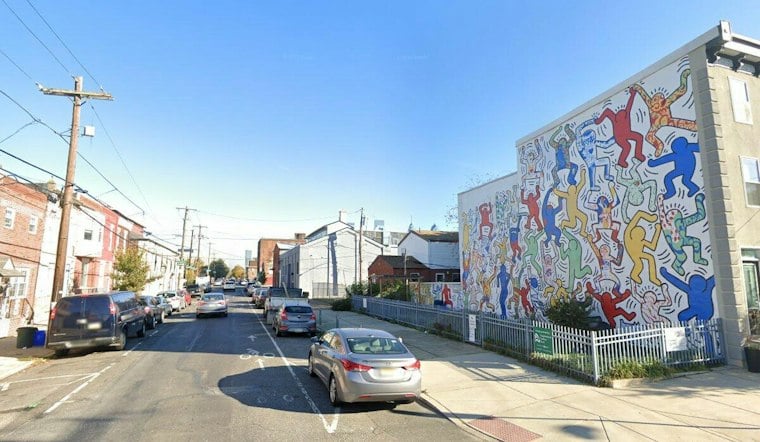
A 1987 Keith Haring mural in Point Breeze is one vote away from becoming Philadelphia's first officially designated outdoor mural, even as the wall it's painted on is cracking and pulling away from the brick beneath it. The Philadelphia Historical Commission's Committee on Historic Designation has recommended that the full commission approve landmark status for “We the Youth” at its October meeting, a step that would grant the mural protection from most demolition for the first time in the city's history.
The mural covers the exposed party wall at 2147 Ellsworth St. in South Philadelphia, overlooking a permanent community garden dedicated to Haring, according to WHYY. Haring, who was born and raised in Pennsylvania before rising to prominence in New York City's downtown art and graffiti scenes in the 1980s, painted it directly onto the wall's plaster as part of Philadelphia's bicentennial celebration of the U.S. Constitution. He created the piece alongside students from New York and Philadelphia, and Mural Arts Philadelphia notes that “We the Youth” was made in collaboration with CityKids of New York and the Brandywine Workshop. Its title, per the WHYY report, riffs on the first three words of the Constitution's preamble, “We the People.”
A Wall in Trouble
The mural has partially separated from the underlying brick, and the party wall has developed cracks that are worsening its condition, the same WHYY report states. Preserving the mural would likely require interior demolition of the adjoining rowhouse at 2149 Ellsworth to stabilize the wall — a costly and complicated fix for a structure the report describes as being in a perilous state.
Ori Feibush, part owner of the rowhouse containing the mural, has argued that no engineering effort or amount of money could ultimately preserve the artwork at its current location, and he has said historical designation would doom the mural forever, according to the WHYY article. Emily Cooperman, who chairs the Committee on Historic Designation, has countered that the city can designate ruins, and the report notes that a nominated building's or object's physical condition does not prevent the historical commission from designating it. The condition of the wall and mural is expected to be discussed further at the commission's October meeting.
Ownership and Advocacy
The wall is co-owned by the Neighborhood Gardens Trust, which also owns the adjacent garden plot, and OCF Realty, according to Hyperallergic. Hyperallergic reports the full commission is scheduled to vote on the nomination October 9, after the Committee on Historic Designation's advisory group approved the underlying nomination unanimously.
Mural Arts Philadelphia, which stewards the artwork and restored both the wall and the mural in 2013 after earlier damage, per WHYY's reporting, has been vocal about keeping the piece in place. Jane Golden, who founded the organization, has said murals are not really meant to move and that they are connected to the places where they were created, giving meaning to the surrounding community. Golden has also said the mural should remain at its original site nearly 40 years after it was painted. Elizabeth Milory, a committee member and professor emerita of art history at Drexel University, has said designation would help ensure the mural is studied and preserved.
A Rare Kind of Landmark
If the full commission signs off in October, “We the Youth” would become the first outdoor mural ever added to the Philadelphia Register of Historic Places, according to the Philadelphia Inquirer. The designation would be narrowly tailored, applying only to the mural and the wall carrying it rather than the broader property. The Inquirer notes that of 21 objects the city has designated since 1971, only four have been murals or mural collections, and the register currently includes less than a handful of murals overall.
Philadelphia has weighed similar questions before. In 1998 the commission voted to designate Maxfield Parrish's “Dream Garden” mosaic at the Curtis Center but later declined to protect the mosaic murals covering the Painted Bride Art Center, WHYY reports. Elsewhere in the city, the “Dickens and Little Nell” sculpture in Clark Park received historical protection in 2001, according to The Philadelphia Citizen, which also notes that no exterior painted murals are currently protected by the city's historical commission. That outlet points to Judy Baca's “The Great Wall of Los Angeles,” which was added to the National Register of Historic Places in 2017, as a comparison point for how other cities have handled large-scale public murals.
Haring's Legacy, Far From Philadelphia
Haring completed roughly 70 murals in his lifetime but only four outdoors, and Mural Arts Philadelphia describes “We the Youth” as the only Haring collaborative public mural still intact at its original site. His work often addressed political and social issues, including anti-apartheid activism, drug use, homosexuality, safe sex, and AIDS awareness, and he also created hundreds of spontaneous chalk drawings in New York City subway stations during the 1980s. The Keith Haring Foundation has offered support and advice on the restoration of more than 16 Haring murals in the United States and abroad, per Mural Arts Philadelphia.
Other cities have gone to extraordinary lengths to save Haring's outdoor work. In 2007, a 40,000-pound section of wall bearing Haring's 20-by-20-foot Boys Club Mural was cut from a Manhattan demolition site and hauled to New Jersey, an engineering feat that cost roughly $250,000, according to Artsy. In Barcelona, officials guaranteed protection for a Haring mural under a special urban plan while pursuing cultural-heritage recognition as a former club building faced demolition, The Guardian reported in 2021. Philadelphia's own deliberations, as WHYY frames them, revive a long-running debate among preservationists over whether murals belong in the same category as buildings and sculptures when it comes to historic protection.



