

























































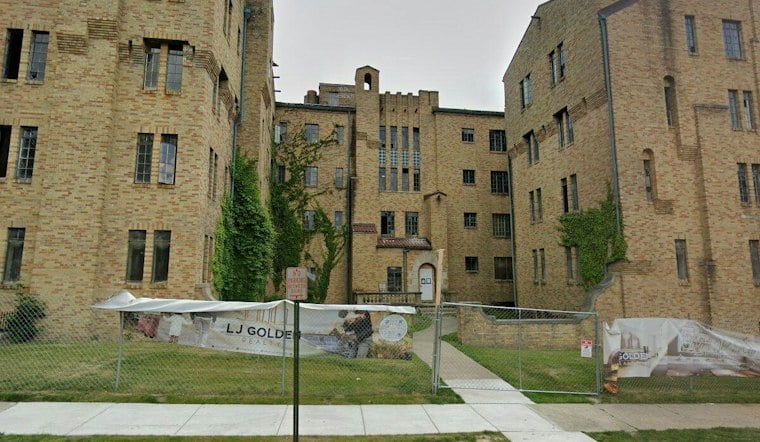
Casa del Rey, the 1929 Spanish Eclectic apartment building that sat vacant and decaying for 20 years in Pontiac's Seminole Hills neighborhood, held its grand opening this week at 111 Oneida St. The tax-foreclosed structure now holds 54 affordable apartments after a $19.5 million renovation, with rents ranging from $971 for a 350-square-foot studio to $2,100 for a 1,600-square-foot three-bedroom unit.
The building's rebirth was reported by MLive.com, which detailed the years-long path from tax foreclosure to reopening. Coleman Allen, the development firm formed by Ronita Coleman and Gregory Coleman, took on the project by partnering with the Oakland County Land Bank Authority, the Oakland Together Housing Trust Fund, the Michigan State Housing Development Authority, the Michigan Economic Development Corporation, regional lender IFF, and Cinnaire's WE Build program. Ronita Coleman said people including Jill Robinson, Amy Hovey and Robert Wittenberg helped save the project, according to the same report.
Renovation work began in November 2024 with an original budget of $15.5 million, but the project ran into serious foundation damage caused by missing downspouts, pushing the final cost to $19.5 million. That financing gap was partly closed by a $3 million low-interest loan from the Oakland Together Housing Trust Fund, a fund created in 2023 using $18 million in federal American Rescue Plan Act money supplemented by $2 million in annual county general fund appropriations, according to Model D Media.
A Financing Puzzle With Many Pieces
Regional non-profit lender IFF closed three loans totaling roughly $6.67 million in late 2024 to support Coleman Allen and 111 Oneida LLC in rehabilitating the long-vacant building, per the outlet's reporting. The Colemans, Pontiac natives and General Motors corporate executives, also contributed $724,000 in developer equity — about 5% of the project cost — which received a formal underwriting exception from the Michigan Strategic Fund tied to Ronita Coleman's participation in Cinnaire's Women Empowered to Build program, a memo reported by LJ Golden Realty shows.
Rents at the property are designed to serve individuals and families earning 60% to 120% of Oakland County's Area Median Income, which translates to annual single-person incomes between $39,790 and $79,560 under state guidelines, according to Michigan State Housing Development Authority figures cited by the same site. Oakland County Executive Dave Coulter said the county's support for Casa del Rey supports Pontiac more broadly, per MLive's reporting.
From Roaring Twenties Luxury To Tax Foreclosure
Real estate investor C.L. Groesbeck Jr. commissioned Casa del Rey in 1928 for $400,000, and when it opened in April 1929, the 41-unit complex was Pontiac's largest structure and featured the city's first residential elevator — an Otis cab detailed in bronze, red finish and leather lining, according to Detroit Architecture Photos. It was designed by Robert O. Derrick, the same architect behind Henry Ford's Greenfield Village, and was built by Pryale Construction Company during Pontiac's automotive boom.
Casa del Rey has been listed on the National Register of Historic Places since 1989. The surrounding Seminole Hills district covers 103 acres platted in the 1910s with curving streets designed around rolling topography — Pontiac's premier Garden City-influenced residential planning project, which received local historic district status in 1987, per History Loves Company.
Preserving the Building's Character
The renovated building preserves ceramic Flint Faience tiles produced by General Motors during the 1920s and early 1930s, according to MLive's reporting. The lobby now features a working fountain alongside a mural of a Latina woman created by artist Ivan Quiñones II. Units include air conditioning and ceiling fans, high-speed internet access and intercoms, wood floors and laundry facilities, and dishwashers, with some units built to be wheelchair accessible.
Coleman Allen plans to open Casa del Rey for rentals starting October 1. MLive's report also noted the renovation is expected to increase property values for nearby residents in a neighborhood that has weathered two decades of a vacant, decaying landmark at its center.
Part of a Broader County Strategy
Casa del Rey's path from blight to occupancy reflects a policy shift Oakland County made under Coulter after 2019, when it created a county land bank and housing trust fund to directly support affordable rental and workforce housing alongside its traditional homeownership programs, Model D Media reported. Before that shift, county housing funds focused almost exclusively on single-family homeownership. Roughly 95% of all properties held in the Oakland County Land Bank Authority's inventory, whose executive director is Jill Robinson, are concentrated in Pontiac, where the agency targets blighted and tax-foreclosed properties for redevelopment — Casa del Rey among them, after it was acquired through tax foreclosure and transferred to local developers.
The reopening also lands amid a statewide push to close Michigan's housing gap. MSHDA CEO Amy Hovey said in July that the state's shortage had fallen from more than 190,000 units to approximately 97,000, figures highlighted by the Office of Governor Gretchen Whitmer during the passage of new state housing legislation. That same month, Michigan enacted the Michigan Housing Opportunity Tax Credit, authorizing up to $42 million annually in state tax credits to work alongside federal low-income housing credits, with an estimated 2,500 affordable units funded per year statewide and at least 25% of credits mandated for preservation deals, according to the same office's announcement.
Casa del Rey joins other recent Pontiac housing efforts, including the 72-unit Westwood South apartments, which was also backed by a loan from the Oakland Together Housing Trust Fund. Together, the projects illustrate how Oakland County's newer funding tools are being paired with state and nonprofit financing to bring century-old buildings back into use without erasing the neighborhoods that surround them.





