

























































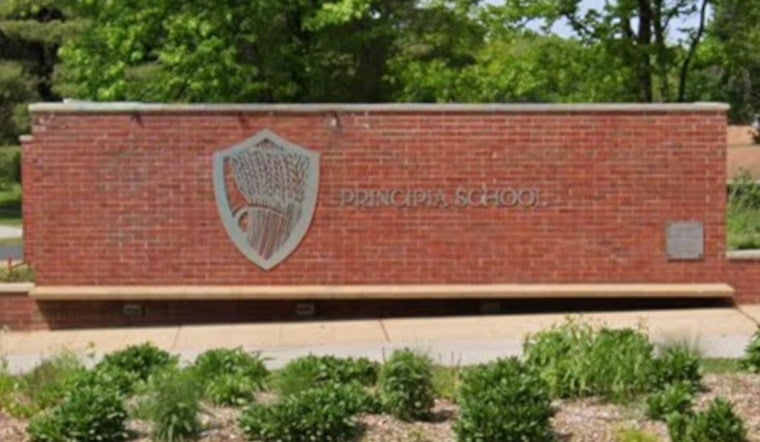
A pair of 3D-printed finger chopsticks let St. Louis disability advocate Aimee Wehmeier eat a crunchy snack by herself for what she said was the first time in her life. The device came out of a Principia School classroom in Town and Country, where 16-year-old students spent months designing and reprinting assistive tools for members of the St. Louis community living with disabilities.
The project was part of an interdisciplinary class period at Principia called CoLab, which blends chemistry, English, world history and STEM, according to St. Louis Magazine. Chemistry teacher Melaine Shedd helped oversee the student projects, which paired teams with real clients recruited through the nonprofit MO Better Foundation. Wehmeier, who lives with spinal muscular atrophy — an inherited neuromuscular disorder that destroys motor neurons in the spinal cord and occurs in roughly 1 in 10,000 to 1 in 11,000 U.S. births, per the National Institutes of Health — told the magazine she had difficulty picking up snacks like chips before the device known as Team Easy Bite's finger chopsticks came along.
Team Easy Bite, made up of students Paige Icy, Marley Dorsey and Loganne Love, worked through 11 iterations before landing on a final version of the chopsticks that let Wehmeier grip food without crushing it. Wehmeier previously spent more than a decade as CEO and President of St. Louis independent-living organization Paraquad before becoming Chief Development Officer at the Starkloff Disability Institute in January 2025, giving the team's client a deep, lived understanding of the daily obstacles the students were trying to solve.
A Second Team Built a Lifeline for a Child's Suction Machine
A second Principia team, Air Benders, designed a portable mount that allows a suction machine to attach to the stroller of a child named Izzy, who needs the machine to help prevent choking. Izzy has Batten disease, a group of rare inherited neurodegenerative disorders that the National Institute of Neurological Disorders and Stroke says affects an estimated 2 to 4 out of every 100,000 children in the United States and progressively impairs motor control and nervous system function.
Team Air Benders, which included students Alik Mboya and Mário Almeida, completed the final mount after six iterations. “Making the finals made me feel good about myself and Mário,” Mboya said, per the magazine's account of the team's reaction to reaching the international competition's finalist round.
Global Recognition for a Local Classroom Effort
Principia students submitted 17 projects total to the international competition, and two of those teams — Easy Bite and Air Benders — advanced all the way to the finals. Air Benders was named one of 49 finalist teams and advanced in the Best Use of 3D Printing category, while Easy Bite advanced to the finals in the Best Showcase of Iterative Design category.
The contest itself, known as the Make:able Challenge, is organized globally by 3D-printing education platform PrintLab and design software producer Autodesk. This year's edition included 1,200 students from 16 countries, according to PrintLab, which announced its shortlisted finalist teams on May 31 before revealing category winners on July 1. Participating school teams get access to specialized curriculum toolkits built around Autodesk design platforms like Tinkercad and Fusion 360, letting students move their assistive-device concepts from sketch to 3D print, per the Make:able Challenge.
The Nonprofit Behind the Matchmaking
The connective tissue between Principia's classroom and its clients was MO Better Foundation, a Missouri nonprofit that describes itself as a gap funder for people with physical disabilities. The organization supplies grants for daily living aids, mobility equipment and assistive technology, and it operates without accepting state or federal funding, relying instead on corporate and individual donations, according to the MO Better Foundation.
The foundation connects potential clients to student engineers through what it calls its Need Knowers outreach framework, refreshed in February 2025, which actively recruits people living with physical disabilities to submit everyday challenges — like picking up potato chips or carrying cups — for students to try to solve. Shedd said the students combined practical STEM skills with empathy over the course of the project, and Paige Icy told the magazine the work taught her empathy by forcing her to imagine how a device would actually function for someone else's body and daily routine.
Part of a Broader Pattern of Local Partnerships
This is not MO Better Foundation's first academic collaboration. In November 2023, the foundation co-funded an adapted toy build event at Saint Louis University that modified play items for local children with disabilities, distributing the customized toys through St. Louis Arc's Capable Kids and Family program. The foundation also runs a MO Better Home initiative launched in 2024 that partners with home service companies to install smart-home accessibility technology and perform safety maintenance for disabled Missourians across the state.
Principia School, founded in 1898 on a 360-acre campus in Town and Country, operates as an independent, co-educational, college-preparatory school grounded in Christian Science principles, serving students from early childhood through 12th grade in West St. Louis County. It remains unclear whether Principia's students plan to produce additional 3D prints of the chopsticks or the stroller mount for wider distribution, or whether MO Better Foundation intends to publish the digital design files so other makers elsewhere could replicate them.





