

























































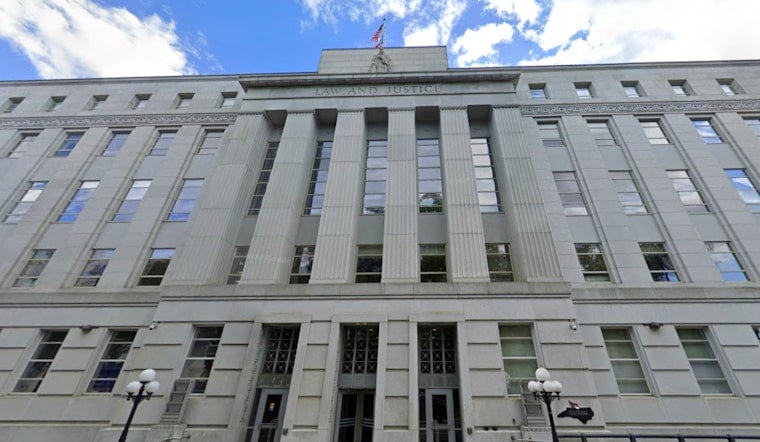
Roughly a dozen protesters gathered outside the North Carolina Supreme Court in Raleigh on Tuesday, then walked into the chambers and quietly sat in on oral arguments in a case involving the NCAA, holding a sign that read “Stop Newby's Corrupt Court.” The demonstration came as the court opened a week of oral arguments and as the sole statewide high court race on this November's ballot, between Democratic incumbent Associate Justice Anita Earls and Republican challenger Sarah Stevens, enters its final stretch.
The protest specifically targeted Chief Justice Paul Newby, a Republican, over the court's decision to uphold a Duke Energy rate hike, according to the Raleigh News & Observer. Protesters pointed out that Newby's wife holds major investments in Duke Energy. Eric Holl, an organizer with the Justice Project, said the demonstrators planned to sit quietly and did not address any specific case currently on the court's docket, but wanted the justices to know they were being watched and would be held accountable.
“The protesters believe the justices place their own interests and powerful North Carolinians above the constitution, rule of law and people,” Holl said, per the same report. The group's sign accused Newby directly of corruption, though the outlet's account did not include a response from the chief justice's office.
Earls Digital Ad Lands as Race Enters Final 55 Days
The protest unfolded the same week Anita Earls released her first digital campaign ad of the election cycle, with 55 days remaining until the midterms, the News & Observer reported. Earls, who has served as an associate justice on the North Carolina Supreme Court since 2018, is running against former state Rep. Sarah Stevens, a Republican who represented Surry and Wilkes counties in the state House. Both candidates have relied largely on social-media posts and appearances at party and campaign events rather than television advertising so far this cycle.
Money has flowed heavily toward the incumbent: Earls has outraised Stevens by a 13-to-one margin in campaign donations, according to the same News & Observer report. Stevens stepped down from her state House seat in June to focus entirely on her Supreme Court campaign, a move the paper detailed alongside her decades of legislative service representing Surry and Wilkes counties.
That resignation set off its own chain of local political changes. Stevens, who served as N.C. House Speaker Pro Tempore from 2017 to 2025, left the legislature effective June 16, and Republican officials appointed Dan Kiger on June 23 to fill her House District 90 seat, according to Carolina Journal. Hoodline previously reported that Kiger took office in time to help override several vetoes from Governor Josh Stein.
Why This Single Seat Carries Outsized Stakes
The court currently holds a 5-2 Republican majority, a balance that traces back to 2022, when North Carolina Republicans won two state Supreme Court seats and flipped control from a 4-3 Democratic majority, according to Ballotpedia. A Stevens win in November would push Republicans to a 6-1 majority, while Democrats view holding Earls' seat as essential groundwork for any attempt to flip control in 2028, when three Republican-held seats — including Chief Justice Newby's — will be on the ballot, per Southeast Politics.
Newby, currently 73, will be able to complete his term through December 2028 thanks to a 2023 law passed by the Republican-led General Assembly that raised the mandatory judicial retirement age from 72 to 76. Also on the ballot in 2028 will be the seat held by Associate Justice Phil Berger Jr., a Republican who announced on Wednesday that he will not seek reelection, though he has indicated interest in pursuing other public offices, according to WFAE. Berger Jr., the son of North Carolina Senate leader Phil Berger, has not recused himself from several major cases directly involving his father, and Hoodline previously covered his announcement and the recusal criticism attached to it.
A Court Race Shaped by Past Legal Battles
North Carolina's judicial elections have grown increasingly contentious in recent cycles. The 2024 Supreme Court race between Democrat Allison Riggs and Republican Jefferson Griffin triggered a six-month legal battle over 60,000 challenged ballots before Griffin conceded in May 2025, with Riggs ultimately winning by 734 votes after multiple recounts, according to Courthouse News.
Earls herself has faced her own prior conflict with judicial oversight bodies. In January 2024, she withdrew a federal civil rights lawsuit against the N.C. Judicial Standards Commission after the commission dismissed an ethics complaint against her tied to public comments she had made about racial diversity and implicit bias within the state judicial system, according to Carolina Public Press.
National Democrats have already thrown their weight behind Earls' reelection. U.S. Senator Elizabeth Warren headlined a sold-out N.C. Democratic Party Unity Dinner in Raleigh on August 1, promoting Earls' campaign alongside former Governor Roy Cooper's U.S. Senate bid, as Hoodline reported at the time. The North Carolina State AFL-CIO also formally endorsed Earls in June, citing her record founding the Southern Coalition for Social Justice and her dissents on rulings involving voting rights and education funding.
With the campaign's lone digital ad now airing and 55 days left before the midterms, the News & Observer's reporting frames the race as one that could determine whether North Carolina ends up with a nearly all-conservative Supreme Court. For the protesters who sat quietly through Tuesday's NCAA arguments, the message was less about any single case and more about who they believe the court is really working for.



