

























































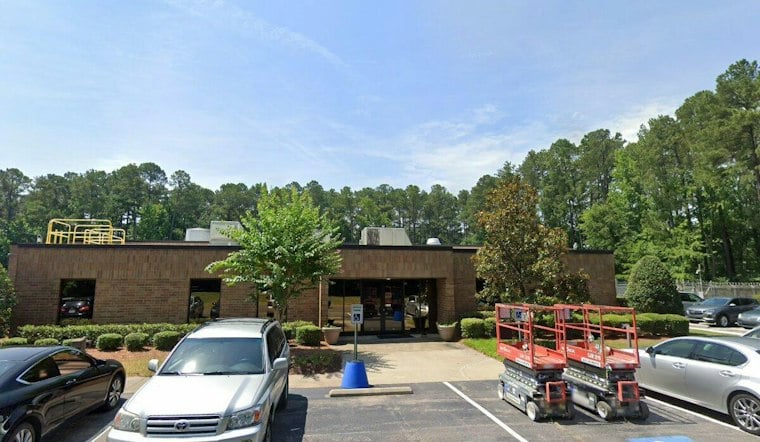
Caterpillar wants to build a roughly $1 billion manufacturing facility in Sanford, North Carolina, about 40 miles south of Raleigh, to ramp up production of compact track loaders and telehandlers. It is one of several major industrial commitments landing across the Raleigh-Durham region this year, a shift that's pulling the area's identity away from its longtime reputation as a life sciences hub and toward something broader.
Caterpillar announced plans for the Sanford facility on September 30, saying in a statement that it intends to invest approximately $1 billion in North Carolina to expand manufacturing capacity, according to Caterpillar. The company said the plant will lean on advanced manufacturing technologies, automation, digital production systems and integrated logistics capabilities. Reported job figures for the project diverge: Cushman & Wakefield describes the Lee County facility as expected to create 600 jobs, while WRAL has reported that Caterpillar does not plan to increase its workforce at the new facility.
The Caterpillar project lands amid a broader industrial surge. Cushman & Wakefield's third-quarter 2026 market report found Raleigh-Durham industrial net absorption topped 1.1 million square feet in the quarter, pushing the year-to-date total to nearly 1.7 million square feet. New leasing activity for the year reached almost 4.3 million square feet, 30.5% above the same period in 2025 and 18.5% above the market's five-year average, per the same report. Overall industrial vacancy slipped 10 basis points quarter over quarter to 9.5%, while 6.0 million square feet of industrial construction was underway, 37.6% above the five-year average, and asking rents rose 2.9% to $11.33 per square foot.
Pharma, Power and Battery Deals Stack Up
Caterpillar isn't the only company pouring money into the region. North Carolina Governor Josh Stein announced in April that AbbVie would invest $1.4 billion to build a 185-acre pharmaceutical manufacturing campus in Durham, a project expected to create 734 jobs, according to a statement from the North Carolina Governor's Office.
Siemens is also growing its footprint, with a new 131,000-square-foot Raleigh facility that will assemble integrated power delivery systems and add 100 jobs by the end of the year. Siemens has invested more than $165 million across North and South Carolina to support U.S. data center manufacturing, and the company says customer demand is at an all-time high as infrastructure upgrades are needed to meet power requirements from rising AI workloads, according to Siemens.
Near Research Triangle Park, Forge Nano broke ground in August on a factory expansion that the company expects to create about 250 manufacturing, engineering and operations jobs. The project, backed by a $100 million grant from the U.S. Department of Energy, would transform Forge Nano's existing 100,000-square-foot operation into a manufacturing campus of nearly 315,000 square feet, with production targeted for 2028, per WRAL's coverage of the chipmaker's expansion, which the outlet reported would also boost the WRAL notes is tied to national security interests. Elsewhere in the region, Vulcan Elements is developing a $1 billion rare-earth magnet facility as part of a $1.4 billion partnership with the U.S. government, and Wolfspeed is building a silicon-carbide semiconductor plant in Siler City, the same report states. In Lee County, Steris has separately unveiled a $600 million investment expected to bring 335 additional jobs, according to Cushman & Wakefield.
Research Triangle Park Opens the Door to Housing
Research Triangle Park, which opened in 1959 and bills itself as the nation's largest research and science park, is undergoing its own transformation. On June 25, present and voting members of the RTP Owners and Tenants Association unanimously approved the RTP Development Code and associated regulations, according to RTP.org. The new rules, known as RTP 3.0, unlock the ability to pursue mixed-use and residential opportunities for the first time in the Park's nearly 70-year history.
RTP officials began accepting development proposals under the new standards in July. The Park currently houses hundreds of companies across labs, data centers, life sciences facilities and corporate offices, and the updated code reflects a 50-year vision to turn the roughly 7,000-acre Park into what organizers describe as a live-work-play environment, as outlined in reporting from the Bisnow article that first tied these threads together, Bisnow reported.
From University Town to Manufacturing Destination
Garret Tripp, office managing partner at PwC Raleigh, told Bisnow that Raleigh-Durham's growth story is no longer just about universities and life sciences, and that the market shift alongside RTP 3.0 gives the region a more diversified growth story. Manufacturing commitments are creating new sources of demand across the market, and companies in industries beyond life sciences are considering Raleigh-Durham for future investment and expansion in greater numbers, per Bisnow's reporting. Tripp also said RTP 3.0 could attract workers and companies while supporting a broader real estate mix.
Raleigh-Durham still ranks among the top life sciences markets in the country — companies in that sector secured nearly $4.4 billion in venture capital funding between 2019 and 2024, ranking 13th globally, according to CBRE data cited in the Bisnow report. But the region's manufacturing investments are now estimated at nearly $140 billion based on Industrial Sage data cited in that same coverage. A ULI and PwC report ranked Raleigh-Durham the 11th U.S. market to watch in 2026 and fourth in 2027, trailing only Dallas-Fort Worth, Nashville and Miami, per Bisnow.
Matt Winters, senior managing director at JLL in Raleigh, said more companies with mission-critical needs are emerging in the market and that industry participants are excited about the greater density and wider range of permitted uses RTP 3.0 allows, according to Bisnow's reporting. The region's cost of living remains 6% below the national average, and its talent pool continues to support manufacturing growth, factors the outlet says are drawing technology, semiconductor and advanced manufacturing firms that are reshaping demand across asset types. That diversification comes as North Carolina's broader economic development pipeline has been shifting away from automotive investments, according to the Triangle Business Journal.




