

























































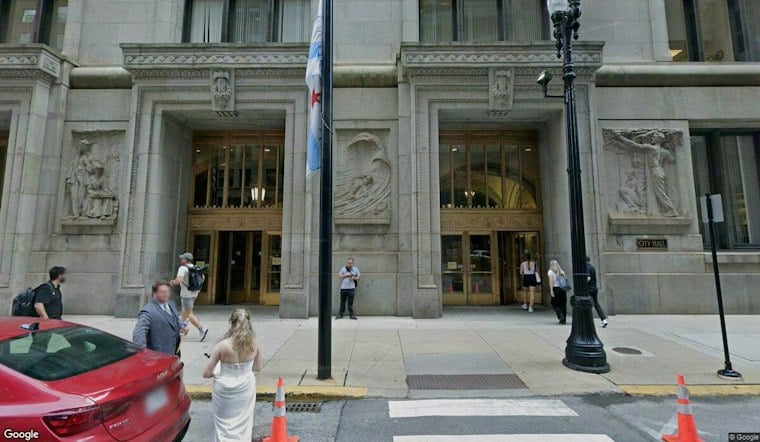
Chicago mayoral candidate Bill Quinlan filed a lawsuit in Cook County Circuit Court on Tuesday seeking to force four prominent officeholders to choose between their current jobs and a run for mayor, or risk being knocked off the ballot entirely. The suit lands exactly one week after Quinlan launched his own campaign for the city's top office.
According to Chicago Sun-Times, Quinlan is challenging the potential mayoral bids of Illinois Secretary of State Alexi Giannoulias, U.S. Representative Mike Quigley, Cook County Treasurer Maria Pappas and Board of Review Commissioner George Cardenas. He argues that the four cannot seek reelection to their current offices while also pursuing the mayoralty under Illinois' incompatible-office rule. The complaint asks the court for a declaratory judgment and an expedited hearing. As Hoodline previously reported, Quinlan entered the 2027 mayoral race citing a lack of leadership in City Hall before filing the petition challenge, according to CBS News.
The Legal Mechanism Behind the Challenge
The suit hinges on Section 10-7 of the Illinois Election Code, which mandates that any candidate who files nominating petitions for two incompatible offices must formally withdraw from one within five business days or face automatic disqualification from both ballots, per Illinois Courts. Chicago mayoral candidates must file nominating petitions by October 26, 2026 — just eight days before the November 3, 2026 election in which Giannoulias, Quigley, Pappas and Cardenas are each seeking reelection to the offices they currently hold. Quinlan's lawsuit seeks a declaratory judgment in his favor along with an expedited hearing before that November election.
The compressed calendar followed a 2024 Illinois statutory change. Lawmakers moved the start of petition signature gathering to July 28, 2026, according to WTTW News, while the Illinois State Board of Elections says many filing periods and related timelines were shifted under Public Acts 103-0586 and 103-0600. To qualify for the February 23, 2027, municipal ballot, mayoral candidates must collect at least 12,500 valid signatures from registered Chicago voters during the applicable filing window.
What the legal record shows
Illinois courts have treated incompatible-office disputes as highly dependent on the offices involved and on whether a candidate met the withdrawal deadline. In a March 11, 2025 order involving a Village of Hazel Crest mayoral candidate, the Illinois Appellate Court said the circuit court had interpreted Section 10-7 as barring certification when a candidate filed for two incompatible offices and failed to withdraw from one. In a separate 2011 Wapella case, the appellate court described village clerk and village trustee as incompatible and noted that the circuit court declined to order ballot placement after the candidate missed the withdrawal deadline, according to the Illinois Appellate Court. Those cases provide context but do not decide whether the offices targeted by Quinlan are incompatible across the election cycles at issue here. The Hazel Crest order also was issued under Supreme Court Rule 23 and was not precedent except in limited circumstances.
The ordinary petition process also differs from Quinlan's statutory theory. For the 2023 Chicago municipal election, eligible objectors had one week to challenge citywide candidates' petitions, with disputes generally moving through hearings before a hearing officer recommended a decision to election commissioners. The Chicago Sun-Times, citing a WBEZ analysis, reported 113 objections that year, the fewest for a Chicago municipal election since 1983. In a separate 2026 school-board dispute, the Chicago Board of Election Commissioners removed five candidates after challenges to signatures and paperwork, according to WBEZ Chicago—a different type of ballot challenge from Quinlan's incompatible-office claim.
Rivals Call It a Longshot and a Publicity Play
Reaction from the targeted camps was swift and dismissive. Quigley called the lawsuit a publicity stunt, while Pappas said she has not formally announced her candidacy for mayor at all, according to the Sun-Times. Cardenas, who spent 20 years as 12th Ward alderman before winning election to the Cook County Board of Review in 2022 and forming a mayoral exploratory committee in May, as Hoodline reported at the time, dismissed the suit as a desperate move to clear the field. An anonymous election law expert cited in the Sun-Times report similarly called Quinlan's legal action a longshot.
Giannoulias, for his part, released a statement focusing on Chicago safety and affordability rather than engaging directly with the lawsuit's legal claims. He enters the fight with a massive financial edge: as of June 30, 2026, Giannoulias held $21.7 million in campaign cash on hand, compared with less than $650,000 for incumbent Mayor Brandon Johnson, according to The Chicago Crusader.
Quinlan's Own Record and Motives
Quinlan, who describes himself as an election law expert and attorney, has served as an election attorney for leading Democrats and worked on Barack Obama's 2012 reelection campaign, per the Sun-Times report. He also served as attorney for fired former Chicago Public Schools CEO Pedro Martinez and represented CPS during high-stakes budget conflicts, according to CBS News, and he chairs the board of Lawrence Hall, a social service agency supporting Chicago youth affected by trauma. Quinlan has denied that the lawsuit is a publicity stunt aimed at raising his political profile, arguing instead that candidates who run for both offices risk disqualification in a way that could hand Republicans a path to those seats.
The broader mayoral field extends well beyond the four names in Quinlan's suit. Illinois Comptroller Susana Mendoza, former Chicago Housing Authority board chairman Matt Brewer and businessman Willie Wilson are among at least ten candidates who have declared bids or formed exploratory committees ahead of the February primary, according to the Daily Herald. Incumbent Mayor Brandon Johnson officially announced his own reelection campaign on September 13, despite a July University of Chicago Mansueto Institute poll finding his approval rating at just 23 percent — even after he won the 2023 runoff with 52 percent of the vote.
What a Ruling Could Mean
Any ruling from the Cook County Circuit Court on Quinlan's petition could set a significant precedent for how dual-office candidates navigate the state's newly condensed election calendar ahead of the February 2027 vote. The case also arrives against a backdrop of tightened campaign finance rules: under Chicago's 2027 candidate guidelines, registered lobbyists are barred entirely from contributing to any mayoral candidate, while separate executive orders prohibit city contractors from donating to the incumbent mayor, according to the City of Chicago Board of Ethics.
For now, none of the four targeted officials have indicated they plan to withdraw from either race. Whether Quinlan's suit forces their hand — or simply fades as another crowded-field maneuver in a mayoral contest already drawing double-digit contenders — will depend on how quickly the court agrees to hear the case before the November 3 election.





