

























































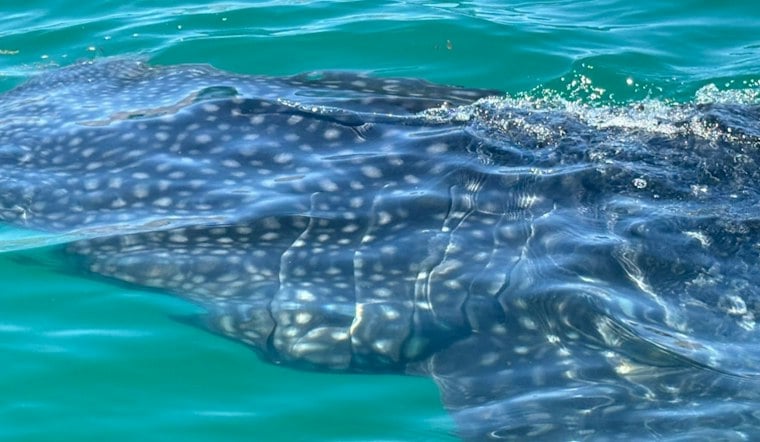
A whale shark estimated at 14 to 16 feet long was spotted swimming alone off the Malibu coast on September 9, gliding between Malibu and Santa Barbara Island in footage captured from the air. The sighting is the latest sign of an unusual influx of subtropical sea creatures moving into Southern California waters as ocean temperatures climb well above normal.
The footage was recorded by commercial fishing-industry pilot Carl Sbarounis, who told KTLA that a friend located the animal while scouting and that he flew around it to film it. Sbarounis estimated the lone whale shark at 14 to 16 feet. Whale sharks are the world's largest fish and can reach about 61 feet; they filter-feed on plankton and are not considered a threat to humans.
Sbarounis separately reported seeing hundreds or thousands of giant rays moving between San Diego and Catalina during the same period, including rays with wingspans of about 10 feet off Orange County. A separate report by SURFER Magazine described spinetail devil rays near San Diego's Nine Mile Bank. The pelagic rays, native to the Gulf of California, filter-feed on krill and zooplankton.
An Extraordinarily Strong El Niño Is Pulling Tropical Life North
The sightings coincided with an unusually strong El Niño developing in the eastern tropical Pacific, a pattern that can affect ocean temperatures and weather far beyond the tropics. Southern California coastal temperatures were running 3 to 5 degrees above average, based on data provided by the National Oceanic and Atmospheric Administration. NOAA Fisheries has separately reported that El Niño can warm nearshore surface waters along the U.S. West Coast through atmospheric and oceanic teleconnections, raising sea surface temperatures from Baja California to Alaska.
What the Sighting Shows—and What It Does Not
Whale sharks are generally associated with tropical and warm-temperate waters, so the Malibu observation is unusual for Southern California but consistent with a broader pattern in which warmer waters can carry subtropical and tropical plankton and fish north. According to Scripps Institution of Oceanography, warmer waters off North America can produce such influxes, although that pattern does not establish why this individual shark moved into the area. Scripps researchers recorded 36 new and rarely seen species in California waters during the 2014–2018 Blob years. The September 9 aerial footage supports the reported estimate of the animal's size, its location and its solitary surface behavior, but it does not provide a tag or in-water examination. Those limits mean the observation alone cannot establish the shark's travel route, seasonal range or cause of movement. NOAA's California Current Integrated Ecosystem Assessment says satellites, surveys and scientists continually monitor the region; the agency also reports that marine heatwaves occurred every year from 2019 through 2025, with six of those seven events ranking among the largest recorded in the region since monitoring began in 1982.
Nearshore sea surface temperatures off Southern California were unusually high during the developing El Niño and regional marine heatwave conditions, according to SURFER Magazine. The article cites Dr. Chris Lowe's assessment that strong El Niño events can bring subtropical visitors from Mexico into Southern California and, on occasion, species such as bull and tiger sharks. That broad relationship does not by itself establish that El Niño caused this individual whale shark to appear off Malibu.
Boaters Warned to Slow Down Around Surface Feeders
Lowe cautioned that boaters should be careful around surface-feeding whale sharks, saying a high-speed collision can be severe. Whale sharks can dive to depths of up to about 6,326 feet but also spend extended periods feeding near the surface, making vessel strikes one of their primary global threats alongside fisheries bycatch, according to the Virginia Institute of Marine Science. NOAA Fisheries advises mariners to remain vigilant, follow speed zones and signage, and slow down where large marine animals may be present.
The Florida Museum of Natural History identifies the whale shark's IUCN Red List status as vulnerable. Whale sharks have been protected from unregulated international trade under CITES Appendix II since 2003, and conservation groups have pushed to upgrade them to Appendix I, a stricter listing that would ban international commercial trade in whale shark fins and meat, per NOAA Fisheries.
Not the First Time — But Still Rare
Not the First Time — But Still Rare Whale sharks have turned up off Southern California before during previous warm-water anomalies, including a December 2023 sighting off Santa Catalina Island and a September 2022 sighting off Point Loma in San Diego, according to Cal State Long Beach. The species is generally associated with tropical and warm-temperate seas, making the Malibu appearance unusual. Hoodline previously reported on a rare hammerhead near Malibu Pier in August, when a local fisherman captured video of the shark amid the same warming trend.
Nate Jaros, vice president of animal care at the Aquarium of the Pacific in Long Beach, expects the unusual sea life to stick around through September and into early October before subtropical pelagic species follow cooling water back south. Jaros said the influx of tropical sea life will be temporary, the station reports. Warmer water months tend to lag behind air temperature months, which helps explain why the ocean is still heating up even as the season turns.
Warming Waters Are Reshuffling Native Species Too
The same warm-water surge that's drawing subtropical visitors north is also disrupting species that already call Southern California home. Research has reported that juvenile white sharks can temporarily depart their established nearshore nursery grounds, with abrupt cooling suspected as a factor, since shallow Southern California beaches serve as the primary nursery for Northeastern Pacific juvenile white sharks. Hoodline covered that shift in an earlier report on baby great whites fleeing San Diego.
Past strong El Niño cycles have brought an entire subtropical food chain northward, including gamefish like yellowfin tuna and mahi-mahi, pelagic red crabs, and the predators that follow them, a pattern documented during the 2015 El Niño by the LA Times. The possibility of yellow-bellied sea snakes approaching Southern California has also been discussed during the current El Niño. For now, marine officials are treating the whale shark and its traveling companions as visible evidence of a much larger, temporary shift moving through Southern California's waters.




