

























































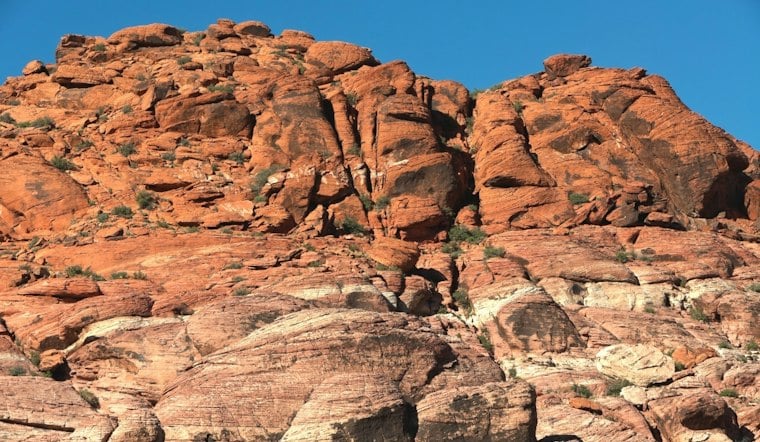
Wild mustangs used to be a common sight in Red Rock Canyon back in the early 1990s, grazing the desert scrub just west of Las Vegas the way their ancestors had for thousands of years. Today there are none. The Bureau of Land Management removed the herds decades ago, promised they would come back, and never followed through — a broken pledge that still stings advocates who have watched the fight play out across Nevada's rangelands.
The story of Red Rock's vanished mustangs was chronicled by KLAS 8 News Now, whose Mystery Wire team traced the herd's removal back to concerns over overgrazing. According to the station's reporting, the Bureau of Land Management said the horses had to be pulled from the canyon to save local grasses, with officials at the time promising the animals would eventually be returned to the range. That return never happened: the initial removal took place more than 30 years ago, and in 2005 the few remaining horses were removed, per the same report.
The station's account ties the disappearance to a cascading ecological problem. Overgrowth of brush in the absence of grazing horses turned the area into a fire hazard, and in 2005 a wildfire in Goodsprings tore through 30,000 acres. The Bureau of Land Management blamed high grasses for that fire and used it as justification to remove the few remaining wild horses still left in the area that year, the station reported.
A Local Advocate Pushed Back
Not everyone accepted that the removals solved the problem. Robbie Franks argued in 2009 that pulling the horses out of Red Rock Canyon had itself created a fire hazard, according to the station's report — an inversion of the government's own rationale that has echoed through wild horse advocacy circles ever since. That same year, journalist George Knapp chronicled the broader plight of Nevada's wild horses in the investigative special Stampede to Oblivion, examining how years of neglect and mixed messages out of Washington, D.C. had pushed wild mustangs in the state toward near-destruction.
The legal backdrop for all of this dates to Congress's unanimous passage of protective legislation in the early 1970s. President Richard Nixon signed the Wild and Free-Roaming Horses and Burros Act into law on December 15, 1971, declaring wild equines “living symbols of the historic and pioneer spirit of the West,” according to Return to Freedom. The law followed a nationwide campaign led by Nevada activist Velma Bronn “Wild Horse Annie” Johnston and was meant to protect wild horses and burros, though federal land agencies also used capture and removal to manage populations. Federal land agencies, however, are also bound to maintain what regulations call a “thriving natural ecological balance” across public lands shared with grazing, recreation, and wildlife, a tension that has shaped decades of management decisions in fragile desert habitats.
Nevada Still Carries the Weight of the National Crisis
Red Rock's empty range sits inside a much bigger statewide reckoning. Nevada is home to more than 35,000 wild horses and burros according to 2025 estimates, according to The Fallon Post. Nevada holds more than 23 million acres of public land open to wild equines, twice as much as any other Western state, but the mismatch between population and capacity has only grown more acute.
Within Red Rock's own Herd Management Area, the numbers are stark. The zone covers nearly 560,000 acres, yet the Bureau of Land Management's target Appropriate Management Level allows for just 16 to 27 wild horses and 29 to 49 wild burros, according to The Cloud Foundation. At the high end of that range, it works out to roughly one horse per 5,900 acres of desert terrain.
Water scarcity compounds the problem. Developing new water sources for wild equines in Southern Nevada is legally restricted because groundwater in the Las Vegas Valley basin has been over-appropriated for decades and closed to new water rights applications by the Nevada State Engineer, according to research published through Utah State University's Digital Commons.
The Cost of Managing Horses Off the Range
The financial toll of removing horses rather than managing them in place has become its own crisis. In fiscal year 2024, the Bureau of Land Management spent $101 million — 66% of its total $153 million Wild Horse and Burro Program budget — solely on housing captured animals in off-range holding facilities. Short-term corrals run about $6 per horse per day, compared with $2.35 per day in long-term pastures, per the agency's own figures.
The agency's Adoption Incentive Program, launched in 2019, offers approved adopters $1,000 for an untrained wild horse or burro.
A New Federal Bet on Fertility Control
Facing mounting costs and concerns about wild horse population growth, the Bureau of Land Management announced a $30 million investment on September 21 to expand fertility control nationwide, according to KNPR. Whether that investment reaches habitats like Red Rock Canyon in time to matter for its long-absent herd remains to be seen, but for advocates who have spent decades pointing to the empty range west of Las Vegas, it marks at least an acknowledgment that roundups alone haven't solved the underlying problem.





