

























































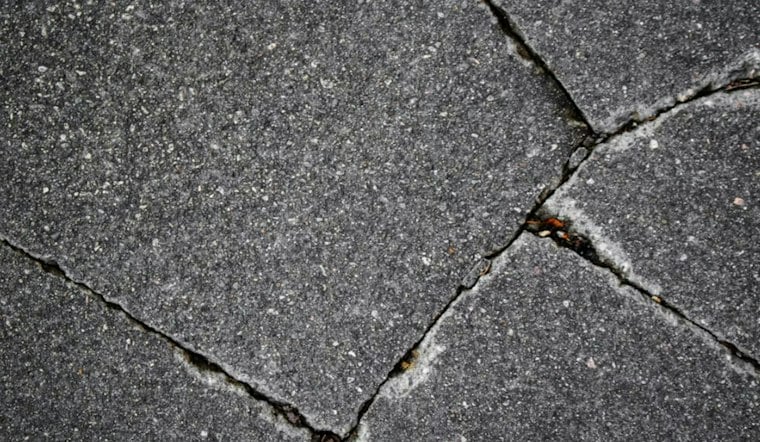
Sidewalks in the Rolling Ridge Club neighborhood have buckled so badly that some slabs now rise four to six inches off the ground, and San Antonio has told the homeowners living beside them that fixing the problem is their responsibility, not the city's. Residents say they've largely given up walking on the cracked concrete altogether, opting instead to walk in the street.
Tree Roots and Cracked Concrete Push Neighbors Into the Street
According to KSAT, tree roots have been pushing sidewalk panels off the ground throughout the neighborhood, leaving behind uneven slabs that many residents consider hazardous. The station reports that many Rolling Ridge Club residents have simply stopped using the sidewalks in front of their homes, choosing instead to walk in the street to avoid tripping on the raised concrete.
An HOA leader in the neighborhood filed a 311 complaint with the city over the damaged walkways, per the same KSAT report, only to have the city deny the request. When the HOA leader filed a second 311 complaint, the city denied that one too, according to the station's account of the dispute.
City Code Places the Burden on Homeowners
City officials point to San Antonio's own municipal code as the basis for the denials. Per the City of San Antonio's Code of Ordinances Section 29-11, abutting property owners are primarily liable for defective sidewalks, curbs, parkways, and driveways next to their property, and they must indemnify the city against any resulting personal injury or property damage claims. That legal framework is why San Antonio's 311 system routinely denies repair requests like the one filed by the Rolling Ridge Club HOA leader.
The stakes for ignoring that duty go beyond a denied complaint. Under the City of San Antonio's Code Sec. 6-1, property owners who fail to maintain clear and safe sidewalks or remove hazards can face municipal citations, with fines reaching up to $500 per violation under Section 1-5. Legal analysis from Ryan Orsatti Law notes that because Chapter 29 assigns primary maintenance duty to abutting owners, slip-and-fall lawsuit liability generally targets homeowners rather than the city, making documentation of any repair notices critical if a case ends up in court.
A Rebate Program With Limits, and a Budget Stretched Thin
San Antonio does offer some financial help. The city's Public Works department runs an annual Sidewalk Rebate Program that provides eligible property owners partial rebates of up to $3,000 to offset the cost of hiring licensed contractors for sidewalk and curb repairs, distributed on a first-come, first-served basis, according to the City of San Antonio for Fiscal Year 2026.
That $3,000 cap sits against a citywide budget that leans heavily toward new construction rather than fixing what already exists. San Antonio's proposed FY 2026 budget allocates $17 million to sidewalk improvements, but $12 million of that is dedicated to building 21 new miles of sidewalk, while only $5 million is set aside to repair 11 miles of existing sidewalks across a network spanning 5,662 miles citywide, per the City of San Antonio's Proposed Operating & Capital Budget. San Antonio plans to spend that $5 million on the city's worst sidewalks next year, according to KSAT's reporting.
Complicating things further, the city's own budget data shows there are 1,370 “gap miles” where sidewalks were never built in the first place, a structural deficit that competes directly with existing maintenance needs for the same limited pool of money, per the same city budget document.
Neighbors Want a Voice in How the Money Gets Spent
The frustration in Rolling Ridge Club isn't happening in isolation. Public Works has received more than 600 sidewalk-related 311 service requests between January 2024 and October 2025, a volume that the station's report frames as evidence of widespread dissatisfaction with sidewalk conditions across San Antonio.
District 1 Councilwoman Dr. Sukh Kaur said in October 2025 that her district alone had more than 200 pending sidewalk repair requests, and she pointed out that asking homeowners to pay thousands of dollars for repairs creates equity problems in older neighborhoods, where developers originally left out sidewalks or where mature trees have since destroyed the concrete, according to KSAT. Rolling Ridge Club residents say they want a seat at the table as the city prepares its sidewalk spending, hoping to shape decisions before the next round of repairs is finalized.
How Other Cities Handle the Same Root Problem
San Antonio isn't the only Texas city leaning on homeowners. Houston and Dallas follow a similar model of assigning sidewalk repair responsibility to property owners, but other cities have taken a different path. Denver has shifted maintenance costs onto municipal government through dedicated fee funds, while Parma, Ohio, passed measures making its service department responsible for repairs caused by city tree roots, according to SidewalkRepairRules.com. Hoodline previously reported on that Ohio policy shift in Parma yanking sidewalk bills from homeowners.
San Antonio's reluctance to take on the full cost has deep roots of its own. City capital planning estimates reported by the San Antonio Express-News in January 2018 found that completing the city's nearly 2,000 missing sidewalk miles would cost roughly $1 billion and take up to 50 years to finish under standard annual budget allocations, a figure that helps explain why municipal leaders have resisted assuming complete financial responsibility for residential sidewalk upkeep.
For now, the Rolling Ridge Club dispute mirrors a similar fight playing out elsewhere, including a Tulsa homeowner recently facing fines over a sidewalk buckled by a nearby tree. Until San Antonio's funding formula changes, homeowners like those in Rolling Ridge Club remain stuck between a $3,000 rebate cap, potential $500 fines, and sidewalks that neighbors say they can no longer safely walk on.




