

























































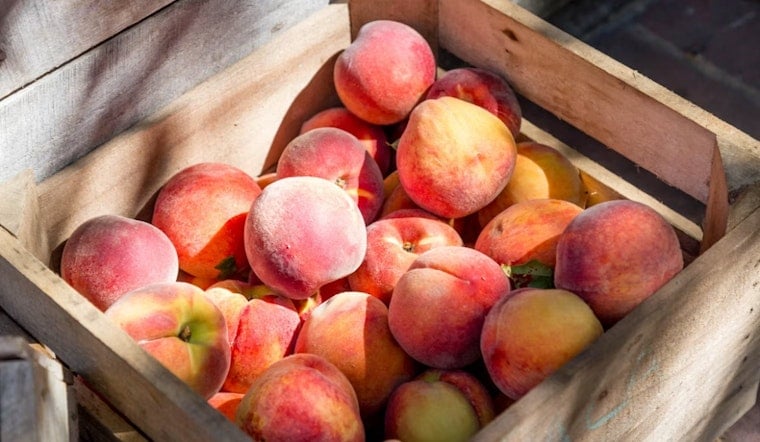
The Romeo Peach Festival kicked off last Thursday and rolls on through Labor Day, marking the 95th year that the Macomb County village has turned its downtown into a celebration of carnival rides, live music and, of course, peaches. The five-day event wraps up its run with a children's parade at 10 a.m. Monday, a hometown parade at 1:30 p.m., and a live performance from 2XL Band later that evening.
The festival, which takes place in Romeo, Michigan, has evolved into a major end-of-summer community tradition, according to ClickOnDetroit, whose reporting on this year's schedule includes carnival rides, live entertainment and food and drink options spread across downtown streets. The outlet also notes the event includes a Kids Market that gives young entrepreneurs a chance to develop their own business ideas. The festival originated as a celebration of the end of the peach harvest and got its start in 1931, the station reports.
A Tradition Nearly a Century in the Making
That 1931 founding makes the Romeo Peach Festival the second-oldest continuous festival in Michigan, according to the Romeo Community Archives, which notes that local merchants and growers originally created the event to promote peach sales. Over its 95-year history, the festival has been called off only twice — once from 1942 to 1945 during World War II, and again in 2020 because of the COVID-19 pandemic, per the same archival account. The 89th annual festival paused that year before resuming.
The festival's survival wasn't guaranteed. A funding crisis in 1951 threatened to end the tradition altogether until the nonprofit Romeo Lions Club stepped in to take over complete organization, planning and financial sponsorship, the Romeo Community Archives account explains. Lions Club members still organize and maintain the main festival fields today, a volunteer structure that has kept the event running for generations.
Deep Roots in Macomb County Orchards
Romeo's connection to peaches runs back further than the festival itself. Commercial peach cultivation in Macomb County dates to the early 1800s, when settler Michael Bowerman brought peach pits from New York, according to People Driven Credit Union. That early planting helped Romeo grow into a regional hub producing hundreds of thousands of bushels annually by the early 1900s, fueled by roadside stands and commercial orchards.
Today, Michigan ranks seventh among U.S. states in peach production, harvesting an estimated 8,500 tons annually according to 2025 USDA agricultural data cited by State Symbols — well behind California, the national leader at 520,000 tons a year. One of the region's key suppliers, Westview Orchards, a 200-acre sesquicentennial family farm in neighboring Washington Township that provides peaches and baked goods for the festival, was awarded the Michigan Agritourism Association's 2025 Excellence in Agritourism Award, according to the Michigan Farm Bureau. The farm is operated by sixth-generation family members.
Parades, Bed Races and a Peach Queen Past
The festival's estimated 25,000 visitors over Labor Day weekend fill downtown Romeo, where streets are closed for vendor booths and main events, according to Lake.com. Among the most distinctive local traditions are the annual Peach Festival Bed Races, held along East Lafayette Street on the Saturday before Labor Day, in which teams build and race decorated beds down village streets.
The festival hasn't always centered on parades and rides. From 1931 to 1973, it featured a Miss Romeo pageant and Peach Queen competition drawing 11 contestants from Macomb, Oakland, St. Clair, Lapeer and Genesee counties, per the Romeo Community Archives. Three local Romeo contestants won the overall Peach Queen title during that era, though the pageant tradition eventually gave way to the family-oriented parades and entertainment that define the festival today.
Romeo's appetite for community events doesn't stop at Labor Day. The village is also known for “Terror on Tillson Street,” where roughly 30 neighboring homes decorate for Halloween and hand out more than 60,000 pieces of candy each year, according to WCSX. The village itself was once known as Indian Village and Hoxie's Settlement before adopting the name Romeo in 1838.




