

























































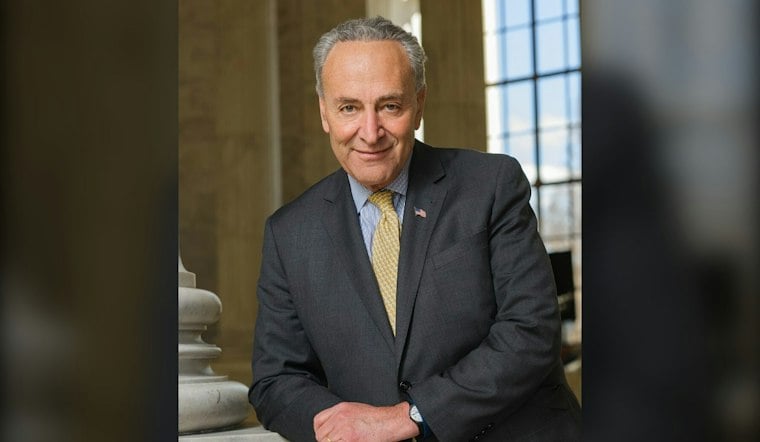
Resurfaced comments from Senate Democratic leader Chuck Schumer defining antisemitism as denying Jewish people the right to a state of their own are colliding with the records of two of the party's most closely watched figures: New York City Mayor Zohran Mamdani and Michigan Senate nominee Abdul El-Sayed. Both men have spent months fielding accusations that their positions on Israel cross into antisemitic territory, even as both insist they oppose bigotry against Jews and distinguish their criticism from hatred.
Schumer's Resurfaced Remarks
According to a report from the New York Post, Schumer said in a resurfaced video that people who do not believe Jewish people should have a state are antisemites, adding that if every other people should have their own state but Jewish people should not, that is antisemitic. The remarks came from a New York Public Library event tied to Schumer's book, Antisemitism in America, A Warning. The Post's report framed those comments as potentially applying to both Mamdani, the mayor of New York City, and El-Sayed, Michigan's Democratic Senate candidate, though Schumer's office reportedly had no immediate comment on the comparison.
Mamdani has previously declined to say whether Israel should exist specifically as a Jewish state, per the seed reporting cited above, while separately saying in 2025 that Israel has a right to exist with equal rights for all in New York City. He has also supported the boycott, divestment and sanctions campaign against Israel and accused Israel of committing genocide in Gaza, according to the same account. Mamdani's office had no immediate comment, the report noted.
Mamdani's Antisemitism Record As Mayor
As mayor, Mamdani revoked New York City's implementation of the International Holocaust Remembrance Alliance definition of antisemitism on January 1, a move confirmed by the Times of Israel. He did not eliminate the city's Office to Combat Antisemitism, the outlet reported, and he said at the time that officials must distinguish between antisemitism and criticism of the Israeli government. Mamdani skipped New York's Salute to Israel Day Parade this year and has called for the arrest of Israeli Prime Minister Benjamin Netanyahu over alleged war crimes in Gaza, saying he himself lacked the authority to make such an arrest and instead calling on the federal government to do so, according to a separate report from CBS News New York.
Netanyahu has accused Mamdani of being an antisemite himself, saying the mayor fanned the flames of hatred and made New York City less safe for Jews. Mamdani has pushed back directly, telling CBS News New York that there's no tolerance for antisemitism in the city and that he supports Jewish New Yorkers with zero tolerance for bigotry.
El-Sayed's Gaza Language and Jewish Outreach
In Michigan, El-Sayed has criticized sending U.S. money to Israel for what he calls genocide and apartheid instead of investing in American children, and has called for ending both offensive and defensive U.S. military aid to Israel, according to the New York Post report and the Guardian's coverage of his candidacy.
In an interview, El-Sayed said he disputes the idea that any country should be an ethno-state, extending that skepticism to Egypt and Saudi Arabia as well as Israel. He said the question of whether Israel has a right to exist is secondary to whether it has a right to U.S. tax dollars, adding that Israel exists, that its existence is not a question, and that he would not participate in what he called a gotcha game on the subject. He said everyone should have equal rights to peace, dignity and self-determination, and his campaign had no immediate comment beyond those remarks, per the Post's reporting.
A Fragile Coalition and a Close Race
El-Sayed is the Democratic Party's nominee for Michigan's open Senate seat in November's midterm elections, having won the primary by roughly 15,000 votes, as the Guardian reported. That same account noted he lost Oak Park's Oakland County precinct, home to a significant Jewish population, to Haley Stevens by nearly 20,000 votes during the primary. Polls have since put El-Sayed and Republican opponent Mike Rogers in a dead heat, the paper reported, underscoring how consequential the Jewish vote could be in a race this tight.
El-Sayed has also declined to endorse the Democratic Party's traditional two-state solution platform without qualification, telling Michigan's Jewish Democratic caucus he was open to a two-state outcome only if both Palestinians and Jewish Israelis chose it, according to the Jewish Telegraphic Agency. At that same late-August meeting he apologized for past comments made after the March attack on Temple Israel, telling the caucus, “I made a mistake.” He has since expanded his outreach to Jewish voters, the outlet reported, and said in a subsequent JTA report that antisemitism had increased and that protecting Jewish Americans was critical.
That outreach has not quieted internal Democratic divisions. A petition led by Michigan Jewish clergy is pressing El-Sayed to moderate his views on Israel and speak more forcefully in support of Jews, the wire service reported. At the same time, a group of Jewish liberals gathered 900 signatures pledging to vote for El-Sayed, compared with 524 signatures on a competing letter backing Rogers, according to the same JTA account. Jewish Voice for Peace endorsed El-Sayed in June, its first political endorsement ever, the Guardian noted, while El-Sayed separately moved to distance his campaign from commentator Hasan Piker in August after Piker suggested American Jews' support for Israel could worsen antisemitism and invite violence, according to CNN.
The debate over where legitimate criticism of Israel ends and antisemitism begins was also on display during the week of September 21–27 at the New York Public Library, which hosted an event for author Benjamin Moser, who wrote Anti-Zionism, A Jewish History and likened the Jewish state to a dog shelter, per the seed reporting. The library said it presents diverse viewpoints on controversial topics. The event added another flashpoint to a debate that shows no sign of settling before Michigan and New York voters head to the polls.





