

























































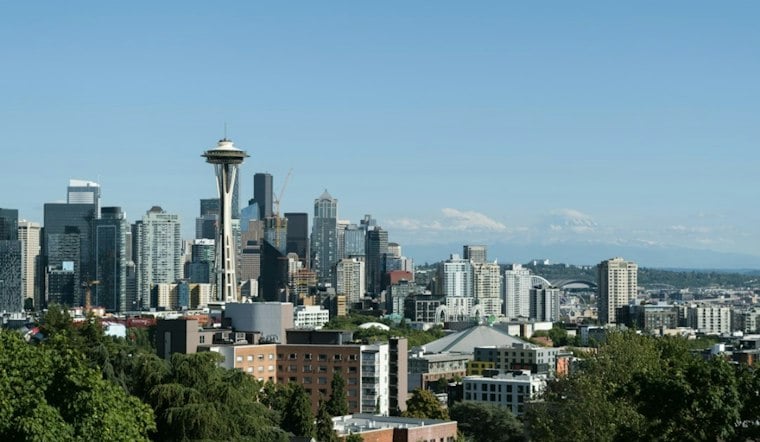
Seattle just landed among the five best cities on the planet, according to a sweeping new global ranking that measured 1,000 cities across everything from economic muscle to quality of life. The Emerald City came in fourth overall with a score of 92.8 out of 100, trailing only New York, London and Paris.
The ranking comes from Oxford Economics' 2026 Global Cities Index, which evaluated 1,000 cities worldwide and combined scores from five categories, according to KIRO 7 News Seattle. Those categories, per Oxford Economics, are economics, human capital, quality of life, environment and governance, all folded into one holistic score meant to capture a city's overall strengths and weaknesses.
New York took first place overall, with London second and Paris third, KIRO 7 reports. Seattle's economic score came in at 89.8, strong enough to crack the top tier of the index but still behind New York, Los Angeles and San Jose, all of which outranked Seattle economically, according to the station's report.
A City of Strengths and One Glaring Weak Spot
Seattle's category breakdown tells a lopsided story. The city ranked 22nd for quality of life, 28th for environment and 47th for human capital, per the same account, numbers strong enough to help push its overall score into the top five worldwide.
But governance is where Seattle stumbles hard, ranking a startling 198th in that category, the report notes. That gap between Seattle's polished quality-of-life numbers and its governance standing is one of the more striking wrinkles in an otherwise glowing result for the city.
Oxford Economics says the index is designed to give a data-driven, forward-looking view of cities' relative strengths, weaknesses and future potential, and to help businesses, governments and investors compare cities and weigh their opportunities and challenges. Seattle's showing suggests it excels on livability and economic firepower even as its governance metrics lag far behind peer cities.
Why Seattle's Quality of Life Score Stands Out
Beyond the numbers, BBC Travel points to specific cultural touchstones behind Seattle's strong quality-of-life showing, citing the Seattle Art Museum and the city's grunge music history, which produced bands like Nirvana and Pearl Jam. BBC Travel also notes that Seattle recently completed its 20-acre Waterfront Park along Puget Sound, a project that adds to the city's appeal on the livability side of the ledger.
San Jose, meanwhile, ranked eighth overall in the same index, according to BBC Travel, giving the Pacific Northwest and Northern California a strong showing among the world's top ten cities.
How Seattle Stacks Up Against Portland
Just down Interstate 5, Portland landed 53rd overall, a far cry from Seattle's fourth-place finish, per KIRO 7's report. Portland's category scores show a similarly uneven pattern to Seattle's, ranking 41st for economics and 31st for environment, but falling to 116th for human capital, 145th for quality of life and 198th for governance, matching Seattle's governance rank exactly.
The comparison underscores how governance appears to be a regional soft spot, even as both Pacific Northwest cities post solid marks elsewhere. Oxford Economics has said the index also tracks broader global shifts, noting that cities across Europe and North America still hold 78 of the top 100 spots this year, even as major cities across Asia increasingly dominate global growth trends. Cities including Shenzhen, Taipei, Kuala Lumpur and Ho Chi Minh City reflect that eastward shift in economic activity, the firm says, while Shanghai, Beijing and Delhi sit outside the top 100 despite being projected for some of the largest GDP increases through 2050.
Dubai and Riyadh broke into the index's global top 50 for the first time this year, according to Oxford Economics, part of a broader reshuffling atop the rankings. For Seattle, though, the headline remains its spot among the world's elite five cities, buoyed by strong scores in nearly every category except the one that governs how the city runs itself.





