

























































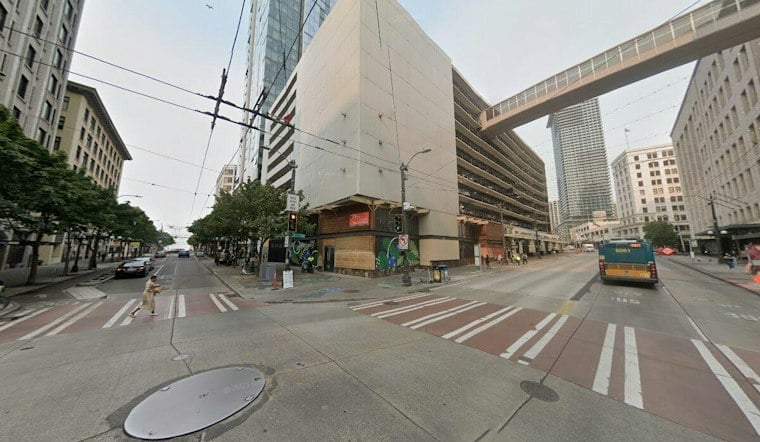
Alrick Hollingsworth is back in custody less than seven months after leaving Washington state prison, facing a Bellevue gun case and a separate first-degree assault case tied to an alleged shooting in Federal Way. The allegations have not been resolved in court.
The new cases put renewed focus on the sentence Hollingsworth received for the 2016 downtown Seattle shooting, and on the distinction between a judge’s sentence, prison credit and the date a person actually leaves state custody.
A below-range sentence preceded the release
Hollingsworth was 18 when he wounded five people near a bus stop at Third Avenue and Pine Street on Nov. 9, 2016. After remaining at large for about five months, he surrendered, according to contemporaneous reporting by KIRO 7. He was later convicted of first-degree assault with a deadly weapon.
In March 2019, King County Superior Court Judge Averil Rothrock imposed a nine-year sentence—below the standard range of 12.75 to 15.25 years and below the 15 years prosecutors had requested, according to KIRO 7. The report said Rothrock emphasized Hollingsworth’s age and the possibility that he could change.
That decision was outside the usual sentencing range, but not outside Washington’s sentencing framework. The Washington State Caseload Forecast Council says the standard range is presumed appropriate in a typical felony case and that an exceptional sentence requires substantial and compelling reasons. In fiscal year 2025, 75.2% of adult felony sentences fell within the standard range; 9.7% were exceptional sentences, and most of those reduced confinement below the standard range, according to the council’s annual statistical summary.
Hollingsworth ultimately served six years, 10 months and 14 days of the nine-year term, according to FOX 13 Seattle. The sentence imposed by the court and the time served are separate parts of the process; prison misconduct can affect earned credit and release calculations.
Corrections decisions weigh conduct and risk
Washington Department of Corrections materials say custody levels and facility placements are determined through an objective scoring system that considers an incarcerated person’s progress and risks to the community, staff, other incarcerated people, visitors and prison operations. The department also says custody designations take account of infraction behavior and program behavior.
FOX 13 reported, citing corrections records, that Hollingsworth lost earned credit after three physical-fighting infractions and an incident involving a fire started with torn Bible pages. Those infractions delayed his release compared with an earlier projected date, but he left custody on Feb. 12, 2026, after serving less than the nine-year sentence.
The department separately states that people under its supervision may not own, use or possess firearms, ammunition or explosives. That rule is distinct from any new criminal case, which must be resolved through the courts.
The new allegations
On Aug. 7, Bellevue officers arrested Hollingsworth after responding to a weapons-related call. FOX 13 reported that officers found a loaded Taurus .45-caliber handgun, including a round in the chamber, and that he was booked on allegations of unlawful possession of a firearm and resisting arrest. He was being held on $100,000 bail, according to the report.
The Bellevue case is separate from the Federal Way matter. A Crime Stoppers tip reportedly linked Hollingsworth to surveillance footage from a June 16 shooting, and prosecutors have charged him with first-degree assault and unlawful possession of a firearm in that case, according to FOX 13. He is scheduled to appear in King County Superior Court on Sept. 28.
Those are allegations, not findings that Hollingsworth committed either new offense. The available account does not establish what happened during the Federal Way shooting, whether the firearm allegations will be proved, or how the cases will affect his supervision status.
The locations have separate crime histories
The original Seattle shooting occurred at an intersection with a documented history of serious violence, but individual incidents do not establish a broader trend. In a separate Jan. 22, 2020, shooting at Third Avenue and Pine Street, Seattle police said seven people were injured and one woman was killed; witnesses reported that two or more men were shooting at each other, according to the Seattle Police Department.
More recent aggregate data point in a different direction for the surrounding jurisdictions. KOMO News, citing Seattle’s year-end crime dashboard, reported that violent crime in the downtown core fell 15% year over year in 2025. Federal Way reported that overall crime declined 21% during the first six months of 2026 compared with the same period in 2025, while shots-fired incidents declined 22%, according to the city government.
Those figures describe broad citywide or downtown patterns, not the merits of Hollingsworth’s pending cases. The immediate legal questions are narrower: whether prosecutors can prove the Bellevue and Federal Way allegations, and how the new cases will be handled in light of his prior conviction and release from state custody.





