

























































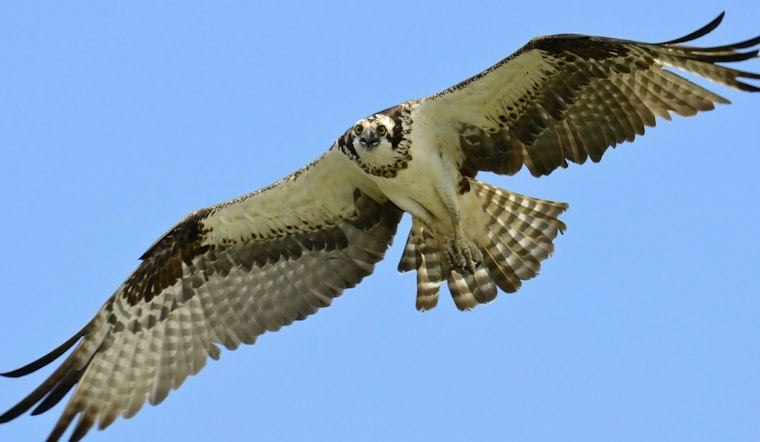
Osprey nests along the Severn River near Annapolis produced almost no surviving young this year, with researchers documenting six nestlings among 37 active breeding nests; later observations indicated that only three reached fledgling age. It is the second consecutive year of collapse for a bird that has long symbolized the Chesapeake Bay's recovery from the pesticide era, and researchers suspect food stress is a major factor, while storms, predators, disturbance and heat also contribute to nest failures.
The Severn River figures come from a survey of 101 osprey nests along the river by Eco-Ed Endeavors, as reported by CBS Baltimore. The Center for Conservation Biology at William and Mary has separately documented osprey declines elsewhere along the Eastern Shore. The station reports that Chesapeake Bay osprey breeding productivity reached new lows in 2026, with reproductive rates falling below 50% of the level needed for the population to sustain itself. Researchers require approximately 1.15 young per breeding nest for the population to hold steady, according to the same report, and the Center for Conservation Biology now expects the Bay's osprey population to decline by an average of 14% a year, a trajectory that could cut numbers in half within a decade.
On the Severn River specifically, productivity measured just 0.08 young per breeding nest in 2026, according to CBS Baltimore's reporting. That figure lines up almost exactly with independent local monitoring: Eye On Annapolis reported this month that the river's 0.08 young-per-nest rate this year followed an already depressed 0.16 in 2025, confirming a second straight year of widespread reproductive failure. Volunteer observers and students monitored 101 nesting structures along the river in 2026, per that outlet.
A Dwindling Food Source
CBS Baltimore's report ties the die-off to a sharp decline in Atlantic menhaden, the small, oily fish that makes up the bulk of an osprey's diet. Menhaden populations have fallen by more than 80% in some Bay areas since the 1980s, the station reports, and osprey diets built around the fish have declined by half. Experts cited in that reporting think the shortage may stem from possible climate effects, changes in commercial harvesting, or menhaden simply arriving in the Bay later than in past years — sometimes not until June or July, well after ospreys need abundant fish during their critical April, May and June breeding window.
The station's report also notes that food stress shows up as high rates of females failing to lay clutches at all, along with low provisioning rates once chicks hatch, leaving young birds emaciated with stunted development. Other stressors — storms, predators, human disturbance and heat — contribute to nest failures, per the same account, but researchers point to food scarcity as the primary driver of the 2026 decline.
That conclusion tracks with years of research from Mobjack Bay, a long-monitored indicator site in Virginia. Reproductive productivity there fell from 1.39 young per nest in 1984 to 0.75 in 2006, and has since reached a record-low 0.03 in recent years as local menhaden availability dwindled, according to the Center for Conservation Biology. A 2023 controlled experiment by the same research group, published in Frontiers in Marine Science, reported on the 2021 breeding-season experiment and found that supplementing wild nests with fresh menhaden significantly boosted nest success and chick survival — evidence that food supplementation improved reproductive performance, without establishing that disease or predation had been ruled out.
Collapse Extends Beyond the Severn
The Severn River is not an isolated case. Along the seaside of Virginia's Eastern Shore, a May 2025 survey documented only nine active osprey pairs, down nearly 90% from 83 pairs recorded in 1987, according to the Center for Conservation Biology. Historical accounts from 1875 recorded roughly 50 nests on a single barrier island in that same coastal corridor, underscoring how far the population has fallen in what was once a breeding stronghold.
Researchers have also examined other explanations for nest failures. The supplied sources say the bald eagle population in the Virginia Eastern Shore study area has more than tripled, but that does not establish a tripling across the entire Chesapeake watershed.
A Recovery Now at Risk
The scale of the current decline is especially stark given the osprey's history in the Bay. Following the federal ban on the pesticide DDT in 1972, the Chesapeake's osprey population rebounded from an estimated 1,450 breeding pairs in 1973 to roughly 3,473 pairs by 1995-1996, according to the Journal of Raptor Research — one of North America's signature wildlife recovery stories. The 1995-1996 survey documented those population figures, and the watershed still supports one of the world's largest osprey breeding populations today, according to reporting highlighted by the Maryland Bird Conservation Partnership, earning it the nickname the osprey garden of the world.
Regulators are now weighing whether to intervene. In August, the Menhaden Board advanced Draft Addendum II to Amendment 3 for public comment, proposing options to cut the commercial menhaden reduction harvest cap in the Chesapeake Bay by as much as 50%, according to WHRO. The draft also considers spreading commercial catches more evenly across the fishing season rather than concentrating harvests early on.
Commercial fishing operator Ocean Harvesters, which supplies the Omega Protein reduction plant in Reedville, Virginia, catches up to 51,000 metric tons — roughly 244 million individual fish — from the Bay each year under the existing reduction cap, per Chesapeake Bay Magazine's reporting cited by WHRO. Virginia remains the only East Coast state that allows commercial menhaden reduction fishing within its estuarine waters. The commission had already moved toward ecosystem-based management in August 2020, when it adopted Ecological Reference Points for menhaden that explicitly account for the fish's role as prey for predators like striped bass and ospreys, replacing single-species stock models that had ignored those food-web dynamics, according to the commission's own materials.





