

























































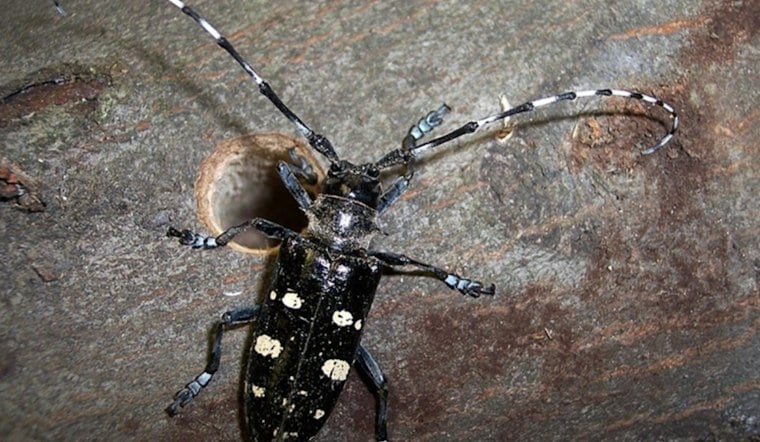
Shrewsbury has officially eradicated its population of the Asian longhorned beetle, state officials say, making the town the second Worcester County community cleared from the destructive insect's quarantine zone. The wood-boring pest has been the target of a sprawling, years-long removal effort by Massachusetts state and federal crews working to stamp it out since it was first detected in nearby Worcester in 2008.
The milestone was reported by The Boston Globe. Holden was the first Worcester County town removed from the quarantine zone, in 2025, and Shrewsbury's release follows that same painstaking process of inspections, tree removals, and restrictions on moving wood that could carry the beetle to new areas.
A Pest That Has Plagued Massachusetts Hardwoods for Nearly Two Decades
The Asian longhorned beetle is believed to have entered the United States through wood packing materials, according to state officials. Once established, the insect is a destructive invasive species that feeds on maple and other hardwood trees and eventually kills them.
Crews inspected trees, removed infested wood, and restricted the movement of hardwood material in an effort to keep the beetle from spreading. Removing Shrewsbury from the quarantine area marked a major eradication milestone, while officials called the achievement a significant step in the broader push to eradicate the pest across Massachusetts.
Officials Credit Cooperation Between Agencies and Residents
The eradication involved state and federal partners. Massachusetts has chipped away at the beetle's foothold in Worcester County, one community at a time.
Massachusetts is not alone in working through eradication efforts to adjust its beetle boundaries. In South Carolina, where the beetle was first detected near Hollywood in June 2020, officials revised their own quarantine after a second infestation turned up in Mount Pleasant in 2025, according to Clemson University News. As of this past July, survey crews there had inspected more than 596,000 trees and identified 13,140 infested ones, ultimately removing 9,174 infested trees along with 25,236 additional high-risk host trees.
South Carolina's Parallel Fight Shows Both Progress and New Ground
That South Carolina survey data led to a mixed outcome rather than a clean victory. Officials found the Mount Pleasant infestation was smaller than initially feared and shrank that quarantine zone, while the Hollywood-area zone actually expanded after crews turned up additional infestation pockets, the same Clemson reporting notes. The revised South Carolina quarantine will take effect Aug. 23, 2026, according to CountOn2 News, a reminder that eradication efforts elsewhere can move in both directions even after years of work.
Quarantines like the one Shrewsbury just exited exist to prevent movement of hardwood firewood, logs, stumps, branches and other regulated materials that could carry the beetle into unaffected areas, per Clemson's reporting on the South Carolina program. The New York State Department of Environmental Conservation similarly notes that such restrictions are established around infested areas specifically to stop the insect from spreading further.
Another Invasive Insect Is Spreading Fast Across the State
Even as Shrewsbury celebrates one victory, Massachusetts is contending with a different invasive threat gaining ground. The spotted lanternfly is an invasive insect that can imperil certain kinds of trees.
For Shrewsbury, though, the beetle fight appears to be over for now. The town's release from the quarantine zone stands as evidence that the years of tree inspections, removals, and cooperation between residents and officials paid off, even as Massachusetts turns its attention to the next invasive pest working its way across the state.





