

























































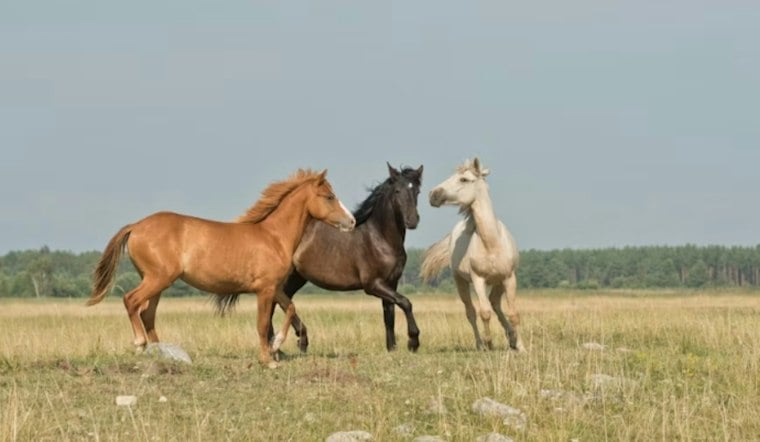
At a 33-acre property in Sicklerville, Circle S: Second Chance Ranch has become a refuge for horses pulled from the auction pipeline and other animals in need of care. Owned by Kevin and Hilary Schultz, the ranch now houses seven horses as well as goats and pigs, linking a local sanctuary's work to the ongoing movement of American horses toward slaughterhouses across the border.
From One Horse to a Full Herd
The ranch's growth was detailed in a CBS News Philadelphia report. Kevin Schultz told the outlet that some animals were saved directly from slaughter, while others were pulled from the auction pipeline before they could be shipped away. He said one horse was rescued 15 minutes before it was due to be loaded onto a truck. The effort expanded from one horse to two, then three, and eventually seven at the Gloucester Township property, according to the report.
The ranch aims to save and care for as many horses and animals as possible, per the outlet's account, and it has since taken in goats and pigs alongside its equine residents. Circle S was founded in 2024 in Sicklerville, within Gloucester Township, as an animal rescue and sanctuary, according to Cat Country 107.3.
A National Pipeline, a Local Safe Harbor
The rescues at Circle S sit against a much larger backdrop. Commercial horse slaughter has been barred within the United States since 2007, after federal appropriations riders stopped the USDA from funding horsemeat inspections, though live export of horses across U.S. borders remains legal under federal law, according to Gentle Giants. That loophole has kept the pipeline running: in 2025, nearly 5,000 more American horses were exported to Mexico and Canada for slaughter than in the prior year, per Return to Freedom.
New Jersey has tried to wall itself off from that trade for over a decade. The state enacted a law in September 2012 criminalizing the slaughter of horses for human consumption, the sale of horsemeat, and the transport of horses through New Jersey to out-of-state slaughterhouses, as reported by Equus Magazine. More recently, the U.S. House Transportation and Infrastructure Committee passed a bipartisan amendment in May 2026, led by South Jersey Representative Jeff Van Drew, that would prohibit transporting horses across state and national borders for human slaughter, according to BloodHorse.
Healing for Veterans and First Responders
Beyond animal rescue, Circle S has built a mission around helping people. The ranch offers a program addressing PTSD and anxiety for first responders and veterans, and its Equine Assisted Support Program meets on the second and fourth Saturday of every month, offered free of charge through funding from the Second Chance Ranch Foundation, according to the ranch's Facebook page. The foundation supports the ranch's broader mission and its community giving.
That community connection already runs deep locally. Members of the Gloucester Township Police Department's Third Platoon attended a ranch event called Story Time With Linda, The 25-Year-Old Painted Horse, according to Cat Country 107.3. Hilary Schultz told CBS News Philadelphia that the ranch allows the community to experience its daily blessing.
Sustaining the Sanctuary
Keeping seven horses, goats, and pigs fed and cared for isn't cheap, and Circle S leans on local partnerships to help cover costs. The sanctuary is hosting a Dine & Donate fundraiser with the Sicklerville Texas Roadhouse in October, with 10% of food sales going to the Second Chance Ranch Foundation, per the ranch's Facebook page. The ranch also hosts events, field trips, and school visits, and welcomes volunteers looking to get involved.
The rescues come as New Jersey's overall horse population has been shrinking for decades. The 2022 USDA Census of Agriculture, reported in September 2024, found the state's population of horses and ponies had fallen to 20,782 animals, down from more than 50,000 at the turn of the century, according to NJ Spotlight News. Even so, the New Jersey Department of Agriculture's 2025 Annual Report noted that equine operations remain a vital part of the state's agricultural economy, helping preserve thousands of acres of open space in the nation's most densely populated state, per USDA NASS.
What the records show
New Jersey's legislative record offers a documented starting point for the state's restrictions: the New Jersey Legislature shows that Senate Bill 1976 was introduced on May 24, 2012, proposing to prohibit horse slaughter and the sale of horseflesh for human consumption. The article's cited account also describes a 2012 state law covering horse slaughter, horsemeat sales and transportation through New Jersey; the verified materials available here do not identify specific state-agency or court records documenting enforcement since then. The USDA figures provide a more precise recent comparison than the broader long-term decline: New Jersey's horse-and-pony inventory fell from 23,374 in 2017 to 20,782 in 2022, while the number of farms reporting those animals dropped from 2,754 to 2,368, according to USDA National Agricultural Statistics Service county-level census data. The verified figures supplied here do not provide the corresponding 2002 and 2012 cycle totals.


