

























































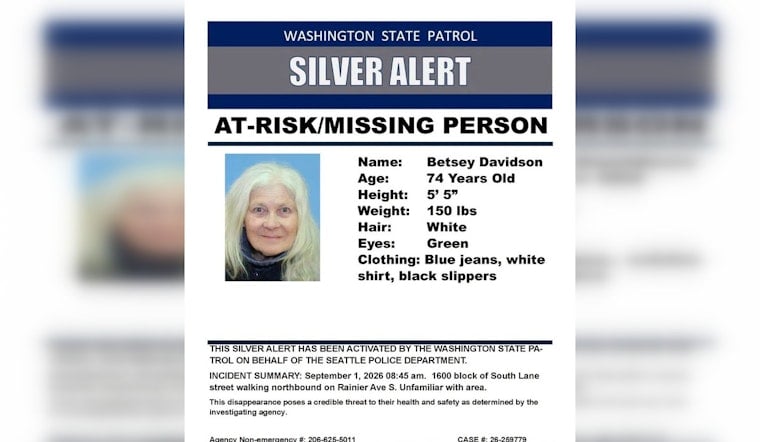
A Silver Alert is active for a 74-year-old Seattle woman who vanished Monday morning after being seen walking along one of the city's busiest transit corridors, unfamiliar with her surroundings. Betsey Davidson was last seen around 8:45 a.m. in the 1600 block of South Lane Street, heading northbound on Rainier Avenue South, according to the alert issued by the Washington State Patrol.
The alert, activated by the WSP Missing Person Alerts account on behalf of the Seattle Police Department, describes Davidson as 5 feet 5 inches tall and about 150 pounds, with white hair and green eyes. She was last seen wearing blue jeans, a white shirt, and black slippers. Investigators determined that her disappearance poses a credible threat to her health and safety, and the case has been assigned number 26-259204.
The location where Davidson was last seen sits in Seattle's Judkins Park neighborhood, immediately east of the Chinatown-International District, according to Seattle.gov. Rainier Avenue South is one of the city's primary arterial corridors, carrying high-frequency King County Metro bus routes that connect South Seattle to downtown, per King County Metro. The corridor sees heavy vehicle volume alongside ongoing bus priority and pedestrian safety projects, the transit agency notes.
Why Police Moved So Fast
Seattle police did not wait to act on Davidson's disappearance. Under Seattle Police Department policy, officers are required to take missing person reports immediately, without any mandatory waiting period, whenever there is reasonable concern for someone's safety. That stands in contrast to a common public misconception that officers must wait 24 to 48 hours before beginning a search.
Washington's Silver Alert system itself dates back to 2015, when it was established under state law to issue rapid public advisories whenever an endangered person 60 or older with dementia or cognitive impairment goes missing. The Washington State Patrol's Missing Persons Unit distributes these alerts strictly at the request of local law enforcement, pushing them out as Endangered Missing Persons Advisories across statewide listservs and police clearinghouses, acting as the centralized broadcaster on behalf of agencies like Seattle police.
No Phone Alarms, But Highway Signs and Social Media
Unlike Amber Alerts issued for missing children, Washington's Silver Alerts do not trigger automatic Wireless Emergency Alert tones on mobile phones. Instead, they rely on state Department of Transportation highway message signs, press releases, and social media notifications to reach the public, a distinction intended to prevent alert fatigue while still leveraging regional transportation infrastructure.
Seattle police protocols also require responding officers to log detailed physical descriptions — including height, weight, clothing, and footwear — into a shared database for immediate cross-agency dissemination, which is how specific details like Davidson's black slippers and white shirt became part of the public broadcast.
Why Time Matters
Medical experts stress why speed matters in cases like this. According to the Alzheimer's Association, roughly 60 percent of people living with dementia or cognitive decline will wander from their surroundings at least once during their illness, and wandering can happen suddenly even in people who have never left home unassisted before, per the Cleveland Clinic. Research cited by the National Institutes of Health indicates that up to half of missing individuals with dementia who wander for more than 24 hours without being located suffer serious injury or death, with vehicular traffic, weather exposure, and physical exhaustion among the primary hazards.
Davidson's case adds to a string of Silver Alerts issued across King County in recent weeks, with similar advisories activated in Seattle, SeaTac, and Burien during August and September alone. Anyone who spots Davidson is asked to call 911 immediately; the Seattle Police Department's non-emergency line, 206-625-5011, is also listed on the alert for additional information. As of publication, her intended destination and the specifics of her medical condition beyond being unfamiliar with the area remain unknown.





