

























































Bobbee McGuire was sent home from her job at an Eckerd drugstore on Route 9 in Poughkeepsie, New York on the morning of September 11, 2001. Within a day, she'd be back behind the counter, running the store's one-hour photo lab as it quietly became a resupply point for volunteers heading toward the wreckage at the World Trade Center. Twenty-five years later, McGuire lives in Sky Valley, California, and still keeps a photograph from that time hanging where she can see it.
McGuire worked as an assistant manager at the Poughkeepsie Eckerd, according to KESQ. On September 12, 2001, New York Guard volunteers arrived at her store on their way to the World Trade Center site, part of a mobilization that the New York State Division of Military and Naval Affairs has described as the state defense force's largest activation since World War I. The volunteers took shopping carts, water, first-aid supplies, gauze and bandages from the shelves, and McGuire refused to charge them for any of it.
An Eckerd district manager ordered nine stores east of the Hudson River to over-order supplies, and those extra shipments were funneled to McGuire's location, per the same account. For weeks, the Poughkeepsie Eckerd functioned as a resupply point, with volunteers hauling donations south in big rigs. On their return trips, those same volunteers began handing McGuire something else entirely: rolls of film.
A Photo Lab Becomes an Unofficial Archive
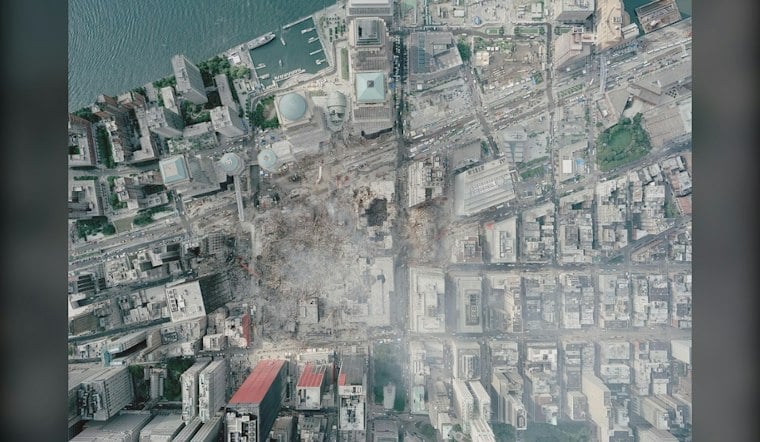
A New York Guard sergeant selected McGuire as the sole person responsible for processing the film coming out of Ground Zero. She processed film deliveries from about 25 volunteers every other day, with each volunteer typically dropping off two or three rolls at a time. By the time the work wound down, McGuire's lab had developed more than 40,000 images of the wreckage and recovery effort, the station's report notes.
Most of those Ground Zero images have never been seen publicly. McGuire has said she saw things nobody should have to see or experience, and that she stood looking at the television after first seeing the attacks unfold. Still, she has kept photographs from that period on display, saying that remembering matters.
Among the images she has held onto is a photograph of the flag-raising at Ground Zero, taken moments after Thomas E. Franklin captured his now-famous photograph for The Record newspaper. Franklin shot his image shortly after 5 p.m. on September 11, 2001, using a telephoto lens from near the World Financial Center, according to Wikipedia. That photograph later became the basis for the U.S. Postal Service's Heroes of 2001 semipostal stamp, which raised funds for FEMA to assist families of emergency responders killed or disabled on 9/11, per the U.S. Postal Service.
A Fundraiser, and a Toddler Fingerprinted for Safety
About two weeks after the attacks, the Eckerd store organized a relief fundraiser that collected donations for the Red Cross, with Culinary Institute students running the grills. Poughkeepsie police used the event to fingerprint children for identification cards, including McGuire's one-year-old daughter, Amanda, at the time.
The Eckerd chain itself no longer exists. Rite Aid Corporation acquired 1,854 Eckerd and Brooks drugstores from Canada's Jean Coutu Group for $3.5 billion in 2007, according to the Federal Trade Commission, phasing out the Eckerd brand. Eckerd's New York stores became Rite Aids that same year, and the Poughkeepsie Rite Aid location that had once been McGuire's store closed in 2025. McGuire herself moved to Arizona in 2003 before eventually settling in Sky Valley.
The Toll Keeps Climbing, Decades Later
The 9/11-related illness death toll now exceeds 9,000 people, per the National September 11 Memorial & Museum, which will include a permanent seventh moment of silence this year for those who have died of 9/11-related illnesses. As of mid-2026, the federal World Trade Center Health Program had more than 135,000 enrollees, with nearly 84,000 having at least one 9/11-related condition, according to EMS1. A 2026 study of 28,430 responders found lower mortality among World Trade Center Health Program members. According to a 2025 study available through the National Institutes of Health, World Trade Center Health Program membership has grown annually by approximately 7,500 since 2019, and more than 80,000 members are certified for at least one WTC-related condition. A study indexed by the National Institutes of Health found that World Trade Center Health Program membership may reduce risks of all-cause and smoking-related mortality among 9/11 responders.
Physical reminders of that day have also made their way west. Between 2010 and 2016, the Port Authority of New York and New Jersey's World Trade Center Artifacts Program distributed more than 2,600 wreckage relics from JFK Airport's Hangar 17 to over 1,500 civic and emergency organizations nationwide, including 65 artifacts sent to California organizations, according to PBS News Weekend. Indio's permanent 9/11 memorial at Miles Avenue Park was built around one of those relics, a 12-foot-tall structural steel beam recovered directly from the World Trade Center wreckage, according to Patch. The 9/11 Memorial & Museum says Hangar 17 at JFK International Airport became a central repository for World Trade Center objects, serving both as a storage facility and a space of reflection.
Coachella Valley Marks the 25th Anniversary
This year's remembrances in the region include the Indio memorial's dedication at 9 a.m. on September 11 at Miles Avenue Park, the Cathedral City Fire Department's remembrance beginning at 8:15 a.m. that same day at Fire Station 1, and the Palm Springs Fire Department's ceremony starting at 8:30 a.m. at Fire Station 2. Broader Coachella Valley observances also include a memorial stair climb inside the 27-story tower at Morongo Casino Resort and an evening candlelight vigil at the Civic Center Campus in La Quinta, according to KESQ.
For McGuire, the anniversary carries a different weight than the ceremonies and memorials built from steel and stone. Her photographs, developed in the quiet back room of a drugstore hundreds of miles from Ground Zero, remain mostly unseen by the public a quarter-century later. But she has said the reason she still displays them is simple: remembering is important.





