

























































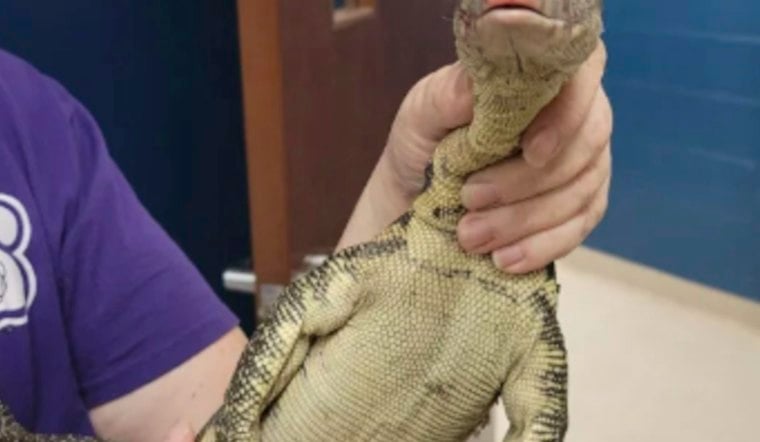
A large monitor lizard pulled from a storm drain near the 9300 block of Niles Place in South St. Louis County on Tuesday is now living with a county animal control employee, who is fostering the reptile while officials wait to see if anyone claims it. County workers have nicknamed the lizard Gojira, and it's currently completing a mandatory five-day stray hold before it can be placed for adoption.
Crews rescued the animal from the storm drain around 3 p.m. Tuesday, according to FOX 2, which first reported the discovery. Gojira is a Varanus salvator, commonly known as an Asian water monitor, a species native to South and Southeast Asia. The lizard is now in the care of St. Louis County Animal Care and Control, which says the employee currently fostering the animal has sufficient housing to keep it safe in the meantime.
A Species Built for Waterways, Not Missouri Winters
Asian water monitors are semi-aquatic predators that naturally inhabit riverbanks, swamps, and urban drainage channels across their native range, according to Wikipedia. That instinct to seek out waterways likely explains why Gojira ended up navigating a South County storm drain rather than, say, a backyard or park. The species is also massive: it's recognized as the second-heaviest lizard in the world behind only the Komodo dragon, with adult males commonly stretching 5 to 8 feet long and weighing more than 50 pounds.
Officials reported there is no concern about breeding activity or invasive potential from the discovery. But the lizard's tropical origins do create an urgent timeline. Monitor lizards would not likely survive a St. Louis winter in the wild, per the county's assessment relayed through FOX 2's reporting. As cold-blooded tropical reptiles, water monitors depend entirely on warm ambient temperatures to function, and sustained exposure to temperatures below 50 degrees Fahrenheit can cause hypothermia, respiratory infections, and fatal organ failure, according to research published on ResearchGate. Unlike native Missouri reptiles that brumate underground through the cold months, tropical monitors simply lack the physiology to survive a freeze.
Strict Adoption Rules Reflect Demanding Care Needs
Anyone hoping to adopt Gojira once the stray hold ends must prove knowledge of best care practices for monitor lizards and demonstrate the ability to properly house the animal, county officials said. That bar exists for good reason: herpetological care guides note that housing an adult water monitor typically requires a room-sized custom enclosure of at least 8 to 10 feet, an integrated water basin, humidity levels between 60% and 70%, and a basking spot reaching 85 to 95 degrees, according to Reptiles Magazine. Inadequate space, dry air, or a lack of swimming features frequently lead to serious health and behavioral problems in captive monitors.
The commitment doesn't end with the enclosure. With proper environmental controls, diet, and veterinary care, Asian water monitors can live 15 to 25 years in captivity, according to the Herpeton Academy. Many exotic pet surrenders and escapes happen precisely because owners underestimate that multi-decade lifespan and the rising costs of caring for a large varanid lizard as it matures. St. Louis County will work with local reptile rescue partners to determine whether they're a good fit for Gojira if the lizard ultimately needs placement beyond a private adopter.
Legal Gray Zone for Large Pet Reptiles
Missouri law adds another layer to the situation. Under Section 578.023 of the Revised Statutes of Missouri, keeping a deadly, dangerous, or poisonous reptile — or any dangerous reptile over eight feet long — without registering it with local law enforcement is a Class C misdemeanor, according to the Missouri General Assembly. Juvenile monitors under eight feet may not trigger that registration requirement, but adult water monitors frequently reach or exceed that length, meaning it's unclear whether Gojira's original owner, if one existed, would have fallen under the statute.
Internationally, Asian water monitors are listed under CITES Appendix II, a designation that restricts and monitors commercial trade to prevent wild populations from being overexploited, per information published by Canada.ca. Captive-bred specimens are common in the exotic pet trade, though international transport still requires formal export documentation. It remains unknown whether Gojira was an escaped pet or was intentionally abandoned in the storm drain.
Part of a Broader Regional Pattern
Gojira's rescue fits into a string of recent exotic reptile incidents across the region. In July, an abandoned iguana found duct-taped to a tree in Dardenne Park in nearby St. Peters was rescued by residents and turned over to animal control, as Hoodline reported. And last year, an escaped pet water monitor nicknamed Goose triggered a two-week, multi-state search across Massachusetts and Connecticut after escaping through a second-story window, illustrating just how far these strong, agile lizards can roam once they get loose.
The pattern tracks with a broader rise in exotic pet ownership nationally. Specialty pet ownership in the U.S. grew 26% between 2011 and 2016, with roughly 13% of households now keeping specialty pets like reptiles, according to American Veterinary Medical Association survey data cited by Patterson Legal Group. That growth has put added strain on municipal animal control agencies increasingly tasked with handling strays, surrenders, and escapes involving non-native species.
Under St. Louis County's Animal Control Code, the Department of Public Health and Animal Care and Control oversees impounded stray animals, including holding periods, fostering, and adoption placements. Gojira will be made available for adoption if no owner comes forward within the five-day window. Anyone with proof of ownership or interest in adopting Gojira is asked to contact St. Louis County Animal Care and Control at 314-615-0650.




