

























































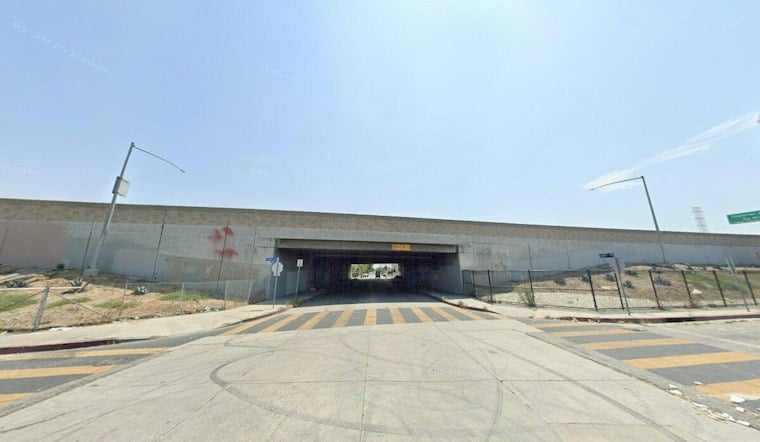
A new mural stretching across the I-110 corridor at Colden Avenue and Flower Street now tells the story of South Los Angeles through the faces of the people who live there. Artist Moses Ball unveiled the piece, titled “South Central Strong,” featuring urban gardener Ron Finley showing off his growing skills and local father Hassan Wells carrying his daughter Rhythm on his shoulders.
The mural marks the completion of the $2.89 million Clean California I-110 Beautification Project, according to the Los Angeles Daily News. The broader project spans a seven-mile freeway corridor between Imperial Highway and Adams Boulevard, incorporating native drought-tolerant landscaping and decorative rock-scaping alongside new fencing installed in 2024, as Our Weekly reported when the corridor work began. The project also removed trash along the freeway and was funded through Clean California dollars, per the Daily News account of the unveiling.
A Trilogy of Murals Along the Harbor Freeway
“South Central Strong” is the final installment in a three-mural trilogy commissioned along I-110 by Caltrans District 7 and the L.A. Department of Cultural Affairs. The other two works, “Jazz on the Field” by artist MisterAlek at 43rd Street and Grand Avenue and “Safe Travels” by artist Bodeck Luna at 43rd and Flower Streets, round out the series, according to Caltrans. Luna's “Safe Travels” depicts Black families traveling through Los Angeles under the guidance of Victor H. Green's 1936 “Negro Motorist Green Book,” which helped Black Americans navigate segregation during the Jim Crow era, as detailed by the NAACP Los Angeles.
Toks Omishakin, who oversees the statewide Clean California initiative, spoke at the ceremony, which brought together the artist and several of the people depicted in the mural, according to the Daily News. Ron Finley, described in the report as a fashion designer and creator of the Ron Finley Project, attended the event, and Hassan Wells was there with his daughter Rhythm, the same girl shown perched on his shoulders in the artwork.
An Artist Rooted in South Central
Moses Ball grew up in South Central Los Angeles and earned a Bachelor of Fine Arts from the School of the Art Institute of Chicago in 2000. In 2021 he was chosen as an inaugural artist in the L.A. Lakers' “In the Paint” program supporting local creators of color, according to Metro Art. His earlier public works in South Los Angeles include “The Heart of Hyde Park” at Crenshaw Boulevard and Slauson Avenue, featuring local activists and community icons, and “Gateway to Greatness” in Exposition Park, according to the African Diaspora Art Museum of Atlanta. Ball also created a 2019 mural featuring community icons including Nipsey Hussle, per the Daily News, and he was previously commissioned by Metro Art in 2022 to design integrated transit artwork for the future Westwood/UCLA Station on the Purple Line Extension, drawing on community portraits collected during public workshops.
Ball's work has also extended beyond street murals. He created “Motivation in Motion” for the California Science Center's Game On exhibition, according to the Daily News, adding another dimension to a career that has consistently centered South LA identity and its people.
Why Ron Finley Made the Cut
Finley's inclusion in the mural traces back more than a decade to a fight over a strip of dirt outside his own home. He began urban gardening in 2010 on a 10-foot by 150-foot city-owned median outside his South LA house, a move that triggered a city citation and a 900-signature petition, according to Destination Crenshaw. That pressure ultimately led the City of Los Angeles to change its parkway planting ordinance, cementing Finley's reputation as a founding figure in the city's urban food justice movement.
The State Program Behind the Project
The I-110 mural project draws its funding from Governor Gavin Newsom's statewide Clean California initiative, a $1.2 billion effort launched in July 2021 and led by Caltrans to remove roadway litter, fund local grant projects, and transform public transportation corridors into community assets. Between its 2021 launch and March 2026, the program cleared more than 3.5 million cubic yards of trash from California highways and public spaces, the equivalent of 165,000 garbage truck loads, and funded over 600 public art installations statewide, according to Caltrans. The May 2026 revision to the state budget also provides broader context for the program.
The I-110 unveiling echoes a similar push in Turning Underpasses Into Murals, where a Clean California grant funded a 13-mural corridor transforming freeway underpasses in San Diego's Logan Heights neighborhood. Together, the projects reflect how the statewide program has become a recurring tool for turning grey freeway infrastructure into showcases of local history and identity, from South Los Angeles to San Diego.





