

























































A new $95 million research initiative has set up shop at Dexter Yard in Seattle's South Lake Union neighborhood, betting that artificial intelligence can accelerate the design of proteins and genes fast enough to match the pace of synthetic biology itself. Called AI BioDesign, the project pairs bench scientists with machine-learning teams to generate massive amounts of biological data and train AI models to design novel molecules from scratch, with backers hoping the work could eventually yield new disease therapies, plastic-dissolving proteins, or programmed cells that travel through the body.
The initiative is funded by the Fund for Science and Technology, the philanthropic vehicle created by the estate of Microsoft co-founder Paul Allen, which is providing nearly $94.6 million over five years, according to GeekWire. The money is split among three institutions: $46.1 million goes to the Allen Institute, $43.8 million to the University of Washington, and $4.7 million to Fred Hutch Cancer Center. As of mid-August, the project employed 62 people, with the Allen Institute contributing 13 staffers, UW accounting for 41, and Fred Hutch supplying eight, per the outlet's reporting.
Leading the effort is David Baker, the UW biochemist who shared the 2024 Nobel Prize in Chemistry, alongside Jay Shendure, a genome scientist affiliated with both UW and the Allen Institute. Baker told the outlet that AI speed is beginning to match synthetic biology's experimental power, a claim that captures the central premise behind the project: that computational design and laboratory testing can now move at roughly the same tempo.
How the Lab Actually Works
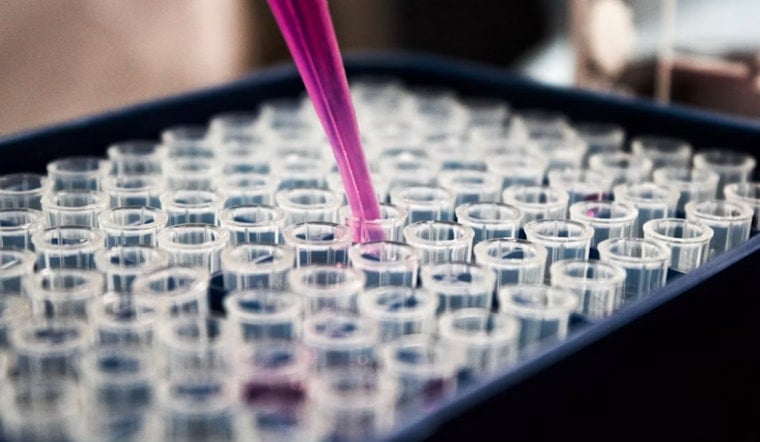
Inside the Dexter Yard space, AI BioDesign organizes its researchers into bench teams of five or six people, each paired with a four-person machine-learning unit. Rather than relying on heavy robotics, the setup parallelizes testing inside single test tubes, using DNA sequencers capable of reading millions of sequences at once. In one experiment, the project ran six million distinct sequences through its sequencer inside a single tube, illustrating the scale the team is chasing.
The project draws on cellular machinery that turns DNA into proteins, and rather than pursuing one general model for how any cell works, it deploys narrow models built to solve specific biological design problems. Sanjay Srivatsan, an assistant professor at Fred Hutch Cancer Center, leads that institution's contribution to the effort. The goal, according to GeekWire's reporting, is to make biological design feel more like ordering a part than running a years-long experiment.
An Open-Science Bet With a Clock Running
AI BioDesign has committed to sharing its results freely to support the development of medicines and materials, an approach Allen Institute leader Rui Costa framed as aimed at impact rather than competition. Costa said open science was intended to affect entire fields rather than beat rival companies to a discovery, and added that it would be a positive outcome if outside companies used the shared data to change the world. He also said Paul Allen wanted to exponentially accelerate the field, a founding aspiration the current project is meant to embody.
Marc Malandro, who is now co-leading the Fund for Science and Technology on an interim basis, said AI BioDesign represents exactly the kind of collaborative science FFST was created to support. Malandro joined FFST after nearly a decade at the Chan Zuckerberg Initiative and stepped into a leadership role alongside CFO/COO Liz Carey following the May departure of founding chief executive Dr. Lynda Stuart, a physician-scientist who had previously led the University of Washington's Institute for Protein Design.
The project carries a defined timeline: AI BioDesign needs to show real progress within 18 to 24 months, and it has not yet established whether its open, non-proprietary approach will outperform alternative methods used elsewhere in the field. Organizers say the effort may eventually spin out startups, nonprofits, or other initiatives from its three principal institutions, and they plan to expand access to researchers around the world within five years.
Part of a Broader Allen Estate Push
AI BioDesign is not an isolated bet. It builds on groundwork laid in December 2023, when the Allen Institute, UW, and the Chan Zuckerberg Initiative established the Seattle Hub for Synthetic Biology at the same Dexter Yard location, also under Shendure's direction, according to UW Medicine. Shendure also serves as scientific director of the Brotman Baty Institute for Precision Medicine, a partnership among UW Medicine, Fred Hutch, and Seattle Children's that launched in November 2017, per the Brotman Baty Institute.
The Fund for Science and Technology, established with a $3.1 billion endowment after Allen's death, has moved quickly since its August 2025 debut, when it issued its first $15 million in grants covering cancer immunotherapy work at Fred Hutch and pediatric trials at Seattle Children's Hospital, according to Forbes. In June, the Allen Institute separately announced a $400 million Brain Health Accelerator, backed by $200 million from FFST, aimed at shifting brain-mapping research toward gene therapies for conditions like Alzheimer's and ALS.
Notably, the Allen Institute for AI, known as Ai2, is not a funded partner in AI BioDesign despite sharing its founder's name and legacy. Instead, its robotics and research teams are expected to collaborate informally with the project on model architectures and automated hypothesis tools, GeekWire reported.
South Lake Union's Growing Research Footprint
The lab's location reflects South Lake Union's continued pull for major research tenants even as national biotech investment has cooled. Seattle added more than 500,000 square feet of lab and office space in 2025 across developments like 701 Dexter, with institutional tenants such as UW and the Allen Institute driving demand, as Hoodline previously reported. That growth has come despite a separate slowdown in federal research funding from agencies like the NIH and NSF that has squeezed UW and Fred Hutch labs elsewhere.
AI BioDesign's launch also arrives amid a wave of massive philanthropic commitments to the region's research institutions, including a record $540 million gift from the Gates Foundation to a UW health institute in August. Whether the open-science model championed by Baker, Shendure, and their collaborators can outpace proprietary AI discovery efforts elsewhere in the industry remains an open question, one that the project's backers say they expect to start answering within the next two years.





