

























































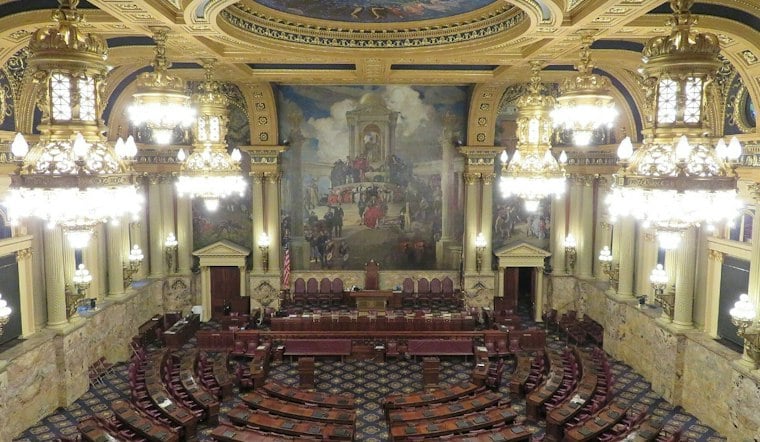
The contest between Republican challenger Timothy McCune and three-term Democratic incumbent Jessica Benham for Pennsylvania's 36th House District has both local and statewide implications. The district includes Brentwood, Mount Oliver, Carrick, Beechview, Brookline, Mount Washington and the South Side, as TribLive reported. Its outcome could affect the balance in Harrisburg, where House Democrats hold a 102-101 majority that they won in 2022 and have maintained since, according to PBS News.
Benham, 35, was first elected to the legislature in 2020, becoming the first openly LGBTQ+ woman and first openly autistic person elected to the Pennsylvania General Assembly, and she is now seeking a fourth term, according to TribLIVE. Before entering politics, she served as director of development at the Pittsburgh Center for Autistic Advocacy, and the outlet reports she said she first ran for office to improve life for her neighbors. Democrats outnumber Republicans by nearly 3-to-1 in the district, per the same account, giving Benham a structural advantage McCune is trying to overcome.
McCune, 45, lives in Brentwood and works as a home health aide. He previously ran an unsuccessful write-in campaign for a Brentwood council seat, and he now serves as president of Safety Net of Hope, a nonprofit that assists families whose children have been involved in serious accidents, according to TribLIVE's reporting. McCune has two autistic sons, ages 9 and 21, and told the outlet that higher costs and financial problems affecting residents and businesses inspired him to run.
Transit Funding Splits the Candidates
Transit funding is one of the race's clearest policy divides. Benham has proposed a Transit for All PA package that would raise rental-car fees and impose a 6% excise tax on ride-hailing services, directing the revenue to public transit, according to 90.5 WESA.
Proposals concerning skill-game machines have included taxes on their revenue, per the same TribLIVE account. The issue remained under consideration when Spotlight PA reported on proposals to legalize and tax skill games at rates of 16%, 35%, and 52%, as reported by Spotlight PA. Governor Josh Shapiro has previously advocated for a 52% tax rate on skill games to address structural state budget deficits, the outlet notes.
The stakes for Pittsburgh Regional Transit are considerable. The agency faced a projected $100 million operating deficit for the current fiscal year before PennDOT approved redirecting up to $106.7 million in state capital funds into its operating budget in September 2025, staving off a previously proposed service cut and the elimination of 41 bus routes, according to Pittsburgh Regional Transit. That relief has since been complicated by a September 2026 federal budget continuing resolution that cut national transit funding by $4.2 billion, translating to a direct $7.3 million formula funding loss for PRT, as reported by the Pittsburgh Post-Gazette.
PRT's Budget Gap and the State Funding Debate
Pittsburgh Regional Transit's financial pressure persists even as ridership has recovered. According to the agency's FY 2025 budget book, FY 2024 ridership had rebounded approximately 60% from its FY 2021 pandemic low, and PRT forecast a further 7.3% increase for FY 2025. The agency says its FY 2027 operating budget preserves current fares and service levels but relies on $44.8 million in capital funding and $15.4 million in operating reserves to balance a $595.7 million operating budget, according to Pittsburgh Regional Transit.
The agency's recent budget history illustrates how quickly the consequences can escalate. PRT board minutes from June 27, 2025, show that a proposed FY 2026 budget assumed a 35% service cut and a 9% fare increase, although final action depended on state funding. State support has remained a central part of the debate: the governor's 2025-26 budget proposal called for $292 million in new annual mass-transit funding and $1.5 billion over five years through a larger share of sales-and-use-tax revenue dedicated to transit, according to the PRT board minutes and the Pennsylvania Governor's Office.
Housing, Health Care and Local Wins
Benham points to a legislative record built around housing, health care and schools. She backed Pennsylvania's Whole-Home Repairs Program and plans to seek more state funding for affordable homeownership and home-repair initiatives, per TribLIVE's reporting. That program, created in 2022 with $125 million in federal COVID-19 relief funds, offers grants up to $50,000 for low-income homeowners to fix habitability, energy efficiency and accessibility issues, while continuation efforts in 2023 and 2024 failed and a 2025 proposal was under consideration, according to Spotlight PA.
Locally, Benham says she secured $500,000 in state funding for affordable senior apartments in Carrick; she also points to funding to repair Carrick High School's HVAC system and state funding for the Becoming a Man mentorship program at the high school, as reported by TribLive. The article also raises the issue of pharmacy benefit managers and independent pharmacies.
Beyond that legislation, Benham has sponsored bipartisan legislation to increase Medicaid funding for people with disabilities, backed pending paid family and sick leave legislation, supported expanded child tax credits, and pushed for more state funding for school therapists and counselors, per TribLIVE. She opposed Pittsburgh Public Schools' decision to close nine school buildings and supports preventative programming aimed at reducing youth violence and disruptive behavior. She also co-sponsored a bill restricting law enforcement from being within 100 feet of polling places on Election Day, and she supports state liquor control enforcement assistance for local partners when bars cause problems, along with regulations requiring data centers to pay for their own electricity, the outlet reports.
McCune's Platform on Disability Services and Public Safety
Drawing on his experience raising two autistic sons, McCune plans to extend services for people with disabilities until they can sustain a job, and he wants to use existing nonprofits while seeking state funding to expand their reach, according to TribLIVE's reporting. He also supports more state funding for sidewalk ramps and accessible pedestrian signals, along with kids' clubs and increased funding for youth activities.
On public safety, McCune supports more state funding for law enforcement, though he says he will not support state policies to either support or restrict U.S. Immigration and Customs Enforcement, believing individual officers should use discretion about cooperating with the agency, per the same account. He also supports allowing neighborhoods to separate from Pittsburgh as independent municipalities and spreading liquor-license establishments along East Carson Street. Both candidates agreed that public schools need more funding, the outlet notes.
State representatives in Pennsylvania serve in Harrisburg. Benham was elected to the seat in 2020.



