

























































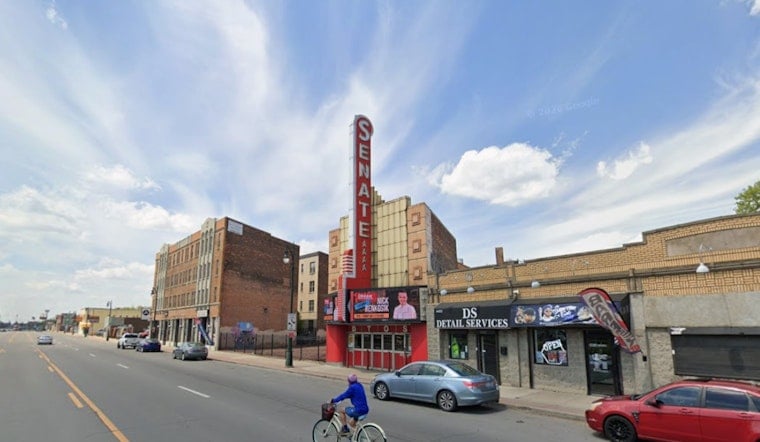
The Senate Theater at 6424 Michigan Ave. in Southwest Detroit is turning 100 years old, and it's marking the occasion by bringing back the very film that opened the place on October 7, 1926. The volunteer-run movie theater and performing arts venue will kick off a slate of centennial festivities in October, including a screening of Cecil B. DeMille's silent film The Volga Boatman — the same picture Detroiters watched on the Senate's opening night a century ago.
According to Deadline Detroit, the celebration begins October 7 at 7:30 p.m. with an event called Centennial Encore, designed to recreate the spirit of the theater's first night. Tickets for that event cost $15, and Lance Luce — president of the Detroit Theater Organ Society and a Detroit Red Wings organist — will accompany The Volga Boatman live on the Senate's Mighty Wurlitzer organ. The festivities continue October 10 at 7 p.m. with Party of the Century, a community event inspired by neighborhood movie houses that pairs film with live entertainment, featuring music, comedy, magic, spoken word, film, Detroit performers and the Wurlitzer. Tickets to that event range from $25 to $150.
A Building With a Dramatic Past
The theater's history goes back further than its films. Designed by architect Christian W. Brandt, who was known for several smaller Detroit neighborhood theaters including the Times Square and LaSalle Garden theaters, the Senate opened in 1926 as a 1,200-seat neighborhood movie house, according to Historic Detroit. It served blue-collar filmgoers for three decades before post-war economic shifts forced its closure as a commercial movie house around 1959, following an Art Deco update in the 1930s and an Art Moderne redesign in 1949 led by architect Ted Rogvoy.
The building's near-death came shortly after. Per 94.7 WCSX, the city seized the abandoned Senate for unpaid taxes, and by 1963 it had a flooded basement and a gaping hole in its roof. That year, the Detroit Theater Organ Club bought the derelict building from the city for just $1,000, saving it from further ruin while giving organ enthusiasts a permanent home for an instrument they badly needed to place.
The Organ That Outlasted Its First Home
That instrument is the Senate's 4-manual, 34-rank Mighty Wurlitzer pipe organ, which was originally installed in 1928 at Detroit's Fisher Theatre as a memorial to the parents of the seven Fisher brothers. The organ's origin story makes it one of the largest Wurlitzer organs ever built — the eighth-largest, according to Historic Detroit — and it includes rare classical stops that let it play orchestral works by Bach as well as theater scores by Gershwin. When the Fisher Theatre was remodeled in 1960, organ enthusiasts formed a society specifically to find the Wurlitzer a new permanent home, and the Senate became that home.
Volunteer restorers spent thousands of hours in the early 1960s refurbishing the Senate building, in the process shrinking its seating capacity from 1,200 down to roughly 900 to make room for four organ chambers built across the main stage. The organ concert hall reopened in 1964, and the Wurlitzer has now played there continuously for over 60 years — far longer than the 32 years it originally spent inside the Fisher Theatre, where it had accompanied silent films and stage shows in New Center from 1928 until 1960.
The Senate's original 1926 instrument was actually a different organ altogether: a 2-manual, 7-rank Robert Morton pipe organ that was removed in 1931 and sent to WXYZ radio studios, per Wikipedia. WXYZ later donated that Robert Morton to an Oak Park church in 1955, and it was destroyed by fire the following year.
Back Into the Movie Business
For nearly 50 years the Senate operated purely as an organ concert hall with no film projection equipment at all. That changed in May 2013, when the theater reinstalled projection technology and resumed public movie screenings, broadening the volunteer-run organization's programming beyond organ concerts alone, Historic Detroit reports. The Senate and the Redford Theatre in northwest Detroit are the only two historic neighborhood movie houses left in the city that have been preserved and still run regular public programming, according to Model D Media — a rarity in a city where dozens of single-screen neighborhood cinemas were demolished or repurposed over the mid-to-late 20th century.
That survival connects to a much larger regional story. Between 1911 and 1930, during the peak of silent cinema, more than 130 venues across Metro Detroit were fitted with theater pipe organs to accompany silent films and live stage acts, as Detroit's population swelled to 1.5 million by 1930 and demand for neighborhood movie palaces grew with it.
Looking Ahead to the Next 100 Years
Luce, quoted by Deadline Detroit, said the anniversary will welcome more people, celebrate what the community saved and build support to keep the theater open for the next 100 years. He added that the Senate made it to 100 because generations of volunteers and supporters believed Detroit still needed a place like this.
The centennial isn't purely celebratory — it's also a fundraising push. The Senate Theater building needs a roof replacement and waterproofing, and the Mighty Wurlitzer itself requires specialized, ongoing care to keep functioning. Ticket sales and donations from the anniversary events will fund building upgrades, and the theater plans to preserve and share more than 700 historic concert recordings between 2026 and 2028 while pursuing a National Register of Historic Places designation. The Senate will work with the Detroit Sound Conservancy on the recordings project, and with the Detroit Collaborative Design Center, which will help the community shape the theater's future.
Hoodline has previously spotlighted the Senate Theater as a Southwest Detroit event venue, including a Ballet Folklorico holiday show hosted there. The centennial celebrations mark a bigger milestone for a theater that has spent a century adapting — from silent-film house to organ sanctuary to neighborhood cinema once again.


