

























































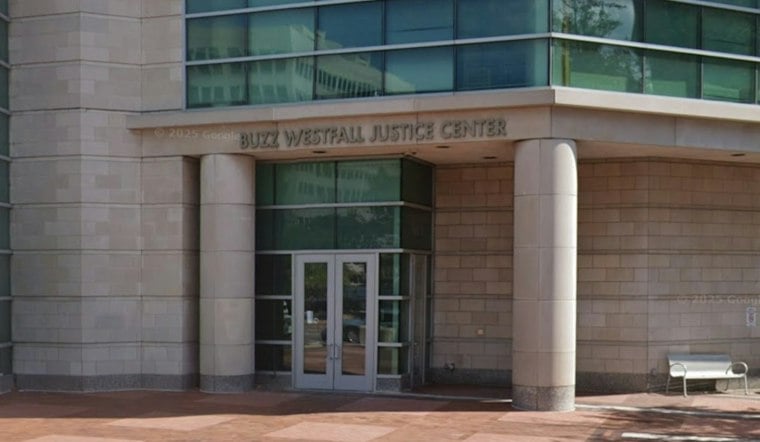
Christopher Gatlin says St. Louis County officers used a blurry surveillance photo in a facial-recognition system during the investigation; the prosecution also relied on a witness identification. He didn't do it, according to a lawsuit he has filed, and the case against him eventually fell apart in court. Now Gatlin is suing St. Louis County, the city of St. Louis and Amazon Web Services, arguing that shoddy police work and facial-recognition technology were involved in the case. The claims against Amazon remain unresolved.
Gatlin's arrest followed an assault reported at the St. Charles Rock Road MetroLink station, according to the lawsuit's account as reported by STLtoday.com. Officers investigating the case were part of a joint team of St. Louis County officers and city detectives who work MetroLink-related crimes, and the suit alleges that team uploaded a grainy surveillance photograph pulled from a bus into the St. Louis Mugshot Recognition Technology System, a facial-recognition tool that scans stored photographs for similarities. According to the federal court record described by Biometric Update, the image was grainy, blurry, shot from a distance and from above the suspect's face, with a hood and medical mask obscuring key features.
As reported by IDTechWire, police built their investigation around the resulting match rather than treating it as a starting point for further verification. Gatlin's suit alleges that detectives focused on the resulting match during the investigation.
A Database in Dispute
The regional system searched a database containing more than 250,000 mug shots, according to Biometric Update.
Biometric Update reported that Gatlin was arrested on August 14, 2021, and remained incarcerated for roughly 17 months while his case was pending. The lawsuit says prosecutors ultimately dismissed the charges against Gatlin more than two years after his arrest.
Suppressed Evidence and a Broken Case
The case against Gatlin unraveled once a judge scrutinized how the identification was obtained. St. Louis County Judge Brian May suppressed the witness identification in February 2024 after finding officers had not followed accepted impartial-lineup procedures, and prosecutors dismissed the charges the following month, Biometric Update reported.
Gatlin is the plaintiff in the suit. His suit alleges that St. Louis County gave officers access to facial-recognition technology without adequate training, amid broader concerns that the technology can disproportionately misidentify people of color.
Amazon's Role and Its Denials
Gatlin's original lawsuit, filed in January 2025, named only the city of St. Louis and St. Louis County, according to IDTechWire. He later amended the suit to add Amazon Web Services as a defendant, arguing that his arrest and indictment were the product of shoddy police work, poor training, police misconduct and the use of a defective facial-recognition program, as characterized in the complaint reported by Bloomberg Law.
Amazon has pushed back on any suggestion that its technology was used as intended. The company told Biometric Update that its terms of service prohibit the use of Rekognition's face-comparison feature by police departments in connection with criminal investigations. Amazon's current Rekognition documentation also states the technology does not support images that are too blurry or grainy for a human to recognize a face, or images with large portions of a face obscured — a description that matches how the court record characterizes the photo used in Gatlin's case.
Case Moves Forward, Echoing a National Pattern
A federal magistrate judge has already allowed most of Gatlin's claims to proceed, including allegations of reckless investigation, malicious prosecution and inadequate facial-recognition training, according to Biometric Update. Gatlin's case is not an isolated one nationally. The ACLU has tallied 14 wrongful arrests nationwide connected to facial-recognition technology, per IDTechWire, and a Washington Post investigation found that 15 of 23 police departments examined had arrested at least one AI-identified suspect without independent evidence connecting that person to the crime, as reported by Biometric Update.
Similar cases have played out in Detroit, where Robert Williams was arrested in January 2020 after facial-recognition software falsely identified him in the theft of Shinola watches and was held for about 30 hours before his release, according to Michigan Public. Detroit had adopted a policy the previous summer, before Williams's arrest, prohibiting arrests based solely on facial-recognition evidence and requiring corroborating proof. That policy didn't prevent another Detroit case: Porcha Woodruff sued police after being falsely arrested for robbery and carjacking based on a facial-recognition match that had generated a field of 73 possible suspects, according to Bridge Michigan. In Bloomington, Minnesota, a similar misidentification case was settled after a man was held for five days over a robbery and carjacking he did not commit, per IDTechWire.




