

























































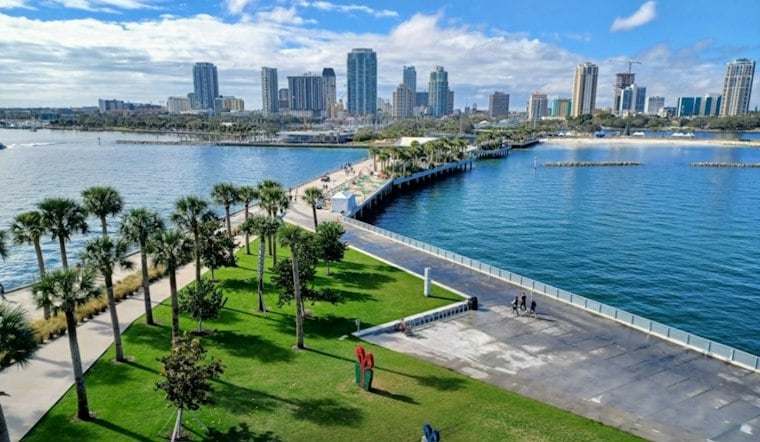
Sunsets over Tampa Bay, the downtown skyline glowing behind every shot, and a waterfront angle for every visitor with a camera — a new video making the rounds calls the St. Pete Pier the most photogenic spot in the city, and it is hard to argue with the view.
The clip, posted by St. Pete Pier on Facebook, shows the pier's skyline glowing behind visitors as they take in sunsets over the bay, with the post crediting video contributions from Brittventures and Mommamarkakis and inviting followers to share their own best pier photos in the comments. It is easy to see why the spot draws a crowd with a camera in hand — but the pier's photogenic reputation is backed by more than social media buzz.
A Global Design Award Behind the Photo Ops
In 2022, the pier was selected as one of six global winners of the Urban Land Institute Global Awards for Excellence, making it one of only two urban design projects in the United States to receive the international honor that year, according to the City of St. Petersburg. Then-Mayor Rick Kriseman and Mayor Kenneth T. Welch noted that the award cemented the pier's status as a marquee global waterfront destination, per the city's announcement.
That international acclaim lines up with the pier's pull on visitors. The 26-acre St. Pete Pier District draws an estimated 2.3 million visitors annually and generates roughly $125 million in local economic impact each year, according to FOX 13 Tampa Bay. The average visit lasts about 70 minutes, the station reports.
A 14-Year Road to the Current Design
The current $92 million Pier District officially opened on July 6, 2020, capping a 14-year process of public forums, design competitions, and a citizens' referendum that ultimately replaced the city's earlier pier structure, according to Architectural Record. An earlier design known as “The Lens” was rejected by St. Petersburg voters in 2013 before the plan from Rogers Partners was ultimately selected, the outlet notes.
Waterfront piers have anchored downtown St. Petersburg since 1889, starting with the Railroad Pier and followed by the 1926 Million Dollar Pier and the five-story Inverted Pyramid Pier, which operated from 1973 to 2013, according to Northeast Journal. The Inverted Pyramid was demolished in 2015 to clear space for the district that stands today, the outlet reports.
Design Elements Built for the Camera
The current pier was designed collaboratively by Rogers Partners, ASD/SKY, and Ken Smith Workshop, and it features a 1,380-foot pedestrian promenade, a multi-level pierhead building, and a 10,000-square-foot “tilted lawn” raised to offer elevated bay views, per Architectural Record's reporting. Landscape architect Ken Smith reportedly designed the tilted lawn specifically to break up the long sightline out into the bay.
Among the pier's most photographed features has been “Bending Arc,” a 424-foot suspended aerial sculpture by Tampa-born artist Janet Echelman. The 5,000-pound net sculpture, made from 180 miles of fiber engineered to withstand 150 mph winds, was temporarily removed in February 2025 after suffering recurring damage from back-to-back 2024 hurricanes, according to WUSF.
Sunset Views and Deeper History
For visitors chasing sunset shots today, the district hosts seven distinct dining venues, including the fourth-floor Teak restaurant and the rooftop Pier Teaki, which sits atop the main pierhead building and offers unobstructed 360-degree views of Tampa Bay and the downtown skyline at sunset, according to Visit St. Petersburg Clearwater.
The site's history runs deeper than its Instagram appeal. Spa Beach and Spa Pool, located at the pier, were the focus of a landmark 1957 U.S. Supreme Court ruling ordering the desegregation of municipal beaches and swimming pools following swim-ins organized by local Black residents, according to the Tampa Bay Times.
Engineering for the Next Storm
The pier's physical structures and foundations were designed by engineering firm Thornton Tomasetti to resist 100-year storm surges, withstand Category 4 hurricane winds up to 155 mph, and accommodate a one-foot rise in sea level over an 80-year lifespan, the firm states. The design also reduced the number of pile supports needed, lowering material costs while enhancing resilience, according to the firm.
The district's environmental features extend beyond storm resistance. Throughout the 26 acres, 866 newly planted trees, dry and wet ponds, and bioswales filter more than 405,000 gallons of stormwater runoff per year before it reaches Tampa Bay, according to the Landscape Performance Series. Tree plantings and habitat expansion have contributed to a 43% increase in continuous seagrass area in adjacent waters, per the same source.
Between the sunset selfies and the skyline backdrops, the St. Pete Pier carries a layered story — an award-winning design, a civil rights landmark, and a piece of climate-resilient engineering all wrapped into the waterfront spot locals and visitors keep pointing their cameras at.



