

























































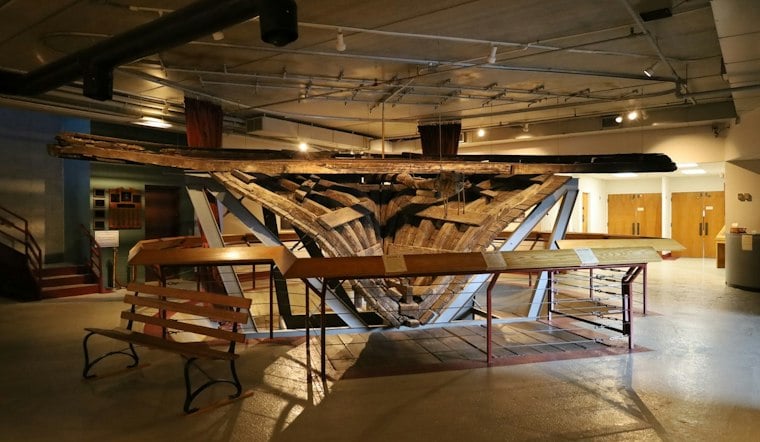
Kansas City has decided not to renew the lease for the Steamboat Arabia Museum, ending the attraction's 35-year run in the River Market neighborhood and setting a firm deadline of 2026 for its departure. The museum, built around artifacts pulled from a steamboat that sank in the Missouri River 170 years ago, now faces the task of finding a new town willing to house the museum and thousands of recovered items.
Museum manager Matt Hawley said the site has told the story of the Steamboat Arabia for 35 years, according to FOX 4 Kansas City WDAF-TV. The museum opened in 1991, filling its halls with clothing, jewelry, tools, and kitchenware that Hawley's grandfather, father, uncle, and friends dug out of the riverbank in 1988. Kansas City, meanwhile, has a different vision for the building, and museum leadership is now seeking a town that wants to tell the Arabia's story going forward, the outlet reports.
A City With Other Plans For the Building
The City Market Oversight Committee laid the groundwork for that different vision back in November 2024, issuing a request for developers to convert the museum's building at 400 Grand Blvd. into a mixed-use project featuring street-level retail, a boutique hotel, and subterranean parking, according to The City Market. The museum's lease at the site expires in 2026, closing out its 35-year run in downtown Kansas City, as reported by KCUR. The city has not clarified exactly what it intends for the museum location once the museum moves out.
Friction between the Hawley family and their municipal landlords isn't new. Tensions date back decades, including a 1990s lawsuit over leaking fish-market wastewater from an upstairs tenant and disputes over heavy vibrations from outdoor concerts that shook concrete loose inside the exhibit halls, according to Flatland KC. Moving the museum will itself be a major undertaking, given the sheer size and weight of its massive recovered parts.
A Failed Move and New Candidates
A letter of intent to move to St. Charles, Missouri — where the Arabia's 1850s captain lived and is buried — outlined a possible 80,000-square-foot facility and an estimated $50 million combined project cost, per the same Flatland KC report. Since then, alongside prior legislative funding proposals in Jefferson City, museum leadership has evaluated relocation options in Leavenworth, Kansas, and Marshall Junction, Missouri, KCUR notes.
Hawley said a town along the Missouri River would be ideal for the museum's next chapter, and that its future home should help visitors connect with the river itself. The stakes go beyond real estate: before the non-renewal decision, the Steamboat Arabia Museum ranked as Kansas City's third most popular tourist attraction in TripAdvisor user surveys, trailing only the National WWI Museum and Memorial and the Nelson-Atkins Museum of Art, according to Flatland KC.
What Sank, and What's Still Down There
The Arabia sank on September 5, 1856, after striking a submerged tree snag in the Missouri River while hauling 200 tons of merchandise bound for 16 Midwestern frontier towns, according to the museum's own account at 1856.com. All 150 passengers and crew escaped safely; the only casualty was a carpenter's mule left tied to the deck, according to the Heinz History Center. The river later shifted course, and rapid silt buildup buried the ship 45 feet underground in oxygen-starved soil, preserving 132-year-old jarred pickles that were reportedly still edible when the ship was excavated in 1988.
Hawley said the Smithsonian has told him the museum holds the largest single collection of artifacts of its kind. The Hawley family now plans to expand that collection further, having identified at least a couple of other steamboats still preserved four stories beneath the earth's surface between Kansas City and St. Louis. Co-founder David Hawley has pinpointed the buried site of the Malta, an 1840s fur-trade steamboat that sank near Malta Bend, Missouri, and estimates it would cost over $3 million to excavate for inclusion in an expanded national steamboat museum, according to Flatland KC.
The family says it would be willing to spend millions of dollars to locate those other boats, but Hawley has warned that the museum could lose the chance to preserve additional American stories and treasures if a suitable new home doesn't materialize. For now, the Arabia's next port remains undecided, with Missouri and Kansas towns still in the running before the lease expires in 2026.





