

























































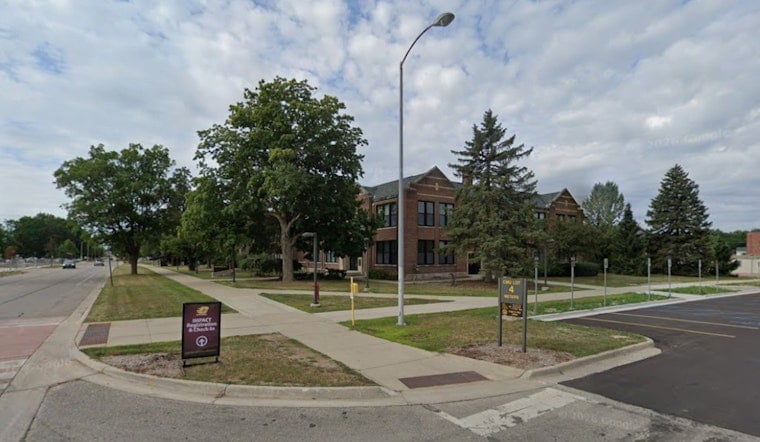
Water poured through a shared wall between the printmaking lab and critique lab in Wightman Hall at Central Michigan University Thursday, sending students and faculty scrambling for mops, wet vacuums and sandbags as torrential rain pounded the Mount Pleasant campus. Two classrooms in the 75-year-old building took on water, while a flooded Moore Hall room forced its own cleanup effort just as heavy rain sent branches crashing from trees and turned nearby roads into standing water.
Zoey Lawrence, a student who was in the room when the flooding began, said the classroom was flooding and no one had a calm reaction, according to Central Michigan Life. Scott De Brestian, chair of CMU's Department of Art and Design, told the student newspaper that employees and students quickly began removing the water once the leak was discovered, and that the response was initially chaotic before it was brought under control.
The flooding hit Wightman Hall and Moore 110 on Thursday, Sept. 3, with facilities operations and the CMU Office of Residence Life responding to multiple flooding reports across academic buildings and residential halls that day. No other parts of Wightman Hall were affected, the student paper's report notes. CMU employees and outside vendors worked through the day and into the evening assessing the damage, and Ari Harris, executive director of strategic communications at CMU, said all reported flooding issues across campus had been addressed.
What Caused the Leak Remains a Mystery
Exactly what let groundwater into Wightman Hall's art labs is still unclear. The source of the flooding is unknown, and campus facilities officials had not completed a diagnostic assessment of the building in the immediate aftermath of the storm, per the same account from the student newspaper.
Wightman Hall's age may be part of the puzzle. The building was dedicated in October 1951 as the Arts and Crafts Building under architect Roger Allen during CMU's post-war expansion, and it wasn't renovated to house the Department of Art until the late 1980s, according to the CMU Clarke Historical Library. Moore Hall, where room 110 flooded, dates to the late 1960s and was built on the former site of CMU's original campus security headquarters; it now houses the school's communication and broadcast facilities.
A Regional Storm With a Familiar Local Echo
The flooding at CMU was one piece of a much larger weather system. The National Weather Service tracked consecutive waves of severe thunderstorms off a frontal boundary over southern and central Michigan from September 2 to 3, generating wind gusts up to 70 mph, one to four inches of rain in spots, and three confirmed tornadoes. Utility crews across the state faced widespread damage as a result, with DTE Energy alone reporting more than 300,000 customer outages and deploying over 3,400 storm-response personnel, according to BridgeDetroit. Central Michigan Life separately reported that the Southeast and Mid-Michigan region had more than 347,000 businesses and homes without power, citing MLive.
Mount Pleasant has seen far worse. In June 2017, a record 7.29 inches of rain fell on the city within 24 hours, pushing the Chippewa River to its highest crest since 1986 and prompting a state disaster declaration for Isabella County, according to the National Weather Service. That storm forced CMU to close its entire campus after floodwaters soaked into the Dow Science Building, while streets like Bellows and Crapo went under several feet of water, as WCMU Public Media reported at the time. The 2017 flood ultimately caused an estimated $21 million in crop and property damage across Isabella County and washed out more than 90 roads, per MSU Extension.
Older Buildings, Newer Flood Rules
Mount Pleasant now requires properties built near Chippewa River flood zones to either carry national flood insurance or place up to 12 feet of soil fill beneath structures, a regulation detailed in an April report from Central Michigan Life. CMU environmental science faculty told the student paper that older city and campus structures built before detailed flood mapping existed remain especially vulnerable to heavy runoff — a description that fits both Wightman and Moore halls, constructed decades before that framework was in place.
The university's 480-acre Mount Pleasant campus serves more than 14,000 students and 1,000 faculty members, according to background compiled on Wikipedia. Past flood damage has left lasting marks on campus before: the student campus garden was completely destroyed by 2017's floodwaters and had to be rebuilt through a joint effort between Central Sustainability and Facilities Management, which installed dedicated water lines during the rebuild, Central Michigan Life reported in an April 2025 piece.
For now, CMU says the immediate cleanup is finished. Harris said all reported flooding issues across campus had been addressed following Thursday's storm, even as the underlying cause of the Wightman Hall leak awaits further review.





