

























































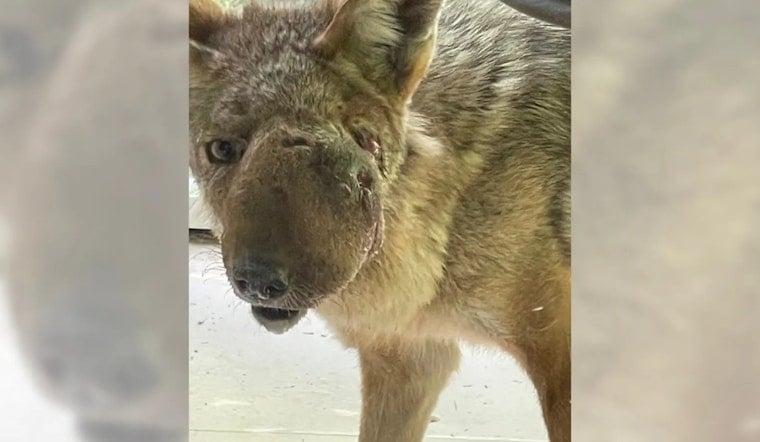
After more than a year of roaming Studio City streets with a disfiguring facial growth, the coyote known to locals as Wendy has finally been captured. Wildlife Care of Southern California announced it caught the animal, who has also gone by the nicknames Narly and Sunshine, and that she is now receiving veterinary care that includes antibiotics and anti-inflammatory medication.
The rescue capped weeks of coordinated tracking by the Los Angeles Daily News, which reported that Wildlife Care of Southern California, a nonprofit based in Simi Valley about an hour from Studio City, said it normally lacks the resources to run field capture operations. The group relies on private donations rather than public funding, according to a podcast report on the rescue effort, which is part of why capturing Wendy required outside help. Southern California Pit Bull Rescue and a group called Urban Rescue both assisted in the operation, per the Daily News account.
Wildlife Care of Southern California said it began tracking sightings of the coyote online starting July 14, gathering dates, times and locations from community members who had grown familiar with her routine. By August 7, the organization had collected enough information to deploy field teams to two specific locations in Studio City, a timeline detailed by Canyon News. Wendy proved time-consuming and difficult to capture, moving inconsistently across a roughly 2.5-mile range within the community and finding water on her own even as she struggled to find food.
A Growth That Changed Her Behavior
Wendy's condition — described as a huge abscess or an undiagnosed facial growth — extended from her left eye down to her snout, according to the Daily News. That impairment reportedly made it difficult for her to hunt live prey, which is part of why she began approaching homes for handouts instead. The Mary Sue, in its coverage of the coyote's viral popularity, reported that the growth impaired both her vision and her physical ability to catch wild prey, pushing her toward soft food left out by sympathetic neighbors.
Studio City residents responded by feeding her items she could actually manage to eat given her condition, including cut-up hot dogs and canned cat food, per Wildlife Care of Southern California. Once in the organization's care, Wendy was fed cut-up rat innards, liver and raw ground chicken. She's now described as comfortable, resting on a cozy blanket while she awaits further treatment, according to the group.
The Legal Gray Area Behind Good Intentions
The outpouring of community feeding, however well-meaning, sat in tension with wildlife law. Under Title 14, Section 251.1 of the California Code of Regulations, intentionally feeding wildlife is legally classified as harassment because it disrupts an animal's natural foraging behavior, making it a state misdemeanor, according to the California Department of Fish and Wildlife. Los Angeles Municipal Code Section 53.06.5 and Los Angeles County Code Section 10.84.010 go further, specifically banning the feeding of non-domesticated predators like coyotes and carrying their own municipal misdemeanor penalties, per Angeleno Daily.
State regulations also limit what can happen to Wendy next. California Department of Fish and Wildlife rules prohibit wildlife rehabilitators and animal control officers from relocating healthy or captured wild coyotes to different geographic regions without explicit state permits, the same Angeleno Daily report noted. That constraint means captured urban coyotes are generally either treated and returned to their home territory or, if their condition proves incurable, euthanized.
Wendy Fits a Bigger Regional Pattern
Wendy's story unfolded against a backdrop of intensifying coyote activity across Los Angeles County. Record heat waves and persistent drought through July and August pushed coyotes into populated neighborhoods throughout the region, including a pack that took over a stalled West Hollywood construction site and rising sightings in Glendale and Atwater Village, as Hoodline previously reported on a WeHo coyote den.
Research from the National Park Service offers context for how urban coyotes like Wendy adapt to city life. A study analyzing more than 3,100 coyote scat samples across Los Angeles found domestic cat remains in 20% of urban coyote samples, compared with just 4% in suburban areas, according to Hoodline's earlier coverage of a viral dog park coyote encounter. Separate GPS-collar tracking by the agency found that urban coyotes establish home ranges within dense neighborhoods, routinely crossing major roads like the 101 Freeway and using vacant lots to move around — a pattern consistent with Wendy's own 2.5-mile route through Studio City.
Wildlife Care of Southern California asked the public to keep Wendy in their prayers as she continues veterinary care. What exactly is causing her facial growth — whether a treatable abscess or something more serious — has not been determined, and it remains unclear whether she will ultimately be returned to Studio City once her treatment concludes.





