

























































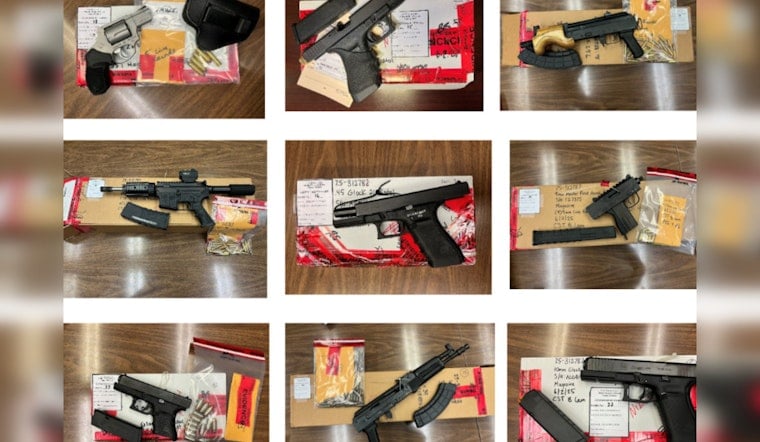
A 31-year-old Tampa man has been sentenced to 60 years in federal prison after a jury convicted him of running a drug trafficking operation armed with a converted machinegun, capping a case that began with police finding him hiding inside a kitchen cabinet during a raid on his home. Michael Devante Curry was sentenced by U.S. District Judge Kathryn Kimball Mizelle following his May 29 conviction on multiple drug and firearm counts, including possessing a machinegun in furtherance of drug trafficking.
According to the U.S. Department of Justice, Curry was convicted of drug conspiracy involving fentanyl, methamphetamine, cocaine and marijuana, alongside machinegun and felon-in-possession counts. The case, tracked in court records as USAO Middle Florida noted in announcing the sentence, is officially listed as U.S. v. Curry, case number 8:25cr343.
A Kitchen Cabinet Hiding Spot and Nine Firearms
The case traces back to a June 1, 2025 raid by Tampa Police, during which officers found Curry hiding inside a kitchen cabinet with fentanyl and more than $3,000 in cash, per the same Justice Department account. A search of the residence turned up nine firearms — including one equipped with a machinegun conversion device — along with drum magazines and body armor.
Investigators also recovered digital photos from Curry's iCloud account showing him holding converted automatic weapons, the report states. Search warrants executed on his cellphones reportedly revealed extensive text messages discussing drug distribution across Tampa between January and June 2025.
From a 15-Year Indictment to a 60-Year Sentence
Curry's federal case did not start out nearly this severe. He was initially indicted in federal court on July 14, 2025, on charges of possessing two Glock handguns as a convicted felon, a case Hoodline covered in a prior report on his initial indictment, which carried a maximum potential penalty of 15 years. That case was later superseded with the drug conspiracy and machinegun charges that ultimately drove Curry's sentence far higher, according to the Justice Department. Court records note that Curry had multiple prior felony convictions, including two previous convictions for possessing a firearm as a felon.
The jump from a 15-year maximum to a 60-year sentence reflects federal law's treatment of machinegun conversion devices. Under 18 U.S.C. § 924(c), possessing a firearm equipped with such a device in furtherance of drug trafficking carries a mandatory minimum of 30 years, which must be served consecutively to any other sentence, according to Deandra Grant Law. Separately, under 18 U.S.C. § 922(o) and the National Firearms Act, a conversion device like a Glock switch or auto sear is classified as a machinegun on its own, with simple unauthorized possession carrying up to 10 years, per the Justice Department.
A Dispute Over Seized Cash
Before his conviction, Curry also fought over money seized during his arrest. In an April 8 federal court order, Judge Mizelle ruled that while the federal government laid no claim to $3,618.38 seized from Curry by local police, the federal court lacked jurisdiction to order the Tampa Police Department to return the state-held funds, according to court records obtained via CaseMine. Curry had filed a federal motion seeking to have the seized cash returned to a third party.
Regional Enforcement Push
The prosecution fell under the federal Project Safe Neighborhoods initiative, which has driven a broader crackdown on firearms and violent crime across the Middle District of Florida. In the first quarter of fiscal year 2025 alone, Project Safe Neighborhoods prosecutions across the district generated federal indictments against 46 defendants and led to the seizure of more than 85 firearms, the Justice Department reported. Federal violent crime prosecutions in the district rose by more than 75% over the three fiscal years ending in 2024.
Gregory W. Kehoe, appointed by Attorney General Pamela Bondi as U.S. Attorney for the Middle District of Florida on March 31, 2025, now leads the office that prosecuted Curry. Kehoe previously spent more than two decades as a federal prosecutor and advised the international tribunal that prosecuted Saddam Hussein, according to the Justice Department.
Judge Mizelle, who presided over Curry's trial and sentencing in Tampa, was appointed to the Middle District of Florida bench in November 2020 by President Donald Trump following clerkships with U.S. Supreme Court Justice Clarence Thomas and Eleventh Circuit Judge William Pryor. The Middle District of Florida is the second most populous federal judicial district in the country, serving more than 11.5 million residents across 35 of the state's 67 counties, with courthouses in Tampa, Orlando, Jacksonville, Fort Myers and Ocala.




