

























































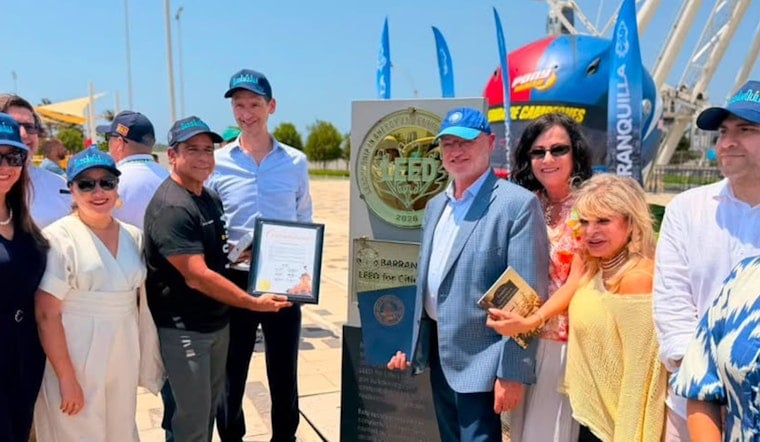
City of Tampa representatives traveled to Barranquilla, Colombia, this week to mark a milestone six decades in the making: Tampa's oldest sister city has become the first metropolis in South America to earn LEED Gold certification for sustainable urban development. Tampa City Council Chairman Alan Clendenin presented a formal city commendation to Barranquilla Mayor Alejandro Char, recognizing the Colombian city's leadership on climate resilience and green infrastructure.
The visit was detailed in a post from the City of Tampa, which described the trip as part of a broader U.S. delegation to Colombia aimed at strengthening international partnerships through sustainability. Barranquilla has held the distinction of being Tampa's oldest active sister city since the partnership was established in 1966, according to Tampa Sister Cities. The two cities have periodically renewed that bond over the decades, including a December 2012 reaffirmation signed by then-Mayor Bob Buckhorn and then-Barranquilla Mayor Elsa Noguera to expand economic cooperation, educational exchanges, and trade relations.
Barranquilla's LEED for Cities Gold certification, awarded by Green Business Certification Inc. and the U.S. Green Building Council, places it among a small group of global cities recognized for measurable performance across energy, water, waste, and public health metrics. According to the Consejo Colombiano de Construcción Sostenible, the achievement makes Barranquilla the first Latin American city with more than a million residents to reach that tier.
What It Takes to Earn Gold
The certification isn't symbolic. Under the U.S. Green Building Council's LEED rating system, a city must score between 60 and 79 points out of a possible 110 across categories including energy efficiency, water conservation, waste management, climate resilience, and public health, per an explainer from CIM.io. The council introduced the LEED for Cities and Communities framework in December 2016 specifically to give local governments a standardized way to measure and certify that kind of performance, according to background published by COAB.us.
Barranquilla's path to Gold traces back to a series of large infrastructure projects that reshaped the once-industrial port city. The Gran Malecón, a five-kilometer riverwalk along the Magdalena River launched in 2017, converted former industrial land into green public space and now draws more than 10 million visitors annually, according to Clean Air for Health. The same source reports that Barranquilla's “Todos al Parque” initiative renovated more than 285 public spaces into parks and sports areas, expanding access so that 93 percent of the city's population now lives within an eight-minute walk of a park.
Wetlands, Mangroves and Storm Protection
Climate adaptation has also been central to the transformation. As part of that strategy, Barranquilla restored 600 hectares of the Ciénaga de Mallorquín coastal wetland by planting 250,000 mangrove trees to buffer storm surges, an effort that earned the city the Dubai International Best Practices Award for Sustainable Development, according to the United Nations Environment Programme. Together, these projects have helped rebrand Barranquilla as a leading example of what regional planners call a “BiodiverCity.”
Tampa's delegation didn't arrive in Colombia solely to celebrate Barranquilla's achievement. Before the visit, Clendenin and Tampa Sustainability and Resilience Officer Kayla Caselli represented the city at the Construverde 2026 green building conference in Bogotá, where they presented Tampa's own resilience and sustainability strategies, according to the City of Tampa.
Six Decades of Ties, Now Rooted in Green Policy
The Barranquilla trip builds on a wave of anniversary programming. Tampa and Barranquilla began marking six decades of municipal ties in 2025 and 2026 through events including a mayoral proclamation of Barranquilla, Colombia Day and an inaugural Tampa Sister Cities 5K run, part of a celebration Hoodline covered last year when the anniversary festivities officially launched. This latest visit adds a new chapter to that relationship, tying the historic diplomatic bond to a concrete, internationally verified sustainability achievement rather than just ceremonial goodwill.





