

























































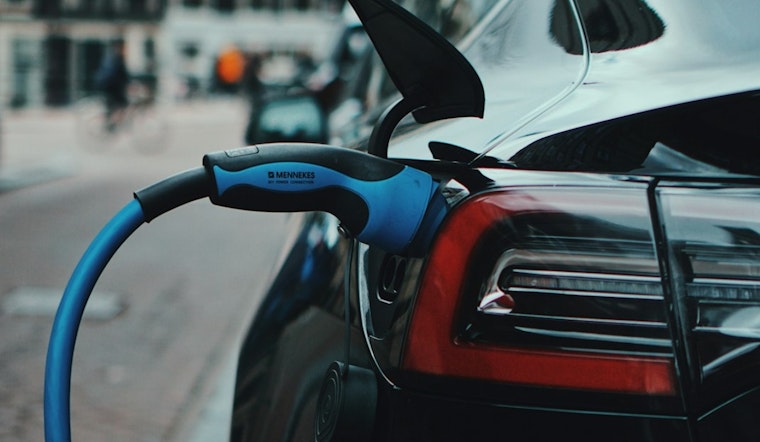
Drivers of non-Tesla electric vehicles can now plug in at four Massachusetts highway rest stops that were previously off-limits to them, after Tesla agreed to open its Supercharger stations along the Mass. Turnpike and Interstate 95 to every EV brand. The change expands access for all EV drivers at state-owned rest stops.
The Massachusetts Department of Transportation announced that Tesla had opened its state-owned rest-stop charging stations to other EV brands, following an agreement amending its contract with the company to allow non-Tesla charging at the four locations, according to The Boston Globe. Before the deal, EV drivers had access to 18 high-speed ports at six rest areas, and only about six relatively slow charging spots were available to non-Tesla drivers at Pike rest areas. Tesla, which operates roughly one-third of all fast chargers in Massachusetts, began opening parts of its Supercharger network to other vehicle brands back in 2023.
How the New Stations Work
The newly opened stations sit at both rest stops in Charlton on the Mass. Turnpike and at the Lexington and Newton stops on I-95. The Globe's report describes the stations as newly available to non-Tesla drivers. The newly opened stations give non-Tesla drivers another charging option.
The additional charging options should help alleviate fears of running out of power for the growing number of EV owners traveling the state's busiest highways, the Globe's report assesses. That relief arrives as Massachusetts had about 166,000 light-duty EVs and plug-in hybrids on its roads, according to the state's Registry of Motor Vehicles.
A Bigger Plan That Fell Apart
The Tesla arrangement is filling a gap left by the collapse of a much larger overhaul. MassDOT's previous $750 million, 35-year agreement with Irish developer Applegreen to renovate 18 highway service plazas collapsed in September 2025 after competitor Global Partners LP sued, alleging procurement law violations and claiming its own proposal offered $900 million more in potential revenue, according to Bisnow. Applegreen had planned to overhaul 17 state rest stops and add dozens of new fast chargers before that plan fell apart.
Hoodline previously reported that Massachusetts Inspector General Jeffrey Shapiro sent MassDOT a formal investigatory letter in early 2026 citing conflict-of-interest issues and procedural flaws in how the agency had handled the original procurement, after the OIG found selection committee members failed to keep written justifications for their scoring, in a story headlined IG torches Applegreen deal. To keep highway travel functioning while the fallout played out, MassDOT finalized 18-month lease extensions through June 30, 2027 with existing operators McDonald's and Gulf Oil across 14 state service plazas, per the same Bisnow report. MassDOT restarted its procurement process for all 18 highway service plazas in March 2026, splitting them into three regional bundles instead of one contract to widen competition ahead of a July 1, 2027 effective lease date.
Federal Charger Money Still Sitting Unused
Beyond the rest-stop saga, Massachusetts has struggled to spend federal money meant to expand highway charging. As of mid-2026, the state had not brought a single highway EV charger online using its roughly $64 million allocation from the federal National Electric Vehicle Infrastructure program established under the 2021 Bipartisan Infrastructure Law, according to CommonWealth Beacon. MassDOT's NEVI plans included sites in Greenfield and Newburyport for Applegreen and in Lancaster, Wrentham and Raynham for Global Partners, per the Globe's reporting.
Even with those approvals, developers awarded NEVI contracts — including Applegreen and Global Partners — had spent roughly $4 million combined on preliminary site engineering and ordering equipment for towns like Greenfield and Wrentham without completing any public charging ports by June 2026, the CommonWealth Beacon report found. Despite ranking fourth nationally in public charging ports per capita in mid-2026, Massachusetts remained about 2,000 charging ports short of what state energy officials estimate is needed to meet near-term climate goals, the outlet reported.
State's Long Road to 900,000 EVs
The stakes behind the charger shortfall are tied to Massachusetts's own climate targets. The state aims to reduce emissions to half of 1990 levels as part of its broader climate goal, and it has set a 2030 electric-vehicle adoption target, according to the Globe. The Massachusetts Electric Vehicle Infrastructure Coordinating Council, established under the state's 2022 Climate Law, set a target to scale the EV fleet from roughly 66,000 registered vehicles in 2023 to 900,000 by 2030, per GreenerU.
Adoption is another focus beyond infrastructure, too. Massachusetts continues offering its own point-of-sale rebates through the MOR-EV program, according to the state's Executive Office of Energy and Environmental Affairs. The technical shift helping make deals like Tesla's possible also involves charging standards.
For now, MassDOT continues to describe its efforts to improve charging options on the Mass. Turnpike as an ongoing struggle, even as Tesla's expanded access offers relief along two of the state's busiest corridors. Long-term highway charging access still depends on whether MassDOT can successfully award its new service plaza contracts by 2027 and finally put its federal NEVI funding to work.




